Takeaway:
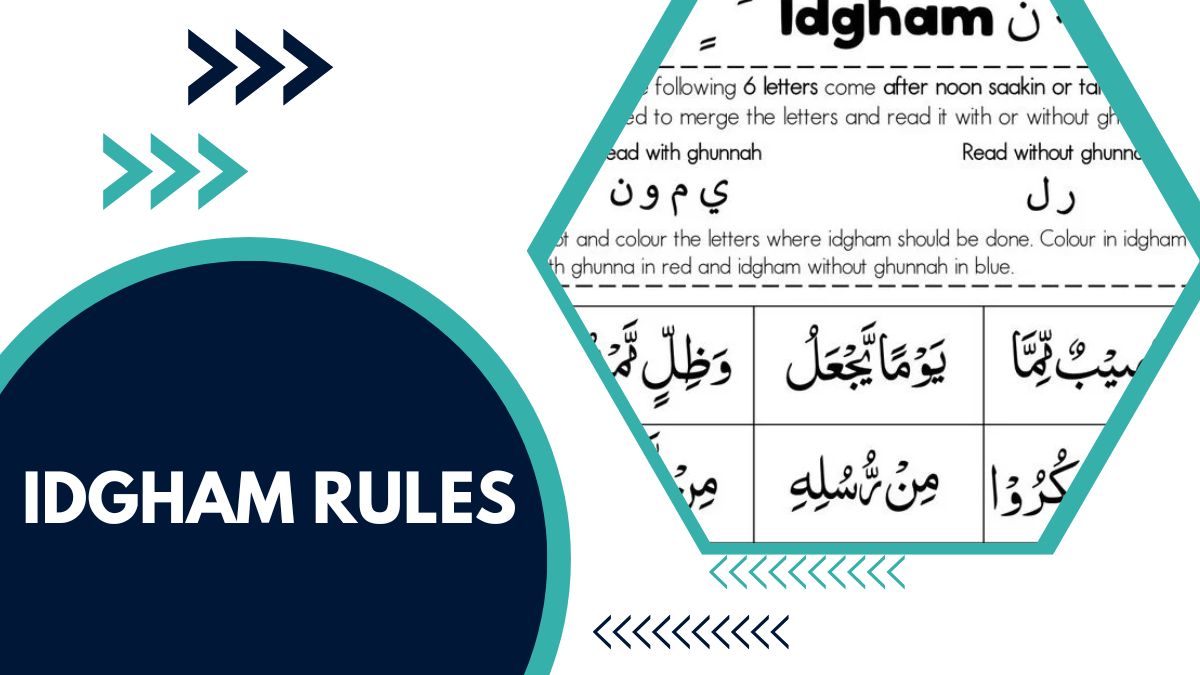
- Idgham merges a Noon Sakinah (نْ) or Tanween (ـًـٍـٌ) into the next letter when it is one of the six “Yarmaloon” letters: ي, ر, م, ل, و, ن.
- The “N” sound is absorbed completely, and the following letter is pronounced with a Shaddah (doubled).
- With Ghunnah (nasal hum held for 2 counts): applies to ي, ن, م, و (remembered as يَنْمُو). The merge is incomplete – the letter disappears but the nasal sound remains. Example: مَن يَقُولُ becomes may-yaqool.
- Without Ghunnah (no nasal sound): applies to ل, ر. A complete merge where the “N” vanishes entirely. Example: مِن رَّبِّهِمْ becomes mir-rabbihim.
- Idgham only happens between two words. It never occurs inside a single word like دُنْيَا (Dunya) – there the Noon must be pronounced clearly.
- In the Mus-haf, Idgham is shown by: a Noon with no Sukun, Tanween strokes written staggered (not parallel), and a Shaddah on the following letter in complete merges.
The science of Tajweed is what brings the recitation of the Quran to life. It transforms reading into a precise, rhythmic, and deeply spiritual experience by giving every letter its right and proper articulation. Among the essential rules that shape this beauty is the rule of Idgham (الإدغام)—a rule of merging that creates smoothness and flow in recitation.
Mastering Idgham is a major step forward for any student of the Quran. It not only improves pronunciation but also enhances the overall rhythm and elegance of your recitation.
In this comprehensive guide from Denk Arabisch, we will unpack the mechanics of Idgham. We’ll explore the “Yarmaloon” letters, the difference between “Complete” and “Incomplete” merging, and how to master the nasal pull (Ghunnah) that defines this rule.

Table of Contents
What is Idgham In Tajweed?
The concept of Idgham is central to achieving fluency in recitation. It prevents the “stutter” or abrupt stop that occurs when two letters meet that are naturally inclined to blend.
1. Meaning of Idgham in Arabic (Lughatan)
The word Idgham (إدغام) literally means “to insert” or “to incorporate.” Imagine putting a sword into its scabbard; the first object becomes completely hidden and unified within the second.
2. Meaning of Idgham in Tajweed (Istilahan)
In Tajweed, Idgham is the meeting of a Noon Sakinah (نْ) or Tanween (ـًـٍـٌ) with one of the six “Idgham letters.” Instead of pronouncing the “N” sound separately, you insert it into the following letter, causing that second letter to be pronounced with a Shaddah (emphasis).
The Result: The two letters become one strengthened, doubled letter.
Understanding Idgham is the first step—but applying it correctly is what makes your recitation truly beautiful. That’s what we focus on at Denk Arabisch.
The Six Idgham Letters: Yarmaloon
Idgham is focused and efficient! While other rules cover many letters, Idgham applies to only six. If a Noon Sakinah or Tanween is followed by any of these letters, the “N” sound is not pronounced clearly; instead, it is absorbed into the following letter.
- ي (Ya)
- ر (Ra)
- م (Meem)
- ل (Lam)
- و (Waw)
- ن (Noon)
A Helpful Mnemonic:
To make these six letters easy to remember, scholars grouped them into one simple word:
يَرْمَلُونَ (Yarmaloon)
If you remember this one word, you have mastered the entire list of Idgham letters!
The Sign of Idgham in Mus-haf
In the Quranic script (the Mus-haf), visual cues act as a “road map” for the reader. These subtle signs tell you exactly when to merge sounds and whether to include a nasal pull (Ghunnah). For Idgham, the signs indicate that the Noon sound is being absorbed into the next letter.
1. The Sign for Noon Sakinah (ن)
When the Noon Sakinah is followed by one of the 6 Idgham letters (ي، ر، م، ل، و، ن), it carries a specific look to show it is no longer independent.
The “Naked” Noon:
Just like in other merging rules, the Noon is written without a Sukun (the small circle) on top.
The Shaddah Cue:
- In Complete Idgham (with ن، م، ل، ر), the following letter will have a Shaddah (ّ). This tells you the “N” has been 100% absorbed.
- In Incomplete Idgham (with و، ي), the following letter usually has no Shaddah. This tells you the “N” is gone, but its Ghunnah (nasal sound) is still there.
2. The Sign for Tanween (ـًـٍـٌ)
The Tanween (double vowels) symbols are the easiest way to spot Idgham at a glance. They use a “staggered” style to signal a flow into the next word.
A. Tanween Fatha (ً) and Kasra (ٍ)
- The Staggered Strokes: Instead of the two strokes being stacked perfectly parallel, they are shifted (successive). The top stroke starts slightly after the bottom one.
- The Visual Logic: This offset appearance visually represents the “sliding” of the Tanween sound into the letter that follows.
B. Tanween Damma (ٌ)
- The Sequential Dammas: In rules where you pronounce the “N” clearly, the Damma looks like a single “9” with a little bow on top. In Idgham, you will see two small Dammas side-by-side (looking like “99”).
- The Meaning: This warns the reciter: “Do not finish the Damma sound with a sharp ‘N’; instead, prepare to merge it.”
Recognizing Tajweed signs while reading the Quran builds confidence. Denk Arabisch helps you read the Quran with awareness and precision.
Read also: Qalqalah Rules – A Complete Guide For Muslims
The Types of Idgham
Mastering the types of Idgham helps you control the “merging” intensity and the flow of your Quranic recitation. Each type follows a distinct pattern that shapes whether the letter disappears completely or leaves behind a beautiful nasal trace.
1. Idgham with Ghunnah (Merging with Nasalization)
This type involves a blend of the mouth and the nose. It refers to the Noon Sakinah (نْ) or Tanween (ـًـٍـٌ) meeting specific letters.
- The Trigger: Four letters collected in the word يَنْمُو (Ya, Noon, Meem, Waw).
- The Mechanism: The “N” sound is merged into the next letter, but the merge is considered “Incomplete” (for Ya and Waw) because the Ghunnah (nasal sound) remains present.
- The Ghunnah: You must hold the nasal vibration for exactly two counts.
- Location: This rule only happens between two separate words (e.g., مَن يَقُولُ). If they meet in one word, you do not merge.
2. Idgham without Ghunnah (Merging without Nasalization)
This is a “pure” merge where the sound transitions entirely through the mouth with no nasal interference.
- The Trigger: Two letters: ل (Lam) and ر (Ra).
- The Mechanism: This is a “Complete” merge. The Noon Sakinah or Tanween vanishes entirely into the next letter. You jump straight to a strengthened Lam or Ra.
- The Ghunnah: There is no Ghunnah here. The transition is swift and crisp.
- Location: Like all Idgham, this only occurs between two separate words (e.g., مِن رَّبِّهِمْ).
3. Idgham Mutamathilayn (Idgham of Two Identicals)
This type specifically involves the Meem Sakinah (مْ) rather than the Noon. It is often called Idgham Shafawi (Labial Idgham) because it happens at the lips.
- The Trigger: Only one letter: م (another Meem).
- The Rule: When a Meem Sakinah (a Meem with no vowel) is followed by a second Meem that has a vowel.
- The Mechanism: The two Meems merge to become one single Meem with a Shaddah. You close your lips fully and hold the sound in the nose.
- The Ghunnah: You hold the nasal sound for two counts.
- Location: This usually occurs between two separate words.
Example:
لَهُم مَّا يَشَاءُونَ
- Transliteration: (Lahum-mma yasha’oon)
- Observation: The first Meem at the end of Lahum meets the second Meem. They become a single, pulled nasal sound at the lips.
Learn the Quran with Denk Arabisch Academy
Master reading and understanding the Quran through structured and supportive learning
Try a Free Trial
Examples of Idgham from the Holy Quran
To master the art of Idgham, one must practice with diverse examples covering all six letters of “Yarmaloon.” Below are comprehensive examples showing how the sound merges and whether it includes a nasal pull (Ghunnah).
Here are the full Quranic verses for the six Idgham letters, provided with the Arabic text, English translation, transliteration, and a detailed explanation of the rule.
1. The Letter: ي (Ya) — Idgham with Ghunnah
Example:
فَمَن يَعْمَلْ مِثْقَالَ ذَرَّةٍ خَيْرًا يَرَهُ
“So whoever does an atom’s weight of good will see it.”
- Transliteration: Fa-man ya‘mal mithqāla dharratin khayray-yarah.
- Explanation: In the phrase man ya‘mal, the Noon Sakinah meets the letter Ya. The “N” sound is inserted into the “Y,” and you hold a vibrating nasal sound (Ghunnah) for two counts.
2. The Letter: ر (Ra) — Idgham without Ghunnah
Example:
أُولَٰئِكَ عَلَىٰ هُدًى مِّن رَّبِّهِمْ
“Those are upon guidance from their Lord.”
- Transliteration: Ulā’ika ‘alā hudam-mir-Rabbihim.
- Explanation: Here, the Noon Sakinah in min meets the letter Ra. This is a “Complete” merge with no nasal sound. You jump straight from the “Meem” to the “Ra,” effectively deleting the “N.”
3. The Letter: م (Meem) — Idgham with Ghunnah
Example:
فِي جِيدِهَا حَبْلٌ مِّن مَّسَدٍ
“Around her neck is a rope of [twisted] fiber.”
- Transliteration: Fī jīdihā hablum-mim-masad.
- Explanation: In hablum-mim, the Tanween meets the letter Meem. The “N” of the Tanween merges completely into the Meem, accompanied by a strong, two-count nasal pull.
4. The Letter: ل (Lam) — Idgham without Ghunnah
Example:
وَيْلٌ لِّكُلِّ هُمَزَةٍ لُّمَزَةٍ
“Woe to every scorner and mocker.”
- Transliteration: Waylul-likulli humazatil-lumazah.
- Explanation: The Tanween at the end of Waylun meets the letter Lam. The “N” sound vanishes entirely. You pronounce it as Waylul, moving directly to the stressed Lam without any nasal sound.
5. The Letter: و (Waw) — Idgham with Ghunnah
Example:
وَمَا لَهُم مِّن دُونِهِ مِن وَالٍ
“And they have not besides Him any defender.”
- Transliteration: Wa mā lahum min dūnihī miw-wāl.
- Explanation: In the phrase min wālin, the Noon Sakinah meets the letter Waw. The “N” sound is merged into the “W,” but it is an “Incomplete” merge. This means the sound of the Noon disappears, but you must keep the Ghunnah (nasal vibration) flowing for two counts while pronouncing the doubled Waw.
6. The Letter: ن (Noon) — Idgham with Ghunnah
Example:
إِن نَّحْنُ إِلَّا بَشَرٌ مِّثْلُكُمْ
“We are only men like you.”
- Transliteration: In-nahnu illā basharum-mithlukum.
- Explanation: The Noon Sakinah of In meets the starting Noon of Nahnu. Because they are the same letter, they merge into one strengthened Noon with a Shaddah, held with Ghunnah for two counts.
Read also: Learning The Quran For Children In Berlin – The Comprehensive Guide For Parents
Common Mistakes of Idgham and How to Avoid
Avoiding common mistakes in Idgham is the key to maintaining the rhythmic “pulse” of the Quran. Because Idgham involves merging two letters into one, it is easy to lose the correct timing or use the nose where it doesn’t belong.
1. Merging Inside a Single Word
This is a foundational rule that many beginners overlook.
- The Mistake: Attempting to merge a Noon Sakinah with an Idgham letter when they appear in the same word (e.g., reciting Dunya as Duy-ya).
- The Fix: Idgham only happens between two separate words. If they meet in one word, you must pronounce the Noon clearly. There are only four such words in the Quran: Dunya, Bunyan, Qinwan, and Sinwan.
2. Dropping the Ghunnah (The Nasal Pull)
Idgham Bi Ghunnah requires time and resonance to be correct.
- The Mistake: Rushing through letters like ي (Ya) or و (Waw) without holding the nasal sound.
- The Fix: For the letters ي، ن، م، و, you must hold the merge in your nose for exactly two counts. It should feel like a rhythmic pause rather than a quick skip.
3. Adding Ghunnah to Lam and Ra
The letters ل (Lam) and ر (Ra) are “clean” merges.
- The Mistake: Allowing the sound to leak into the nose when merging into a Lam or Ra (e.g., saying Mirrrr-Rabbihim with a nasal hum).
- The Fix: These two letters should come entirely from the mouth. The Noon disappears completely, and you move directly to the next letter with zero nasality.
4. Over-Stressing the First Letter
Sometimes, in an effort to prepare for the merge, readers accidentally emphasize the wrong part of the word.
- The Mistake: Pronouncing the Noon Sakinah slightly before merging it, which creates an accidental “Izhar-like” sound.
- The Fix: The transition must be seamless. Your mouth should be shaped for the second letter (the Idgham letter) the moment you reach the end of the first word.
5. Excessive Pressure on the Lips (For Meem)
When performing Idgham with the letter م (Meem).
- The Mistake: Pressing the lips together too harshly, which makes the sound “pop” rather than flow.
- The Fix: Close the lips gently but firmly enough to let the sound resonate through the nasal passage. The flow of breath should be smooth and continuous.
What Our Students Say About Denk Arabisch Academy
See what our students say about learning at Denk Arabisch Academy on Trustpilot. Read their experiences and check out more reviews to discover how our courses help improve Arabic.

Master Idgham with Denk Arabisch
Perfecting these merges is what separates a beginner from a confident reciter. At Denk Arabisch, we provide the structured guidance and live feedback you need to turn these technical rules into a natural habit.
- Step-by-Step Training: We break down the “Yarmaloon” letters until they become second nature.
- Audio Corrections: Our experts listen to your “Ghunnah” to ensure it’s exactly two counts.
- Logic-Based Learning: We explain the phonetic reasons behind the rules so you never have to guess.
Our Courses Include:
- Arabic Courses for German Speakers
- Arabic Levels for German Speakers
- Arabic Dialect Courses for German Speakers
- Qur’an Learning Courses for German Speakers
- Islamic Studies Courses for German Speakers
- Courses for Muslim Kids for German Speakers
👉 Ready to elevate your recitation? Join our Quran Tajweed Course and start reciting with the elegance and soul the Quran deserves.
Learn the Quran with Denk Arabisch Academy
Master reading and understanding the Quran through structured and supportive learning
Try a Free TrialFAQs
To help you solidify your understanding, we’ve gathered the most common questions our students at Denk Arabisch ask while mastering the rules of Idgham.
1. What is the main difference between Idgham and Ikhfa?
In Ikhfa, you “hide” the Noon by keeping your tongue hovering, but the identity of the Noon remains. In Idgham, you “insert” the Noon into the next letter, making the Noon disappear and the second letter become doubled (stressed).
2. Why is Idgham with “Ya” and “Waw” called “Incomplete”?
It is called Incomplete Idgham (Naqis) because although the body of the letter Noon is gone, its attribute (the Ghunnah) is still being pronounced. In Complete Idgham (Kamil)—like with the letter Lam—both the letter and its attribute vanish entirely.
3. How long should the Ghunnah last during the merge?
The standard duration is two counts (Harakatain). A simple way to measure this is the time it takes to slowly open or close a finger. Consistency is vital; ensuring all your “Yanmu” merges have the same rhythmic length creates a beautiful flow.
4. Can Idgham happen within one word?
No. Idgham Haqiqi (with Noon Sakinah) only occurs between two separate words. If the Noon and the Idgham letter meet in a single word, you must pronounce the Noon clearly. This happens in only four words in the Quran:
دُنْيَا (Dunya)
بُنْيَان (Bunyan)
قِنْوَان (Qinwan)
صِنْوَان (Sinwan)
5. Do I need to use the nose for all “Yarmaloon” letters?
No. You only use the nasal passage (Ghunnah) for the letters in يَنْمُو (Ya, Noon, Meem, Waw). For the letters ل (Lam) and ر (Ra), the merge happens strictly in the mouth with no nasal sound.
6. Why do some Idgham letters in the Mus-haf have a Shaddah while others don’t?
The Shaddah (ّ) is a visual cue for a “Complete Merge.” Since the Noon is 100% absorbed into letters like ل and ر, they carry a Shaddah. Letters like و and ي often lack the Shaddah in some scripts because the merge is incomplete (the Ghunnah trace remains).
7. How can I test if I am doing Idgham Bi Ghunnah correctly?
Try the “Pinch Test.” While reciting the merge for a letter like Waw or Meem, pinch your nose. The sound should stop or vibrate intensely. If you pinch your nose and the sound doesn’t change, you are likely using only your mouth, and your Ghunnah is missing.