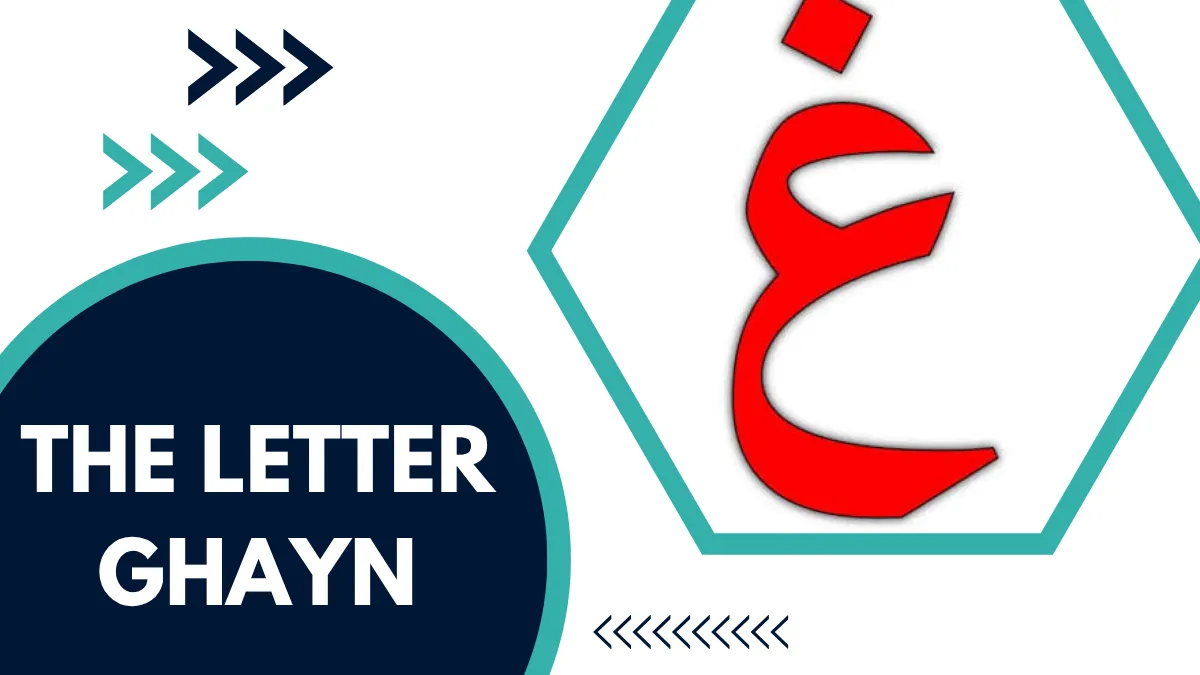
The letter Ghayn (غَيْن) is the 19th letter of the Arabic alphabet. You make it in the upper throat, where air rubs against the back of the soft palate with a soft, gargling buzz. Linguists call it a voiced velar fricative, written [ɣ] in IPA.
This sound has no letter of its own in German, but you already own something very close. The German Rachen-R in “Rad”, “rot” and “Brot” is made in almost the same place. Ghayn is the same idea with more friction and no rolling, and you will learn how to get there.
This guide covers everything you need to know about Ghayn, from the first sound in your throat to the last stroke of your pen:
- Pronunciation: how to move from the German Rachen-R to real Ghayn
- Writing forms: the four shapes and the one dot that never moves
- Vowels: Ghayn with short vowels, long vowels and shadda
- Tajweed: makhraj, attributes, heaviness and iẓhār ḥalqī
- Words and roots: everyday and Quranic vocabulary built on Ghayn
Short exercises at the end let you check what you learned.
Read our Learning Arabic article to discover how to start learning Arabic, understand its basics, and improve your reading, writing, and speaking skills step by step.
| Element | Detail |
| Name | Ghayn (غَيْنٌ) |
| Sound | [ɣ], voiced velar fricative, often realized as uvular [ʁ]. Close to the German Rachen-R in “Rad” or the Spanish g in “lago”. |
| Alphabetical Position | 19th letter (Hijāʾī order). |
| Abjad Value | 28th in Abjad order, with a numerical value of 1000. |
| Transliteration | gh (common), ġ (DIN 31635), 3′ (Arabizi). |
| Point of Articulation | Upper throat (أَدْنَى الْحَلْقِ), shared with the letter خ. |
| Sun or Moon Letter | Moon letter (the preceding definite article al- is pronounced, e.g., al-Ghayn). |
| Heavy or Light | Heavy (mufakhkham), one of the Istiʿlāʾ letters. |
| Dots | One dot above. |
| Connection | Connects to the following letter, featuring four positional forms (isolated, initial, medial, final). |
Table of Contents
Ghayn’s Place in the Arabic Alphabet
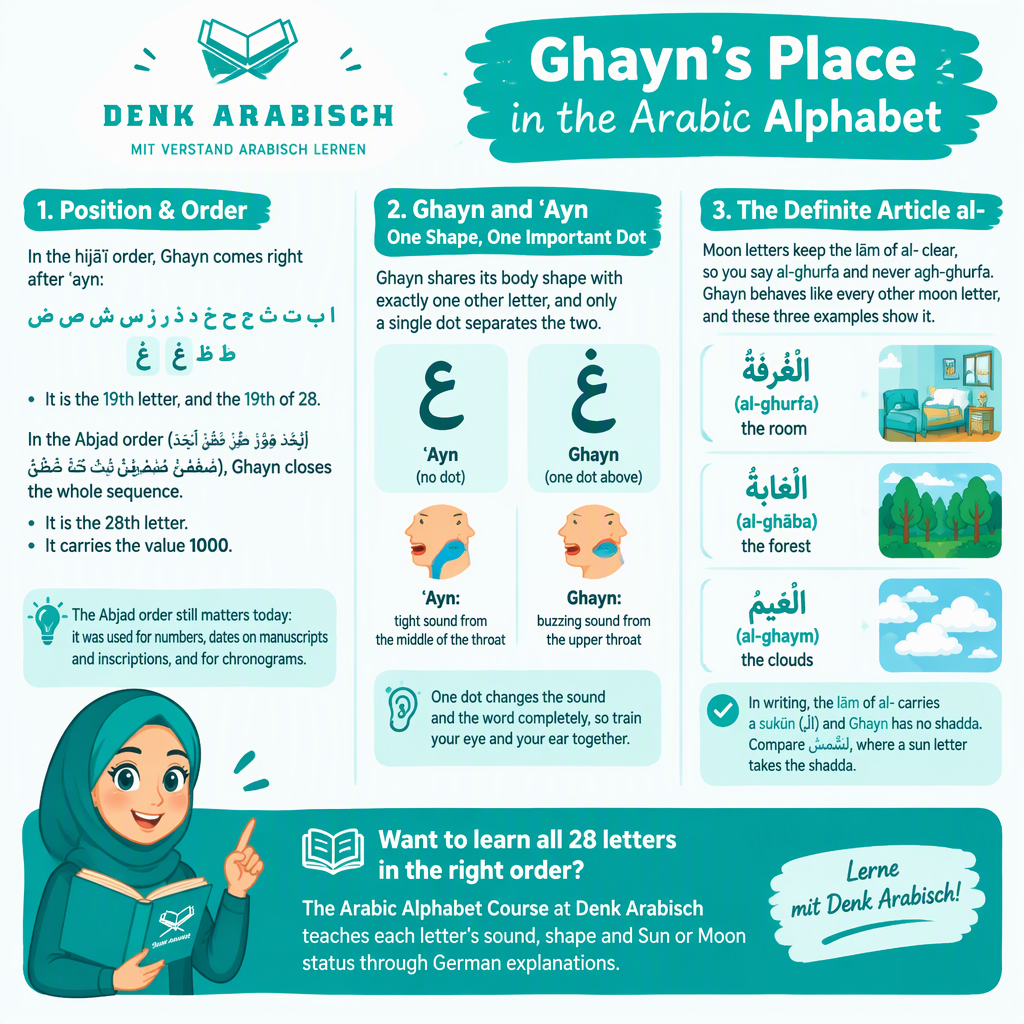
In the hijāʾī order, Ghayn comes right after ʿayn:
ا ب ت ث ج ح خ د ذ ر ز س ش ص ض ط ظ ع غ.
That makes it the 19th letter, and the 19th of 28.
In the Abjad order (أَبْجَدْ هَوَّزْ حُطِّي كَلَمُنْ سَعْفَصْ قَرَشَتْ ثَخَذْ ضَظَغْ), Ghayn closes the whole sequence. It is the 28th letter and carries the value 1000.
The Abjad order still matters today: it was used for numbers, dates on manuscripts and inscriptions, and for chronograms.
Ghayn and ʿAyn: One Shape, One Important Dot
Ghayn shares its body shape with exactly one other letter, and only a single dot separates the two. Learning them together means you write both correctly and hear the sound difference at once.
- ع (ʿayn): no dot, a tight sound from the middle of the throat
- غ (ghayn): one dot above, a buzzing sound from the upper throat
One dot changes the sound and the word completely, so train your eye and your ear together.
How Ghayn Works with the Definite Article al-
Moon letters keep the lām of al- clear, so you say al-ghurfa and never agh-ghurfa. Ghayn behaves like every other moon letter, and these three examples show it.
- الْغُرْفَةُ (al-ghurfa): the room
- الْغَابَةُ (al-ghāba): the forest
- الْغَيْمُ (al-ghaym): the clouds
In writing, the lām of al- carries a sukūn (الْ) and Ghayn has no shadda. Compare الشَّمْسُ, where a sun letter takes the shadda.
Want to learn all 28 letters in the right order? The Arabic Alphabet Course at Denk Arabisch teaches each letter’s sound, shape and Sun or Moon status through German explanations.
Ghayn’s Makhraj and Its Role in Tajweed
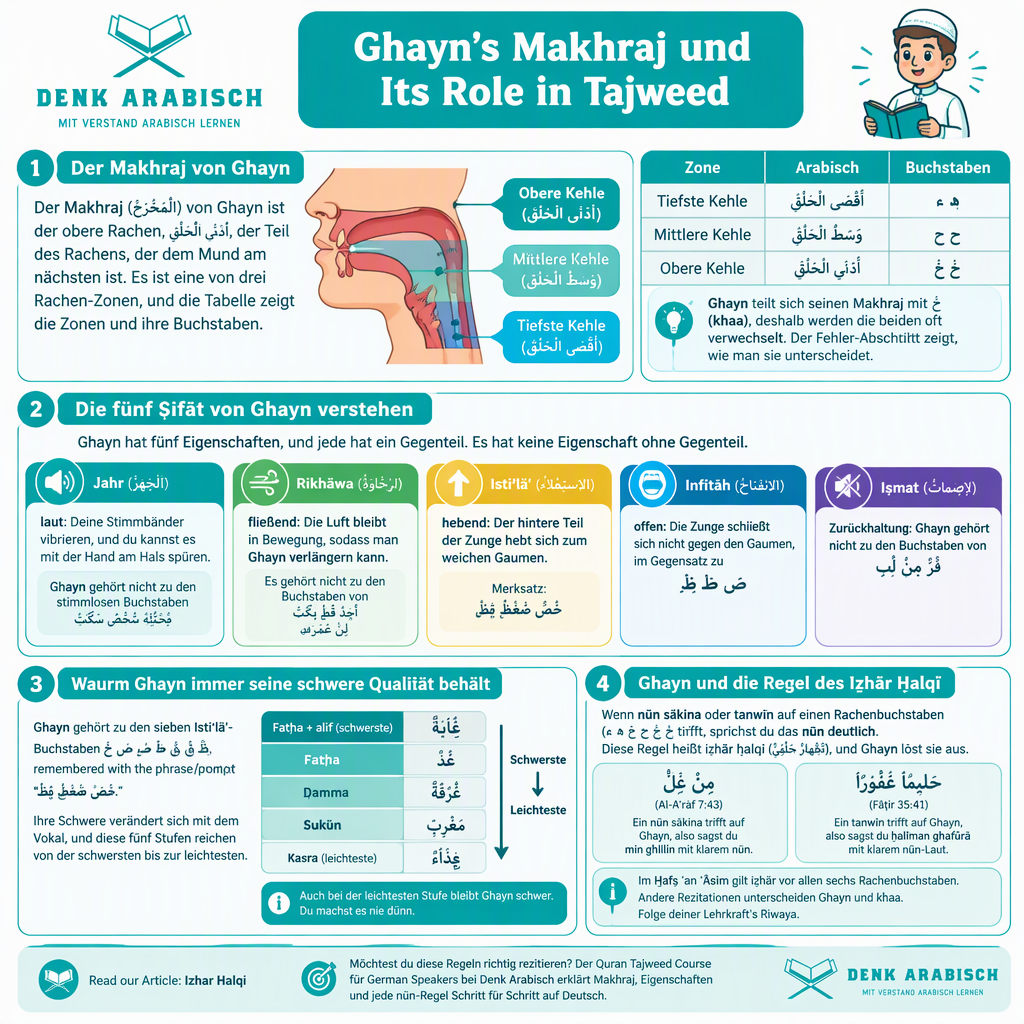
The makhraj (الْمَخْرَجُ) of Ghayn is the upper throat, أَدْنَى الْحَلْقِ, the part of the throat closest to the mouth. It is one of three throat zones, and the table shows the zones and their letters.
| Zone | Arabic | Letters |
| Deepest throat | أَقْصَى الْحَلْقِ | ء ه |
| Middle throat | وَسَطُ الْحَلْقِ | ع ح |
| Upper throat | أَدْنَى الْحَلْقِ | غ خ |
Ghayn shares its makhraj with خ (khaa), which is why the two are often confused. The mistakes section shows how to separate them.
Understanding the Five Ṣifāt of Ghayn
Ghayn has five attributes, and every one of them has an opposite. It has no attribute without an opposite. Each item below gives the transliterated term, the Arabic term, its meaning and one line of explanation.
- Jahr (الْجَهْرُ), voiced: your vocal cords vibrate, and you can feel it with a hand on your throat. Ghayn is not among the voiceless letters فَحَثَّهُ شَخْصٌ سَكَتَ.
- Rikhāwa (الرِّخَاوَةُ), flowing: air keeps moving, so you can prolong Ghayn. It is not among the letters of أَجِدْ قَطٍ بَكَتْ or لِنْ عُمَرَ.
- Istiʿlāʾ (الِاسْتِعْلَاءُ), raising: the back of the tongue rises toward the soft palate. The mnemonic is خُصَّ ضَغْطٍ قِظْ.
- Infitāḥ (الِانْفِتَاحُ), opening: the tongue does not close against the palate, unlike ص ض ط ظ.
- Iṣmāt (الْإِصْمَاتُ), restraint: Ghayn is not among the letters of فَرَّ مِنْ لُبٍّ.
Why Ghayn Always Keeps Its Heavy Quality
Ghayn belongs to the seven istiʿlāʾ letters خ ص ض غ ط ق ظ, remembered with the phrase خُصَّ ضَغْطٍ قِظْ. Their heaviness changes with the vowel, and these five levels run from heaviest to lightest.
- Fatḥa followed by alif (heaviest): غَابَةٌ
- Fatḥa: غَدٌ
- Ḍamma: غُرْفَةٌ
- Sukūn: مَغْرِبٌ
- Kasra (lightest): غِذَاءٌ
Even at the lightest level, Ghayn stays heavy. You never make it thin.
Ghayn and the Rule of Iẓhār Ḥalqī
When nūn sākina or tanwīn meets a throat letter (ء ه ع ح غ خ), you pronounce the nūn clearly. This rule is called iẓhār ḥalqī (إِظْهَارٌ حَلْقِيٌّ), and Ghayn triggers it.
- مِنْ غِلٍّ (Al-Aʿrāf 7:43): a nūn sākina meets Ghayn, so you say min ghillin with a clear nūn.
- حَلِيمًا غَفُورًا (Fāṭir 35:41): a tanwīn meets Ghayn, so you say ḥalīman ghafūrā with a clear nūn sound.
In Ḥafṣ ʿan ʿĀṣim, iẓhār applies before all six throat letters. Some other recitations treat Ghayn and khaa differently, so follow your teacher’s riwāya.
Read our Article: Izhar Halqi
Want to recite these rules correctly? The Quran Tajweed Course for German Speakers at Denk Arabisch explains makhraj, attributes and every nūn rule step by step in German.
Learn to Produce the Ghayn Sound
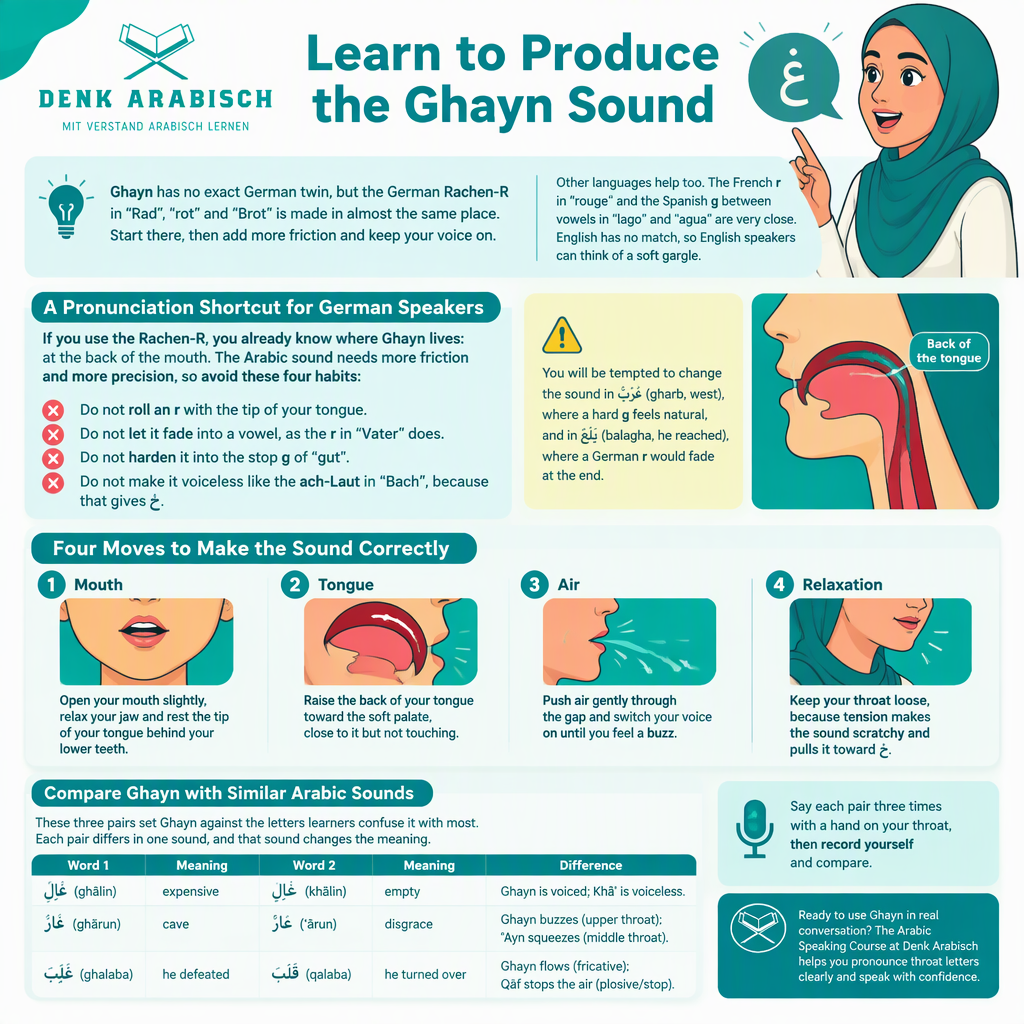
Ghayn has no exact German twin, but the German Rachen-R in “Rad”, “rot” and “Brot” is made in almost the same place. Start there, then add more friction and keep your voice on.
Other languages help too. The French r in “rouge” and the Spanish g between vowels in “lago” and “agua” are very close. English has no match, so English speakers can think of a soft gargle.
A Pronunciation Shortcut for German Speakers
If you use the Rachen-R, you already know where Ghayn lives: at the back of the mouth. The Arabic sound needs more friction and more precision, so avoid these four habits:
- Do not roll an r with the tip of your tongue.
- Do not let it fade into a vowel, as the r in “Vater” does.
- Do not harden it into the stop g of “gut”.
- Do not make it voiceless like the ach-Laut in “Bach”, because that gives خ.
You will be tempted to change the sound in غَرْبٌ (gharb, west), where a hard g feels natural, and in بَلَغَ (balagha, he reached), where a German r would fade at the end.
Four Moves to Make the Sound Correctly
Four small physical movements produce Ghayn. Follow them in order and check each one before you add sound.
- Mouth: open your mouth slightly, relax your jaw and rest the tip of your tongue behind your lower teeth.
- Tongue: raise the back of your tongue toward the soft palate, close to it but not touching.
- Air: push air gently through the gap and switch your voice on until you feel a buzz.
- Relaxation: keep your throat loose, because tension makes the sound scratchy and pulls it toward خ.
Compare Ghayn with Similar Arabic Sounds
These three pairs set Ghayn against the letters learners confuse it with most. Each pair differs in one sound, and that sound changes the meaning.
| Word 1 | Meaning | Word 2 | Meaning | Difference |
| غَالٍ (ghālin) | expensive | خَالٍ (khālin) | empty | Ghayn is voiced; Khāʾ is voiceless. |
| غَارٌ (ghārun) | cave | عَارٌ (ʿārun) | disgrace | Ghayn buzzes (upper throat); ʿAyn squeezes (middle throat). |
| غَلَبَ (ghalaba) | he defeated | قَلَبَ (qalaba) | he turned over | Ghayn flows (fricative); Qāf stops the air (plosive/stop). |
Say each pair three times with a hand on your throat, then record yourself and compare.
Ready to use Ghayn in real conversation? The Arabic Speaking Course at Denk Arabisch helps you pronounce throat letters clearly and speak with confidence.
Writing Ghayn in Its Four Connected Forms
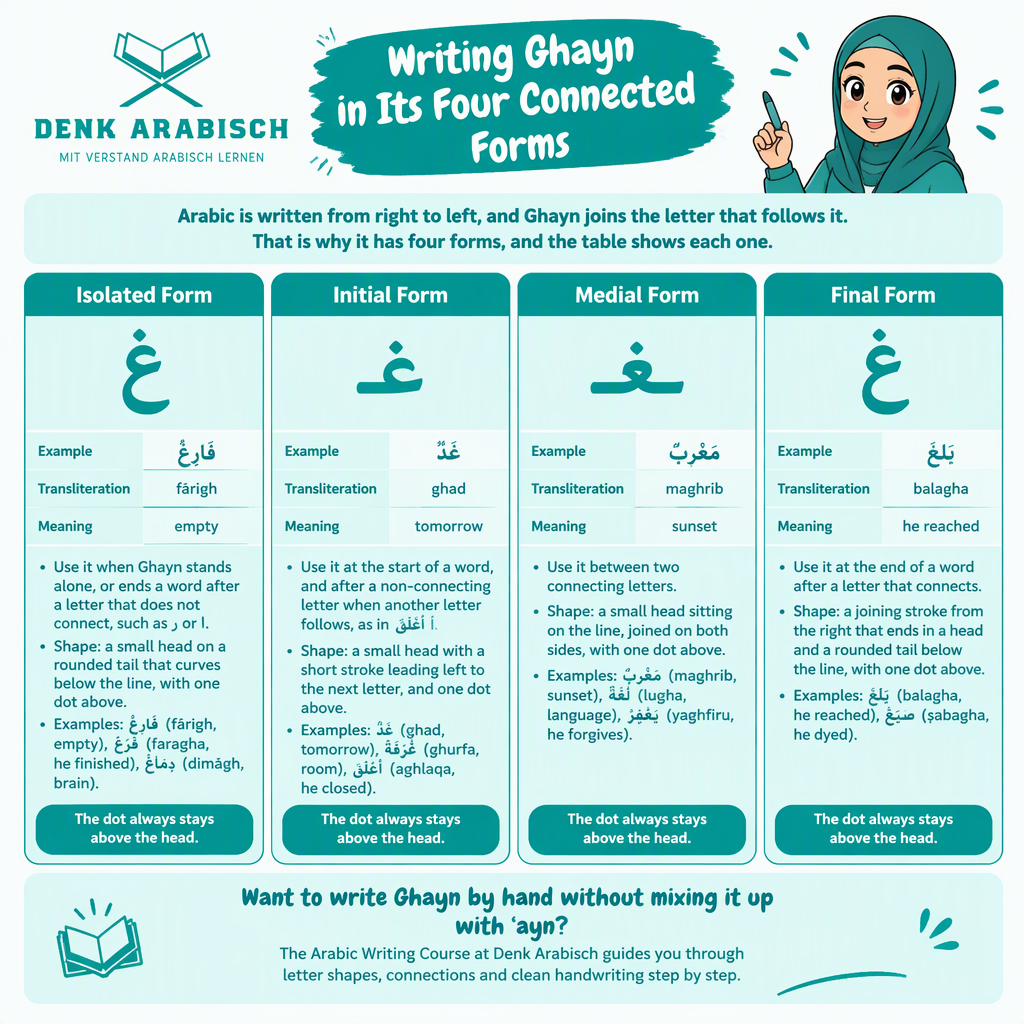
Arabic is written from right to left, and Ghayn joins the letter that follows it. That is why it has four forms, and the table shows each one.
| Form | Shape | Example | Transliteration | Meaning |
| Isolated | غ | فَارِغٌ | fārigh | empty |
| Initial | غـ | غَدٌ | ghad | tomorrow |
| Medial | ـغـ | مَغْرِبٌ | maghrib | sunset |
| Final | ـغ | بَلَغَ | balagha | he reached |
1. Isolated Form (غ)
Use it when Ghayn stands alone, or ends a word after a letter that does not connect, such as ر or ا.
Shape: a small head on a rounded tail that curves below the line, with one dot above.
Examples: فَارِغٌ (fārigh, empty), فَرَغَ (faragha, he finished), دِمَاغٌ (dimāgh, brain).
The dot always stays above the head.
2. Initial Form (غـ)
Use it at the start of a word, and after a non-connecting letter when another letter follows, as in أَغْلَقَ.
Shape: a small head with a short stroke leading left to the next letter, and one dot above.
Examples: غَدٌ (ghad, tomorrow), غُرْفَةٌ (ghurfa, room), أَغْلَقَ (aghlaqa, he closed).
The dot always stays above the head.
3. Medial Form (ـغـ)
Use it between two connecting letters.
Shape: a small head sitting on the line, joined on both sides, with one dot above.
Examples: مَغْرِبٌ (maghrib, sunset), لُغَةٌ (lugha, language), يَغْفِرُ (yaghfiru, he forgives).
The dot always stays above the head.
Learn Arabic with Denk Arabisch Academy
Speak and understand Arabic through a clear and effective learning system
Try a Free Trial4. Final Form (ـغ)
Use it at the end of a word after a letter that connects.
Shape: a joining stroke from the right that ends in a head and a rounded tail below the line, with one dot above.
Examples: بَلَغَ (balagha, he reached), صَبَغَ (ṣabagha, he dyed).
The dot always stays above the head.
Want to write Ghayn by hand without mixing it up with ʿayn? The Arabic Writing Course at Denk Arabisch guides you through letter shapes, connections and clean handwriting step by step.
Reading Ghayn with Arabic Vowel Marks
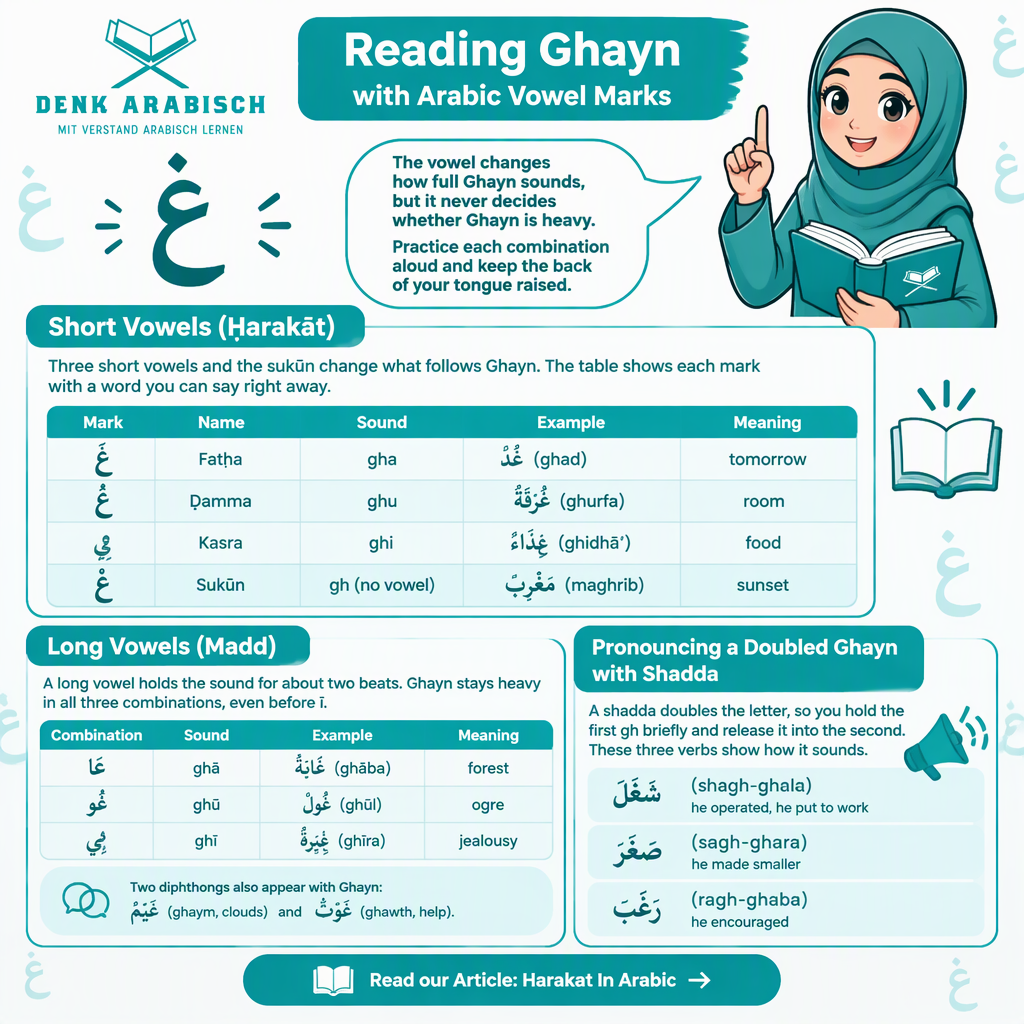
The vowel changes how full Ghayn sounds, but it never decides whether Ghayn is heavy. Practice each combination aloud and keep the back of your tongue raised.
Short Vowels (Ḥarakāt)
Three short vowels and the sukūn change what follows Ghayn. The table shows each mark with a word you can say right away.
| Mark | Name | Sound | Example | Meaning |
| غَ | Fatḥa | gha | غَدٌ (ghad) | tomorrow |
| غُ | Ḍamma | ghu | غُرْفَةٌ (ghurfa) | room |
| غِ | Kasra | ghi | غِذَاءٌ (ghidhāʾ) | food |
| غْ | Sukūn | gh (no vowel) | مَغْرِبٌ (maghrib) | sunset |
Long Vowels (Madd)
A long vowel holds the sound for about two beats. Ghayn stays heavy in all three combinations, even before ī.
| Combination | Sound | Example | Meaning |
| غَا | ghā | غَابَةٌ (ghāba) | forest |
| غُو | ghū | غُولٌ (ghūl) | ogre |
| غِي | ghī | غِيرَةٌ (ghīra) | jealousy |
Two diphthongs also appear with Ghayn: غَيْمٌ (ghaym, clouds) and غَوْثٌ (ghawth, help).
Pronouncing a Doubled Ghayn with Shadda
A shadda doubles the letter, so you hold the first gh briefly and release it into the second. These three verbs show how it sounds.
- شَغَّلَ (shagh-ghala): he operated, he put to work
- صَغَّرَ (ṣagh-ghara): he made smaller
- رَغَّبَ (ragh-ghaba): he encouraged
Read our Article: Harakat In Arabic
Important Arabic Roots with Ghayn
Most Arabic words grow from three root letters, and the root carries the core meaning. These three roots with Ghayn are useful in daily Arabic and in the Quran.
The Root غ ف ر: Forgiveness and Pardon
This root is one of the most frequent in the Quran. Notice that غَفُورٌ is the word you met in Fāṭir 35:41.
| Word | Transliteration | Meaning |
| غَفَرَ | ghafara | he forgave |
| غَفُورٌ | ghafūr | most forgiving |
| مَغْفِرَةٌ | maghfira | forgiveness |
| اِسْتِغْفَارٌ | istighfār | asking for forgiveness |
The Root غ ر ب: West and Sunset
This root describes the sun going down and the direction where it sets. The word مَغْرِبٌ already appeared in the forms table.
| Word | Transliteration | Meaning |
| غَرْبٌ | gharb | west |
| غُرُوبٌ | ghurūb | sunset |
| مَغْرِبٌ | maghrib | sunset, the west |
| غَرِيبٌ | gharīb | strange, foreign |
The Root ل غ و: Language and Speech
This root gives you the everyday word for “language”. In the Quran, it also describes idle talk that believers turn away from: وَالَّذِينَ هُمْ عَنِ اللَّغْوِ مُعْرِضُونَ (Al-Muʾminūn 23:3).
| Word | Transliteration | Meaning |
| لُغَةٌ | lugha | language |
| لُغَاتٌ | lughāt | languages |
| لُغَوِيٌّ | lughawiyy | linguistic, linguist |
| لَغْوٌ | laghw | idle talk |
Want to build your Quranic vocabulary root by root? The Quranic Arabic Course for German Speakers at Denk Arabisch teaches high-frequency Quranic words and roots with clear German explanations.
Examples of Ghayn in Words
These words show Ghayn at the beginning, in the middle and at the end of a word. Read each one aloud and notice which form of the letter you see.
| Position | Arabic Word | Transliteration | Meaning |
| Beginning | غَدٌ | ghad | tomorrow |
| Middle | مَغْرِبٌ | maghrib | sunset |
| End | بَلَغَ | balagha | he reached |
Read Ghayn in Everyday Arabic Sentences
These three short sentences reuse words from the table above, so you can read Ghayn in context. Notice the case endings on every word.
| Arabic Sentence | Transliteration | Meaning |
| أَذْهَبُ إِلَى الْغَابَةِ غَدًا. | adhhabu ilā l-ghābati ghadan. | I am going to the forest tomorrow. |
| اللُّغَةُ الْعَرَبِيَّةُ جَمِيلَةٌ. | al-lughatu l-ʿarabiyyatu jamīlatun. | The Arabic language is beautiful. |
| الْغُرْفَةُ فَارِغَةٌ. | al-ghurfatu fārighatun. | The room is empty. |
The word فَارِغَةٌ is the feminine form of فَارِغٌ.
Read How To Speak Arabic? and learn how to turn single words like these into spoken sentences.
Four Ghayn Pronunciation Mistakes to Watch For
Four mistakes cover almost everything that goes wrong with Ghayn. Each one has a cause and a test you can do right now.
1. Telling Voiced Ghayn (غ) Apart from Khaa (خ)
Both letters come from the upper throat and both are heavy, so only the voice separates them.
Test: put a hand on your throat and say غَالٍ and خَالٍ. You feel a vibration only for the first word.
2. Distinguishing Ghayn (غ) from ʿAyn (ع)
The two letters look the same apart from one dot, and German has no ʿayn, so learners blur both into one sound.
Test: hold غ and ع for three seconds each. Ghayn keeps buzzing at the back of the mouth, while ʿayn feels tight and smooth in the middle of the throat.
3. Hearing the Difference Between Ghayn (غ) and Qāf (ق)
Both are heavy and sound deep, but qāf stops the air and Ghayn lets it flow.
Test: try to prolong the first sound of غَلَبَ, then of قَلَبَ. Only Ghayn can be held.
4. Avoiding the Hard German “g” Sound
The g in the German word “gut” is a stop, so the tongue blocks the air completely.
Test: say غَدٌ slowly. If the back of your tongue closes fully, you said g. The air must keep flowing.
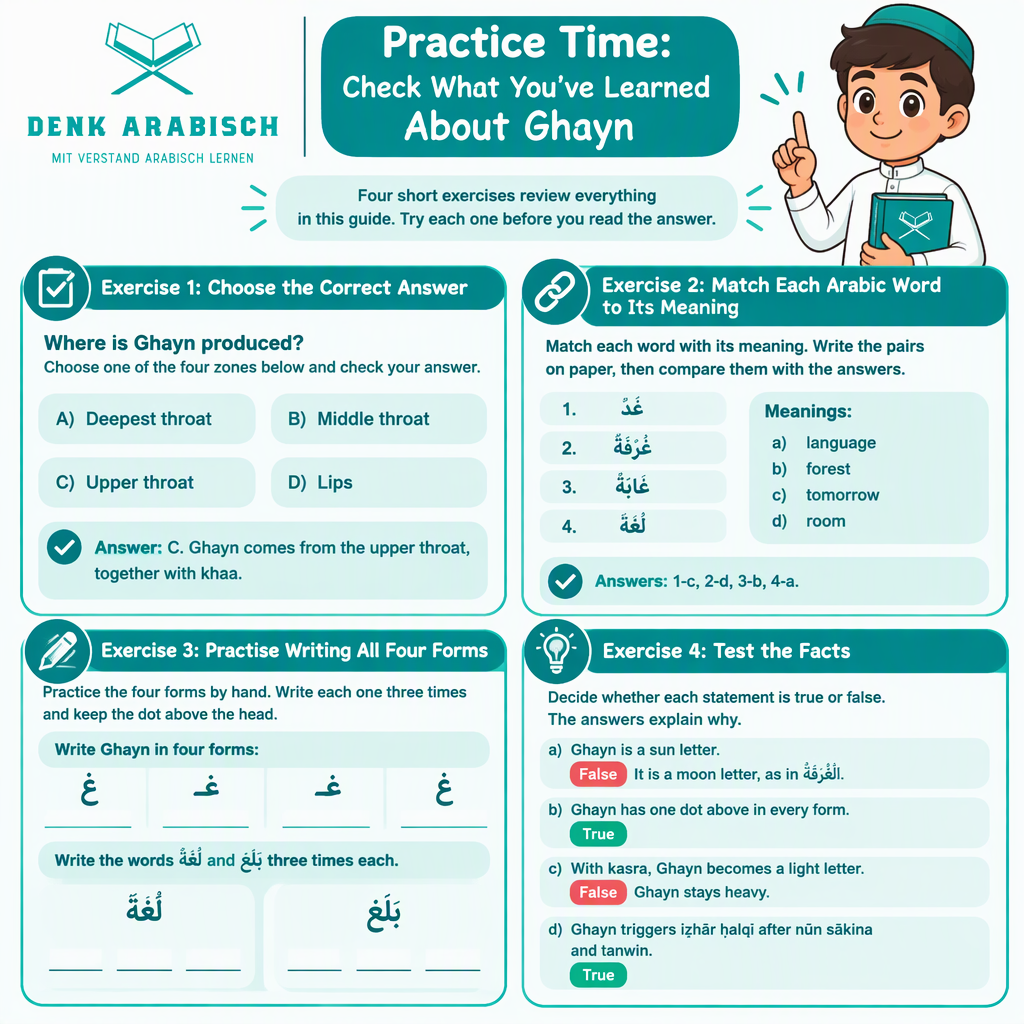
Practice Time: Check What You’ve Learned About Ghayn
Four short exercises review everything in this guide. Try each one before you read the answer.
Exercise 1: Choose the Correct Answer
Where is Ghayn produced? Choose one of the four zones below and check your answer.
- A) Deepest throat
- B) Middle throat
- C) Upper throat
- D) Lips
Answer: C. Ghayn comes from the upper throat, together with khaa.
Exercise 2: Match Each Arabic Word to Its Meaning
Match each word with its meaning. Write the pairs on paper, then compare them with the answers.
- غَدٌ
- غُرْفَةٌ
- غَابَةٌ
- لُغَةٌ
Meanings: a) language, b) forest, c) tomorrow, d) room.
Answers: 1-c, 2-d, 3-b, 4-a.
Exercise 3: Practise Writing All Four Forms
Practice the four forms by hand. Write each one three times and keep the dot above the head.
- Write Ghayn in four forms: غ، غـ، ـغـ، ـغ
- Write the words لُغَةٌ and بَلَغَ three times each.
Exercise 4: Test the Facts
Decide whether each statement is true or false. The answers explain why.
- a) Ghayn is a sun letter.
- b) Ghayn has one dot above in every form.
- c) With kasra, Ghayn becomes a light letter.
- d) Ghayn triggers iẓhār ḥalqī after nūn sākina and tanwīn.
Answers: a) False, it is a moon letter, as in الْغُرْفَةُ. b) True. c) False, Ghayn stays heavy. d) True.
What Our Students Say About Denk Arabisch Academy
See what our students say about learning at Denk Arabisch Academy on Trustpilot. Read their experiences and check out more reviews to discover how our courses help improve Arabic.

Continue Your Arabic Journey with Denk Arabisch
Ghayn is one of 28 letters, and each one builds on the last. A clear structure turns many small sounds and shapes into real reading, writing and speaking.
Denk Arabisch is built for German-speaking learners and explains Arabic through German.
Here is what that means for your learning, and why it helps with sounds like Ghayn:
- Explanations in German, with familiar German sounds as reference points
- A clear path from letters to reading, writing and speaking
- Pronunciation guided by makhraj and Tajweed rules
- Specialized courses for every skill you want to build
Find the Arabic Course That Matches Your Goal
Each course focuses on one skill, so you can start where your goal is. Pick the one that fits you best.
- Arabic Course For Beginners: start from zero with sounds, letters and first words.
- Quranic Arabic Course for German Speakers: understand Quranic vocabulary and structure.
- Quran Tajweed Course for German Speakers: apply makhraj, ṣifāt and rules in recitation.
- Arabic Alphabet Course: learn all 28 letters with their sounds and shapes.
- Arabic Reading Course: read words and sentences with confidence.
- Arabic Writing Course: write letters, connections and clean handwriting.
- Arabic Speaking Course: speak and pronounce Arabic in everyday situations.
Learn Arabic with Denk Arabisch Academy
Speak and understand Arabic through a clear and effective learning system
Try a Free TrialReady to start? Book a free trial at Denk Arabisch and find the right course for you.

Conclusion
The letter Ghayn (غ) is a heavy, voiced throat letter, and a few clear habits are enough to master it.
Three ideas are worth remembering. They cover how Ghayn sounds, how it is written and how you recognize it.
- Sound: a voiced, flowing, heavy sound from the upper throat, close to the German Rachen-R but with more friction.
- Writing: four forms with one dot that always stays above.
- Recognition: Ghayn looks like ʿayn plus one dot, and it is a moon letter.
Practice in four steps. Say the sound with a hand on your throat, write the four forms by hand, and compare Ghayn with خ، ع and ق. Then read the roots غ ف ر، غ ر ب and ل غ و aloud.
Every learner starts with a sound that feels strange, and every learner can master it with steady practice.
Want a teacher to guide your next step? Book a free trial lesson at Denk Arabisch.
FAQs
1. How Are Ghayn (غ) and Khaa (خ) Different?
Both are made in the upper throat and both are heavy. Ghayn is voiced and buzzes, while khaa is voiceless and sounds like the ach-Laut in “Bach”.
2. How Can I Recognize Ghayn (غ) and ʿAyn (ع)?
They share a shape, and Ghayn has one extra dot above. In sound, Ghayn creates friction at the back of the mouth, while ʿayn is a tight, smooth sound in the middle of the throat.
3. Does Ghayn Belong to the Sun or Moon Letters?
Ghayn is a moon letter. The lām of al- stays clear, as in الْغُرْفَةُ, and carries a sukūn.
4. Should Ghayn Be Pronounced as a Heavy Letter?
Ghayn is heavy. It belongs to the isti‘lā’ letters خُصَّ ضَغْطٍ قِظْ, and it stays heavy even with a kasra.
5. Which Tajweed Rule Applies Before Ghayn?
Ghayn triggers iẓhār ḥalqī. When nūn sākina or tanwīn meets Ghayn, you pronounce the nūn clearly, as in مِنْ غِلٍّ.