Learning Arabic is an exciting journey for children, especially for Muslim families who want their kids to connect with the Qur’an. However, many parents often ask an important question: What is the difference between everyday Arabic and Quranic Arabic? Are they the same language, or should children learn them differently?
In this article, we will explore Arabic vs Quranic Arabic for children, explain the key differences, and help parents understand the best way to guide their child’s learning journey. This guide is especially useful for beginners, homeschooling parents, and Islamic teachers.
Table of Contents
What Is Arabic?
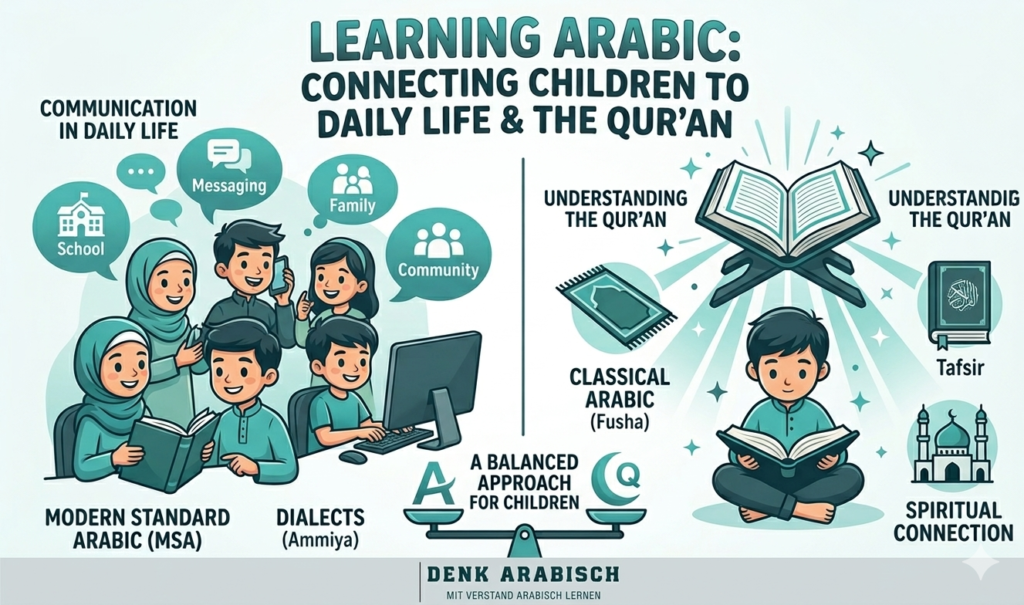
Arabic is a living, modern language spoken by more than 400 million people across the Middle East and North Africa. It is used in daily life for:
- Conversation at home and school
- Writing messages and social media
- News, television, and books
- Business and travel communication
Modern Arabic is often called Modern Standard Arabic (MSA). It is the formal version used in education, media, and official communication across Arab countries.
However, Arabic also has many dialects, such as:
- Egyptian Arabic
- Levantine Arabic (Syria, Jordan, Lebanon, Palestine)
- Gulf Arabic
- Maghrebi Arabic (Morocco, Algeria, Tunisia)
These dialects differ from country to country and are used in everyday speech.
Key Point for Children:
Modern Arabic is what helps children speak and communicate in daily life.
At Denk Arabisch, we offer specialized Arabic Lessons for German-Speaking Children that focus on building a strong foundation in Modern Arabic, helping your child communicate with confidence.
What Is Quranic Arabic?
Quranic Arabic is the classical form of Arabic used in the Qur’an. It is also known as Classical Arabic (Al-Fusha Al-Qadima).
This is the language in which Allah revealed the Qur’an to Prophet Muhammad ﷺ more than 1400 years ago.
Quranic Arabic is used for:
- Reading the Qur’an
- Understanding Tafsir (explanation of Qur’an)
- Islamic prayers (Salah)
- Classical Islamic books and Hadith
Unlike modern dialects, Quranic Arabic has remained unchanged over time, preserving its original grammar, vocabulary, and style.
Key Point for Children:
Quranic Arabic helps children connect directly with the Qur’an and understand Allah’s words.
Our Quranic Arabic Course for German Speakers is designed to help children move beyond simple reading to actually understanding the language of Allah’s revelation.
Arabic vs Quranic Arabic: The Main Differences
To help parents and children understand better, let’s compare both forms step by step.
1. Vocabulary Differences
Modern Arabic (العربية الحديثة) includes words that are used in everyday life and modern technology, especially things that didn’t exist in the past.
Examples:
- Computer = حاسوب
- Internet = إنترنت
- Mobile phone = هاتف محمول
It also includes borrowed or newly created words to keep up with modern life.
On the other hand, Quranic Arabic uses classical vocabulary that comes from the time of the Qur’an. These words are more traditional and often carry deep spiritual or emotional meanings.
Examples from the Qur’an:
- Dunya (دنيا) = worldly life
- Rahmah (رحمة) = mercy
- Iman (إيمان) = faith
- Sabr (صبر) = patience
Children may not hear these words in daily speech, but they are very important for understanding Islamic teachings and the Qur’an.
2. Grammar Structure
Both forms share the same foundation of Arabic grammar, but they differ in complexity and style.
Quranic Arabic:
- Uses more advanced and eloquent sentence structures
- Often includes deeper meanings in fewer words
- May use rhetorical styles that are not common in daily speech
Modern Arabic:
- Simplifies sentence structure for clarity
- More direct and practical
- Easier for everyday communication like school, work, and media
Quranic Arabic can feel harder at first, but it actually strengthens a learner’s understanding of Arabic grammar overall.
3. Pronunciation and Recitation
One of the biggest differences is in pronunciation rules.
Quranic Arabic follows Tajweed rules, which include:
- Proper pronunciation of every letter from its correct articulation point (مخارج الحروف)
- Stretching sounds correctly (المد)
- Rules for stopping, pausing, and continuing recitation (الوقف والابتداء)
- Maintaining rhythm and beauty in recitation
Modern Arabic:
- More flexible in pronunciation
- Can vary slightly depending on dialect or region
- Focuses more on understanding than precise articulation
Tajweed preserves the original sound of the Qur’an as it was revealed.
4. Usage Context
Modern Arabic:
- Used in daily conversations
- Schools, workplaces, news, and social media
- Helps people communicate in real-life situations
Quranic Arabic:
- Used in the Qur’an and Islamic texts
- Found in prayers, sermons, and religious learning
- Helps deepen spiritual understanding and connection with Islam
Modern Arabic helps you “talk to people,” while Quranic Arabic helps you “understand Allah’s message.”
Why Children Should Learn Both Forms?
Many parents wonder: Should my child learn spoken Arabic or Quranic Arabic first?
The truth is, both are important, and they complement each other.
1. Understanding the Qur’an
Quranic Arabic helps children:
- Read the Qur’an correctly
- Understand meanings of verses
- Feel a deeper spiritual connection
Without it, children may memorize without understanding.
2. Communication Skills
Modern Arabic helps children:
- Speak with Arab friends and family
- Understand Arabic media
- Travel or live in Arab countries
It builds real-life communication skills.
3. Strong Language Foundation
Learning both forms helps children:
- Recognize Arabic roots and patterns
- Improve reading and writing skills
- Become confident in language learning
Children who start with Quranic Arabic often find Modern Arabic easier later.
Denk Arabisch provides a balanced curriculum. Our Quran Course for Kids combines reading skills with basic vocabulary, ensuring they grow spiritually and linguistically at the same time.
Challenges Children Face When Learning Arabic
Understanding the difference is helpful, but children may still face challenges:
1. Confusion Between Dialects and Classical Arabic
Children may hear different forms of Arabic at home, school, or online. This can be confusing at first.
2. Difficulty in Pronunciation
Quranic Arabic requires precise pronunciation, which takes practice.
3. Lack of Exposure
If children only study Arabic in class but don’t hear it regularly, progress may be slow.
4. Memorization Without Understanding
Some children memorize the Qur’an without understanding meanings, which reduces long-term engagement.
Learn Arabic with Denk Arabisch Academy
Speak and understand Arabic through a clear and effective learning system
Try a Free TrialBest Ways to Teach Arabic and Quranic Arabic to Children
To make learning effective and enjoyable, parents can follow these strategies:
1. Start with Quranic Arabic Early
Introduce children to:
- Arabic letters
- Simple Qur’an reading
- Short Surahs
This builds spiritual connection from a young age.
Read also: Izhar Shafawi – The Complete Guide For Muslims
2. Use Fun Learning Methods
Children learn best through play:
- Arabic alphabet games
- Flashcards with images
- Songs and rhymes
- Interactive apps
3. Teach Meaning Alongside Reading
Don’t just focus on reading—explain meanings simply:
Example:
- “Alhamdulillah” = All praise is for Allah
- “Bismillah” = In the name of Allah
This helps children connect emotionally.
4. Practice Speaking Modern Arabic
Encourage children to use Arabic in daily life:
- Simple greetings
- Counting
- Naming objects
Even small practice helps.
5. Use Storytelling from the Qur’an
Stories make learning powerful:
- Prophet Nuh (عليه السلام) and patience
- Prophet Musa (عليه السلام) and courage
- Prophet Ibrahim (عليه السلام) and faith
Stories help children understand Quranic Arabic in context.
6. Consistency Over Pressure
Short daily practice is better than long, stressful lessons:
- 10–20 minutes daily
- Regular revision
- Positive encouragement
Which Should Children Learn First?
There is no single answer, but here is a simple guide:
Option 1: Quranic Arabic First
Best for children who:
- Want to read Qur’an early
- Attend Islamic schools
- Have strong religious focus
Option 2: Modern Arabic First
Best for children who:
- Live in Arab countries
- Need communication skills quickly
Best Option: Combined Approach
Most experts recommend a balanced approach, where children:
- Learn Qur’an reading step by step
- Slowly build spoken Arabic skills
Benefits of Learning Both Arabic Forms
Children who learn both Quranic and Modern Arabic gain:
- Strong Islamic identity
- Better understanding of Qur’an
- Communication skills in real life
- Cognitive and memory development
- Confidence in language learning
It also strengthens their connection to Islamic culture and heritage.
The path to excellence begins here, where our Tajweed Course for Kids at Denk Arabisch ensures every letter is spoken with precision and grace.
Read also: Izhar Mutlaq – The Comprehensive Guide For Muslims
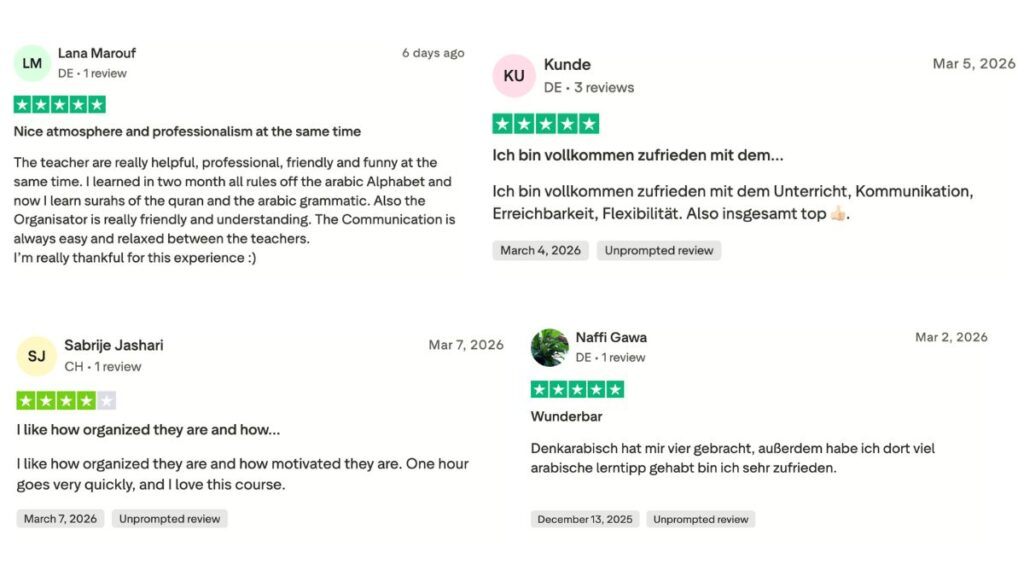
What Our Students Say About Denk Arabisch Academy
See what our students say about learning at Denk Arabisch Academy on Trustpilot. Read their experiences and check out more reviews to discover how our courses help improve Arabic.
GIVE YOUR CHILD THE GIFT OF THE QURAN WITH DENK ARABISCH!
Are you looking for an Arabic school that understands the needs of children growing up in Germany? Denk Arabisch is your partner in building your child’s Islamic identity and language skills.
Why parents in Germany choose Denk Arabisch:
- Specialized Kids’ Curriculum: Designed to be fun, engaging, and age-appropriate.
- Native-Level Teachers: Experts who can explain complex Arabic concepts clearly to German-speaking children.
- Safe Online Environment: Learn from the comfort of your home with flexible scheduling.
- All-in-One School: From Tajweed and Memorization to Islamic Studies and Spoken Arabic.
Our Featured Courses for Kids:
- Tajweed Course for German-Speaking Children
- Quran Memorization & Recitation
- Arabic Lessons for Kids (Beginner to Advanced)
- Islamic Studies (Prophets’ Stories & Ethics)
Invest in your child’s Akhirah today. Let them learn to love the language of the Quran.
Learn Arabic with Denk Arabisch Academy
Speak and understand Arabic through a clear and effective learning system
Try a Free TrialConclusion
Understanding the difference between Arabic and Quranic Arabic for children is essential for parents who want to guide their kids effectively.
While Modern Arabic helps with communication, Quranic Arabic opens the door to understanding the Qur’an and building a deep spiritual connection with Allah.
The best approach is not choosing one over the other, but helping children grow in both—step by step, with patience and consistency.
When learning becomes enjoyable and meaningful, children not only learn a language—they build a lifelong bond with the Qur’an.
FAQs
1. What is the difference between Modern Arabic and Quranic Arabic?
Modern Arabic is used for daily communication, media, and education, while Quranic Arabic is the classical form used in the Qur’an and Islamic texts. Both share the same roots but differ in vocabulary, style, and usage.
2. Can children learn both Arabic and Quranic Arabic at the same time?
Yes, children can learn both together. In fact, a combined approach is often recommended because it helps them develop communication skills while also understanding the Qur’an.
3. At what age should children start learning Arabic?
Children can start as early as 4–6 years old. At this age, they are very receptive to sounds, letters, and basic vocabulary, especially when learning is fun and interactive.
4. Is Quranic Arabic difficult for children?
It may seem challenging at first because of its precise pronunciation (Tajweed) and classical structure. However, with gradual learning and practice, children can master it step by step.
5. Should my child learn Arabic or Quranic Arabic first?
There is no single correct answer. Children who want early Qur’an reading may start with Quranic Arabic, while those focused on communication may start with Modern Arabic. A balanced approach is usually best.
6. How long should children study Arabic each day?
For young children, 10–20 minutes daily is ideal. Short, consistent sessions are more effective than long, intensive lessons.
7. Why is understanding the Qur’an important for children?
Understanding the Qur’an helps children build a stronger spiritual connection, improves memorization, and allows them to apply Islamic values in their daily lives.
8. What is the best way to keep children motivated in learning Arabic?
Using games, storytelling, songs, visual aids, and positive encouragement helps keep learning fun and engaging. Avoid pressure and focus on consistency.