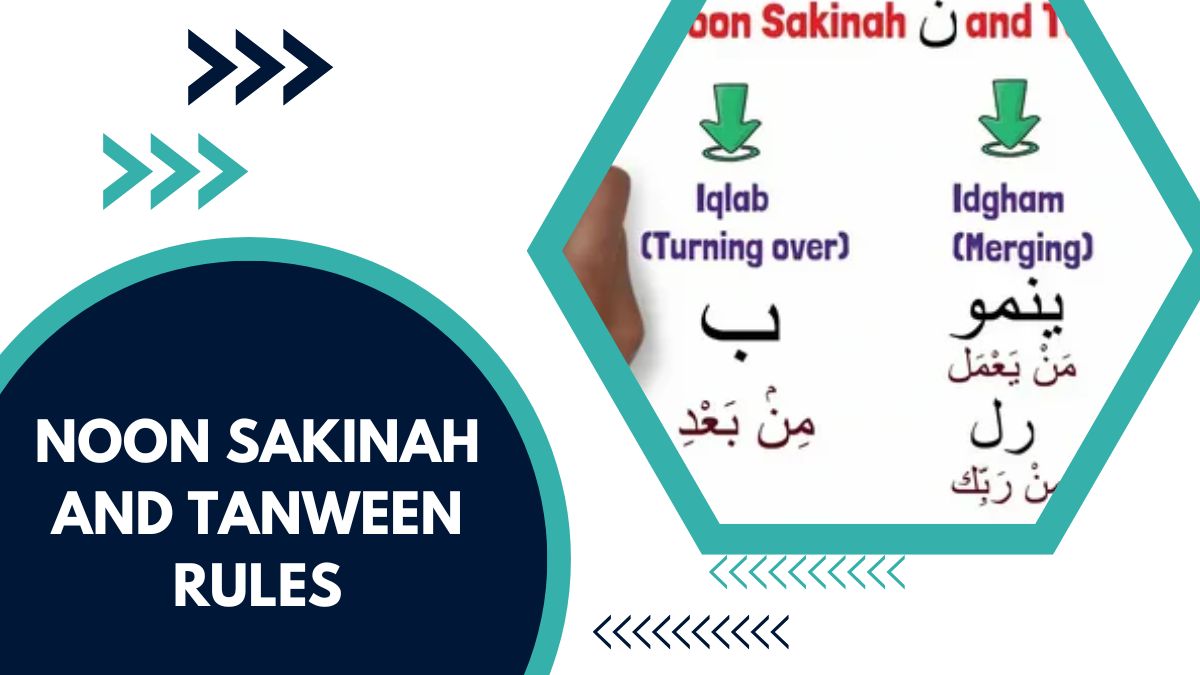
Takeaway:
- Noon Sakinah (نْ) and Tanween (ً ٍ ٌ) both produce an “n” sound and follow identical Tajweed rules based on the letter that comes next.
- Rule 1 – Izhar (Clarity): Pronounce the “n” clearly with no nasal hum when followed by any of the six throat letters (ء, ه, ع, ح, غ, خ).
- Rule 2 – Idgham (Merging): Merge the “n” into the next letter; hold a two-count nasal hum (ghunnah) with ي, ن, م, و, but no ghunnah at all with ل or ر.
- Rule 3 – Iqlab (Conversion): Change the “n” into a hidden Meem (م) sound with two counts of ghunnah when followed by ب (Baa).
- Rule 4 – Ikhfa (Hiding): Conceal the “n” with a light or heavy two-count nasalization when followed by any of the 15 remaining letters (ص, ذ, ث, ك, ج, ش, ق, س, د, ط, ز, ف, ت, ض, ظ).
- The nasal ghunnah always lasts two beats in Idgham-with-ghunnah, Iqlab, and Ikhfa; Izhar and Idgham-without-ghunnah have no nasalization.
- Tanween only appears at the end of nouns, and its “n” sound is dropped when stopping on the word (waqf).
- Practical mastery depends on listening to skilled reciters, consistent practice, and live feedback from a qualified teacher.
Mastering the recitation of the Quran begins with understanding how letters interact. Among the most fundamental yet transformative rules are those governing Noon Sakinah and Tanween. These rules dictate how the “N” sound is pronounced, merged, or hidden, giving the Quranic recitation its unique, melodic rhythm and precision.
In this comprehensive guide, we will break down the mechanics, the letters, and the practical application of these rules to help you recite with beauty and accuracy.
Table of Contents
What is Saakin in Tajweed?
A letter is described as Saakin (ساكن) when it carries no vowel—meaning it has no Fathah (َ), Dammah (ُ), or Kasrah (ِ).
This state is marked by a small circle above the letter, known as a sukoon (ْ).
Key Features of a Saakin Letter:
- It is still (no حركة / harakah)
- It does not carry any vowel sound
- It depends on surrounding letters for pronunciation flow
Example:
- نْ (Noon with sukoon)
In Tajweed, recognizing a Saakin letter is essential because many rules are based on how this silent letter interacts with the letter that follows it.
Definition of Noon Sakinah and Tanween
Noon Sakinah (النون الساكنة) is a Noon (ن) with sukoon, producing a clear “N” sound without a vowel.
Tanween (التنوين) are double vowel endings (ً ٍ ٌ) that also produce an “N” sound, so both follow the same Tajweed rules depending on the next letter.
1. Noon Sakinah (النون الساكنة)
Noon Sakinah is a letter Noon (ن) that carries a Sukoon ( ْ ). This means the letter is “resting” or “still”—it has no vowel sound (like a, i, or u) attached to it.
2. Tanween (التنوين)
Tanween refers to the double vowel markings found at the end of nouns:
- Two Fathahs (ً): Pronounced “an”
- Two Kasrahs (ٍ): Pronounced “in”
- Two Dammahs (ٌ): Pronounced “un”
Though written as double vowels, they are phonetically identical to a Noon Sakinah. For example, بٌ is pronounced exactly like بُنْ (bun).
Key Takeaway: For the purposes of Tajweed, Noon Sakinah and Tanween are treated exactly the same because they both result in an “N” sound that needs a specific pronunciation based on the letter that follows it.
The Difference Between Noon Sakinah and Tanween
| Feature | Noon Sakinah (نْ) | Tanween (ً ٍ ٌ) |
| Written Form | Written as the letter Noon (ن). | Written as double vowels (ـً ـٌ ـٍ). |
| Pronunciation | Always pronounced as “n”. | Pronounced as “n”, but only when continuing recitation. |
| Position in Word | Can occur in the middle or end of a word. | Only occurs at the very end of a word. |
| Type of Word | Found in nouns, verbs, and particles. | Found only in nouns. |
| Permanence | Remains an “n” sound even if you stop reading. | The “n” sound disappears if you stop on the word. |
| Original/Extra | Original letter | Extra added sound |
The Four Rules of Noon Sakinah and Tanween
There are four primary ways to pronounce Noon Sakinah or Tanween. The rule you choose depends entirely on the first letter of the next word (or the next letter in the same word for Noon Sakinah).
1. Izhar Halqi
Izhar “إظهار” literally means “clarification” or “making clear.” Halqi “حلقي” refers to the throat. This rule dictates that you must pronounce the Noon sound clearly from its point of origin (the tip of the tongue) without any extra nasalization (Ghunnah).
The Letters of Izhar:
There are six throat letters. If any of these follow a Noon Sakinah or Tanween, you apply Izhar:
- Hamza ( ء )
- Haa ( ه )
- ‘Ayn ( ع )
- Haa ( ح )
- Ghayn ( غ )
- Khaa ( خ )
The following examples demonstrate how to pronounce the Noon Sakinah or Tanween clearly when followed by one of the throat letters.
A. The Letter: Hamza ( ء )
- Quranic Example:
وَهُمْ يَنْهَوْنَ عَنْهُ وَيَنْأَوْنَ عَنْهُ (سورة الأنعام)
“And they prevent others from him and keep themselves away from him.” (Surah: Al-An’am)
- Transliteration (Ta’reeb): Wayan’awna
- Explanation: The Noon Sakinah is followed by the letter Hamza within the same word. You must pronounce the “N” sound clearly with the tip of your tongue touching the roof of your mouth, then proceed to the Hamza without any nasal humming.
B. The Letter: Haa ( هـ )
- Quranic Example:
مِنْ هَادٍ (سورة الرعد)
“any provider of guidance” (Surah: Ar-Ra’d)
- Transliteration (Ta’reeb): Min haadin
- Explanation: Here, the Noon Sakinah appears at the end of the first word and is followed by the letter Haa in the next word. The rule dictates that the “N” in Min must be perfectly clear and distinct.
C. The Letter: ‘Ayn ( ع )
- Quranic Example:
صِرَاطَ الَّذِينَ أَنْعَمْتَ عَلَيْهِمْ (سورة الفاتحة)
“The path of those upon whom You have bestowed favor.” (Surah: Al-Fatihah)
- Transliteration (Ta’reeb): An’amta ‘alayhim
- Explanation: This is a very famous example from Surah Al-Fatihah. The Noon Sakinah is followed by the throat letter ‘Ayn. You should articulate the “N” sound fully before moving into the deep throat sound of the ‘Ayn.
D. The Letter: Ha ( ح )
- Quranic Example:
وَكَانَ اللَّهُ عَزِيزًا حَكِيمًا (سورة النساء)
“And ever is Allah Exalted in Might and Wise.” (Surah: An-Nisa)
- Transliteration (Ta’reeb): Wa kaana Allahu ‘Azeezan Hakeema
- Explanation: This example uses Tanween Fath (the “an” sound). Because the letter following the Tanween is the throat letter Ha, the “an” sound at the end of ‘Azeezan must be clear, as if you are saying a plain letter Noon.
E. The Letter: Ghayn ( غ )
- Quranic Example:
مِنْ غِلٍّ (سورة الأعراف)
“of resentment” (Surah: Al-A’raf)
- Transliteration (Ta’reeb): Min ghillin
- Explanation: The Noon Sakinah is followed by the letter Ghayn. In this case, you must be careful not to hide the Noon; it should be pronounced sharply and clearly before you produce the scraping sound of the Ghayn.
F. The Letter: Khaa ( خ )
- Quranic Example:
إِنَّ اللَّهَ عَلِيمٌ خَبِيرٌ (سورة الحجرات)
“Indeed, Allah is Knowing and Acquainted.” (Surah: Al-Hujurat)
- Transliteration (Ta’reeb): ‘Aleemun khabeer
- Explanation: This is another example of Tanween. When the “un” sound at the end of ‘Aleemun is followed by the throat letter Khaa, you must ensure the “N” sound is manifest and clear, moving quickly to the Khaa without any nasalization (Ghunnah).
Learn the Quran with Denk Arabisch Academy
Master reading and understanding the Quran through structured and supportive learning
Try a Free TrialSummary Table for Izhar
| Letter | Quranic Example | Transliteration | Position |
| ء | وَيَنْأَوْنَ | Wayan’awna | Same word |
| هـ | مِنْ هَادٍ | Min haadin | Two words |
| ع | أَنْعَمْتَ | An’amta | Same word |
| ح | عَزِيزًا حَكِيمًا | ‘Azeezun hakeem | Two words (Tanween) |
| غ | مِنْ غِلٍّ | Min ghillin | Two words |
| خ | عَلِيمٌ خَبِيرٌ | ‘Aleemun khabeer | Two words (Tanween) |
2. Idgham
Idgham “إدغام” literally means “to merge” or “to assimilate.” In Tajweed, it occurs when a Noon Sakinah or Tanween is followed by one of the letters of Idgham. The “N” sound is swallowed or merged into the following letter, which then becomes emphasized (as if it has a Shaddah).
The Letters of Idgham:
There are six letters of Idgham, collected in the mnemonic word: Yarmaloon (يَرْمَلُون).
- Yaa ( ي )
- Raa ( ر )
- Meem ( م )
- Laam ( ل )
- Waw ( و )
- Noon ( ن )
Idgham is divided into two distinct categories based on whether or not you produce a nasal sound (Ghunnah).
Idgham with Ghunnah
This occurs with four letters: ( ي ، ن ، م ، و ), collected in the word “Yanmu” (يَنْمُو). You merge the Noon and hold a nasal hum for two counts.
A. The Letter: Yaa ( ي )
- Quranic Example:
وَمَن يَعْمَلْ مِثْقَالَ ذَرَّةٍ خَيْرًا يَرَهُ (سورة الزلزلة)
“And whoever does an atom’s weight of good will see it.” (Surah: Az-Zalzalah)
- Transliteration (Ta’reeb): Wamay-ya‘mal
- Explanation: The Noon Sakinah is followed by the letter Yaa. The “N” sound is completely merged into the Yaa, and you must hold a nasal sound (Ghunnah) from your nose for two beats while pronouncing the Yaa.
B. The Letter: Waw ( و )
- Quranic Example:
مِن وَلِيٍّ وَلَا نَصِيرٍ (سورة البقرة)
“any protector or any helper.” (Surah: Al-Baqarah)
- Transliteration (Ta’reeb): Miw-waliyyin
- Explanation: The Noon Sakinah is followed by the letter Waw. Instead of saying “Min,” you transition directly from the “Meem” to the “Waw” with a nasal hum, making it sound like a doubled Waw with Ghunnah.
C. The Letter: Meem ( م )
- Quranic Example:
فِي عَمَدٍ مُّمَدَّدَةٍ (سورة الهمزة)
“In columns extended.” (Surah: Al-Humazah)
- Transliteration (Ta’reeb): Fee ‘amadim-mumaddadah
- Explanation: This is an example of Tanween Kasr. The “in” sound at the end of ‘amadin is followed by Meem. The Tanween merges fully into the Meem, creating a strong nasal connection between the two words.
D. The Letter: Noon ( ن )
- Quranic Example:
مِن نُّطْفَةٍ خَلَقَهُ فَقَدَّرَهُ (سورة عبس)
“From a sperm-drop He created him and destined for him.” (Surah: ‘Abasa)
- Transliteration (Ta’reeb): Min-nutfatin
- Explanation: The Noon Sakinah is followed by another letter Noon. In this case, the first Noon merges completely into the second one, resulting in a single Noon with a Shaddah (emphasis). You must hold the nasal sound (Ghunnah) for two counts, making it a smooth, vibrating transition from the nose.
Read also: Noon And Meem Mushaddad – A Complete Tajweed Guide
Idgham without Ghunnah
This occurs with two letters: ( ل ، ر ). The Noon is swallowed completely, and there is no nasal sound at all.
A. The Letter: Raa ( ر )
- Quranic Example:
أَن رَّآهُ اسْتَغْنَىٰ (سورة العلق)
“because he sees himself self-sufficient.” (Surah: Al-‘Alaq)
- Transliteration (Ta’reeb): Ar-ra’aahu
- Explanation: The Noon Sakinah is followed by Raa. The “N” sound disappears entirely. You move straight from the Hamza to a heavy Raa, as if the Noon was never written. There is no humming in the nose.
B. The Letter: Laam ( ل )
- Quranic Example:
وَيْلٌ لِّكُلِّ هُمَزَةٍ لُّمَزَةٍ (سورة الهمزة)
“Woe to every scorner and mocker.” (Surah: Al-Humazah)
- Transliteration (Ta’reeb): Waylul-likulli
- Explanation: The Tanween Damm is followed by the letter Laam. The “un” sound merges totally into the Laam. You pronounce it as “Waylul,” moving directly to the doubled Laam without any nasalization.
Summary Table for Idgham
| Letter | Category | Quranic Example | Transliteration |
| ي | With Ghunnah | وَمَن يَعْمَلْ | Wamay-ya‘mal |
| ن | With Ghunnah | مِن نُّطْفَةٍ | Min-nutfatin |
| م | With Ghunnah | عَمَدٍ مُّمَدَّدَةٍ | ‘Amadim-mumaddadah |
| و | With Ghunnah | مِن وَلِيٍّ | Miw-waliyyin |
| ل | Without Ghunnah | وَيْلٌ لِّكُلِّ | Waylul-likulli |
| ر | Without Ghunnah | مِن رَّبِّهِمْ | Mir-rabbihim |
3. Iqlab
Iqlab “إقلاب” literally means “to turn” or “to convert.” It is the process of turning the sound of Noon Sakinah or Tanween into a Meem sound because of the letter that follows it.
The Letter of Iqlab:
There is only one letter for this rule: Baa ( ب ).
How to Pronounce:
When a Noon Sakinah or Tanween is followed by a Baa, the “N” sound turns into a Meem (م) sound. You must also apply Ghunnah (nasalization) for two counts while closing the lips lightly.
- Visual Aid: In many Mushafs, a small “m” (م) is placed above the Noon to remind you of this rule.
A. Iqlab with Noon Sakinah (In two words)
- Quranic Example:
مِن بَعْدِ مَا جَاءَتْهُمُ الْبَيِّنَاتُ (سورة البقرة)
“after the clear evidences had come to them.” (Surah: Al-Baqarah)
- Transliteration (Ta’reeb): Mim-ba‘di
- Explanation: The Noon Sakinah is followed by the letter Baa. Instead of pronouncing the “N,” you “turn” it into a Meem sound. You must close your lips lightly and hold a nasal hum (Ghunnah) for two counts. It sounds like Mim-ba‘di.
B. Iqlab with Noon Sakinah (In one word)
- Quranic Example:
قَالَ يَا آدَمُ أَنبِئْهُم بِأَسْمَائِهِمْ (سورة البقرة)
“He said, ‘O Adam, inform them of their names.'” (Surah: Al-Baqarah)
- Transliteration (Ta’reeb): Am-bi’hum
- Explanation: Here, the Noon Sakinah and the letter Baa meet within a single word. The same rule applies: the Noon is converted into a Meem. You pronounce it as Am-bi’hum with a two-count nasalization.
C. Iqlab with Tanween
- Quranic Example:
وَاللَّهُ سَمِيعٌ بَصِيرٌ (سورة البقرة)
“And Allah is All-Hearing, All-Seeing.” (Surah: Al-Baqarah)
- Transliteration (Ta’reeb): Samee‘um-baseer
- Explanation: This example uses Tanween Damm (the “un” sound). Because it is followed by the letter Baa, the “un” sound turns into “um.” You transition from the word Samee‘un to Samee‘um while keeping the lips lightly closed for the Ghunnah.
Learn the Quran with Denk Arabisch Academy
Master reading and understanding the Quran through structured and supportive learning
Try a Free TrialSummary Table for Iqlab
| Letter | Quranic Example | Transliteration | Position |
| ب | مِن بَعْدِ | Mim-ba‘di | Two words |
| ب | أَنبِئْهُم | Am-bi’hum | Same word |
| ب | سَمِيعٌ بَصِيرٌ | Samee‘um-baseer | Two words (Tanween) |
4. Ikhfa Haqiqi
Ikhfa “إخفاء” literally means “to hide” or “to conceal.” In Tajweed, it refers to hiding the Noon Sakinah or Tanween sound. Instead of the tongue touching the roof of the mouth for a clear “N,” it hovers near the exit point of the next letter while producing a nasal sound (Ghunnah).
The Letters of Ikhfa:
There are 15 letters of Ikhfa. If you see any of these following a Noon Sakinah or Tanween, you apply the rule: ( ص ، ذ ، ث ، ك ، ج ، ش ، ق ، س ، د ، ط ، ز ، ف ، ت ، ض ، ظ )
A. The Letter: Taa ( ت )
- Quranic Example:
جَنَّاتٍ تَجْرِي مِن تَحْتِهَا الْأَنْهَارُ (سورة البينة)
“Gardens underneath which rivers flow.” (Surah: Al-Bayyinah)
- Transliteration (Ta’reeb): Min tahtiha
- Explanation: The Noon Sakinah is followed by the letter Taa. To pronounce this correctly, you do not let your tongue touch the roof of the mouth for the “N.” Instead, you keep your tongue close to the teeth (preparing for the Taa) and let the “N” sound come primarily from the nose for two counts. It sounds like a soft, breathy nasal shadow.
B. The Letter: Qaaf ( ق )
- Quranic Example:
مِن قَبْلِ أَن يَأْتِيَ يَوْمٌ (سورة البقرة)
“Before there comes a Day.” (Surah: Al-Baqarah)
- Transliteration (Ta’reeb): Min-qabli
- Explanation: The Noon Sakinah is followed by the letter Qaaf. Since Qaaf is a “heavy” letter, the Ikhfa sound also becomes heavy. You prepare the back of your tongue for the Qaaf while the nasal sound resonates deeply.
C. The Letter: Kaaf ( ك )
Quranic Example:
إِن كُنتُمْ صَادِقِينَ (سورة البقرة)
“If you should be truthful.” (Surah: Al-Baqarah)
- Transliteration (Ta’reeb): In-kuntum
- Explanation: In this phrase, both words contain Ikhfa. The Noon is “hidden” before the Kaaf and the Taa. You move smoothly from a nasalized “I” to the Kaaf without the tongue ever making a sharp “N” sound.
Summary Table for Ikhfa
| Letter | Quranic Example | Transliteration | Quality |
| ت | مِن تَحْتِهَا | Min tahtiha | Light Ghunnah |
| ق | مِن قَبْلِ | Min-qabli | Heavy Ghunnah |
| ك | إِن كُنتُمْ | In-kuntum | Light Ghunnah |
Read also: Ghunnah Rules In Tajweed – A Complete Guide With Examples
Stop Reading About Tajweed—Start Mastering It!
Do you want to feel the true beauty of the Quranic rhythm but don’t know where to start? Reading rules is great, but nothing replaces the guidance of an expert.
At Denk Arabisch, we turn your hesitation into confidence. Our Quran Tajweed Course for German speakers is designed to fix your pronunciation in record time.
Why join Akademie Denk Arabisch?
- Live Feedback: Get corrected in real-time by qualified teachers who understand your specific linguistic challenges.
- Tailored for Busy Lives: Flexible schedules that fit your freelance work, studies, or family life.
- Proven Results: Move from basic reading to beautiful, rhythmic Tajweed with our step-by-step methodology.
- Modern Approach: We simplify complex classical rules into easy-to-apply techniques
Our Courses Include:
- Arabic Courses for German Speakers
- Arabic Levels for German Speakers
- Arabic Dialect Courses for German Speakers
- Qur’an Learning Courses for German Speakers
- Islamic Studies Courses for German Speakers
- Courses for Muslim Kids for German Speakers
Register now at Denk Arabisch and transform your recitation today!
What Our Students Say About Denk Arabisch Academy
See what our students say about learning at Denk Arabisch Academy on Trustpilot. Read their experiences and check out more reviews to discover how our courses help improve Arabic.

Conclusion
Mastering the rules of Noon Sakinah and Tanween is a foundational step in your Tajweed journey. These rules are not just technical guidelines—they are the key to transforming your recitation into a smooth, rhythmic, and spiritually enriching experience.
By understanding when to apply Izhar, Idgham, Iqlab, and Ikhfa, you gain control over one of the most frequent sounds in the Quran. With consistent practice, careful listening, and proper guidance, these rules will become second nature.
Remember, Tajweed is best learned through both knowledge and practice. So take your time, revisit examples, and recite regularly. With dedication, you will not only improve your pronunciation but also deepen your connection with the words of the Quran.
FAQs
1. What is the difference between Noon Sakinah and Tanween?
Noon Sakinah is a written letter (نْ) with a sukoon, while Tanween (ً ٌ ٍ) is a double vowel marking that produces an “n” sound at the end of a word. Although they look different, both are pronounced similarly and follow the same Tajweed rules.
2. How many rules apply to Noon Sakinah and Tanween?
There are four main rules:
Izhar (clarity)
Idgham (merging)
Iqlab (conversion)
Ikhfa (hiding)
Each rule depends on the letter that comes after the Noon Sakinah or Tanween.
3. How long should the Ghunnah (nasal sound) be held?
The Ghunnah is typically held for two counts (about the time it takes to say “one-two” or gently tap your finger twice). This applies in Idgham with Ghunnah, Iqlab, and Ikhfa.
4. Does Tanween appear in the middle of a word?
No, Tanween only appears at the end of nouns. It never comes in the middle of a word, unlike Noon Sakinah, which can appear in both middle and end positions.
5. Can Ikhfa occur within a single word?
Yes, Ikhfa can occur within the same word when a Noon Sakinah is followed by one of the 15 Ikhfa letters. However, Tanween always occurs between two words.
6. Why is there no Ghunnah in Izhar?
Because Izhar means “clarity,” the Noon sound must be pronounced clearly without nasalization. Adding Ghunnah would interfere with the clean articulation required for throat letters.
7. What is the easiest rule to recognize?
Iqlab is often the easiest because it applies to only one letter (ب). Whenever you see Noon Sakinah or Tanween followed by ب, you convert the “n” sound into a soft “m” with Ghunnah.
8. What is the hardest rule for beginners?
Many learners find Ikhfa challenging because it requires balancing between hiding the sound and maintaining proper nasalization, while also adjusting for heavy and light letters.
9. What happens if I stop (waqf) on a word with Tanween?
When stopping, the “n” sound of Tanween disappears, and the word is pronounced without it (e.g., “كتابٌ” becomes “كتاب”).
10. How can I master these rules effectively?
The best way is through:
Listening to skilled reciters
Practicing consistently
Getting feedback from a qualified teacher
Using color-coded Mushafs for visual reinforcement