Takeaway:
- Quran memorization for kids is a spiritual and character-building journey, not just a memory exercise.
- Starting early (ages 5–12) takes advantage of high neuroplasticity and strong phonetic absorption.
- Consistent, small daily lessons beat irregular large sessions; a three-step routine (new lesson, recent review, distant review) locks the Quran into long-term memory.
- Correct Tajweed must come first to avoid locking in mistakes.
- Using one fixed Mushaf (printed copy) and immersing through audio repetition strengthens visual and auditory memory.
- Parents create the Quranic environment: lead by example, discuss meanings, limit screen time, and praise effort over perfection.
- Understanding the meaning of verses through logic-based learning makes memorization deeper and more permanent.
- Revision (Muraja’ah) is the lifeline of Hifz; a structured daily review plan prevents forgetting.
- Modern tools (apps, online tutors, digital pens) are useful allies but should not replace foundational habits.
- Rewards and celebrations build positive emotional bonds with the Quran, but the ultimate intention must be for Allah.
- The goal is not to race through the 30th Juz, but to nurture a child who lives by Quranic values of honesty, patience, and discipline.
Memorizing the Holy Quran (Hifz) is one of the most noble pursuits a Muslim child can undertake. It is more than just a feat of memory; it is a spiritual journey that shapes a child’s character, sharpens their intellect, and secures their rewards in the Hereafter.
In today’s fast-paced digital world, parents often wonder how to balance modern education with the sacred goal of Quran memorization. This guide provides a holistic roadmap for parents and educators to help children memorize the Quran with love, ease, and consistency.
Understanding the “logic” behind the words makes Hifz permanent. Discover how our Quran Course For German Speaking Children at Denk Arabisch turn memorization into deep comprehension.

Table of Contents
What Kids Will Learn For Quran Memorization?
Memorizing the Quran is a comprehensive journey. It is not just about repeating words; it is a full educational program that develops a child’s language, mind, and behavior. At Denk Arabisch, we ensure that through Hifz, your child gains a wide range of essential skills.
1. Correct Pronunciation (Tajweed)
Kids learn the exact rules of how to pronounce every letter and word perfectly. This builds a strong foundation in Arabic phonetics, helping them speak clearly and fluently without a heavy accent or mistakes.
Our Tajweed Course For German-Speaking Children ensures that kids learn perfect pronunciation early on, building habits that last a lifetime.
2. New Arabic Vocabulary
Through the verses, children are exposed to thousands of rich Arabic words. This naturally expands their vocabulary and helps them understand the language of the Quran, making it easier for them to learn Arabic as a second language.
3. Stronger Memory Power
Hifz is like a “gym” for the brain. By memorizing daily, kids improve their ability to retain information quickly. This mental training often leads to better grades in school subjects like math and science.
4. Self-Discipline and Routine
The journey teaches children the importance of a daily schedule. By sticking to their “Sabaq” (new lesson) and revision, they learn how to be organized, patient, and committed to long-term goals.
5. Beautiful Stories and Lessons
Kids learn the stories of the Prophets and the history of Islam. These stories are full of lessons about bravery, honesty, and kindness, providing them with great role models to follow in their daily lives.
6. Good Manners (Akhlaq)
The Quran is a guide for behavior. As kids memorize, they learn about “Taqwa” (God-consciousness) and the importance of respecting parents, being truthful, and helping others, which shapes their character.
7. Better Focus and Listening
In a world full of distractions, Quran memorization requires deep listening and focus. This improves a child’s attention span, helping them become better listeners at home and more focused students in the classroom.
8. Spiritual Connection
Most importantly, kids build a lifelong friendship with the Book of Allah. They learn that the Quran is a source of comfort and guidance, giving them peace of mind and spiritual strength as they grow up.
The Virtues of Quran Memorization for Children
Before diving into the “how,” it is essential to understand the “why.” Instilling the virtues of Hifz in a child’s heart motivates them during challenging times.
1. Elevated Status in Jannah
The Prophet Muhammad (peace be upon him) said: “It will be said to the companion of the Quran: Read and elevate (through the levels of Paradise)… for your status will be at the last verse you recite.” (Tirmidhi).
2. Cognitive Development
Scientific studies suggest that memorizing complex texts like the Quran improves focus, linguistic skills, and memory retention.
3. Character Building
The Quran acts as a moral compass. Children who engage with the Word of Allah are more likely to develop Taqwa (God-consciousness) and excellent manners (Akhlaq).
4. Crown of Honor for Parents
The parents of a Hafiz will be granted a crown of light on the Day of Judgment, a beautiful incentive for the whole family.
Why Start Hifz The Quran Early For Kids?
There is a reason why the tradition of starting Hifz at age five or six has persisted for centuries. Science confirms what Islamic tradition has always practiced: the “golden age” of learning.
1. Neuroplasticity and Language Acquisition
A child’s brain is highly “plastic,” meaning it is constantly forming new neural connections. During the early years, the brain is specifically primed for phonetic coding. This makes it the perfect time to master Tajweed (the rules of pronunciation).
While an adult might struggle to distinguish between the Arabic letters Qaf (ق) and Kaf (ك), a child can mimic these sounds with ease.
2. Memory Capacity
Unlike adults, children have fewer mental “tabs” open. They aren’t worried about bills, work, or social obligations. This mental clarity allows them to absorb information at a rate that far exceeds adult capabilities.
Memorizing the Quran at a young age acts like “engraving on stone,” whereas memorizing as an adult can feel like “writing on water.”
Rote learning is easier when the tongue is already trained. Explore our visual grammar guides at Denk Arabisch to give your child a head start in Arabic fluency.
Read also: Learn Quran In Hamburg For Children – A Complete Guide For Parents
When is the Best Time to Start Memorizing The Quran For Kids?
While every child is different, the “Golden Age” for memorization is generally between 5 and 12 years old. During this window, a child’s brain is like a sponge—highly receptive and capable of retaining information without the distractions of adult life.
However, the foundation can be laid as early as infancy through passive listening. If your child is older, don’t worry! It is never too late to start. The key is readiness and interest.
We offer Arabic Lessons For German-Speaking Children that turn the brain’s natural “sponge” phase into a strong foundation for language and understanding.
Learn the Quran with Denk Arabisch Academy
Master reading and understanding the Quran through structured and supportive learning
Try a Free TrialSeven Proven Strategies to Hifz The Quran For Kids
Helping children memorize the Quran (Hifz) is a beautiful journey that requires patience, structure, and sincere intention. By combining consistency, proper guidance, and positive encouragement, parents can make the process both effective and spiritually rewarding.
1. Sincere Intention (Niyyah)
Everything starts with the heart. Teach your child that they are memorizing for the sake of Allah, not for praise or certificates.
Pro Tip: Make Dua with your child daily, asking Allah to make the Quran easy for them to learn and act upon.
2. Consistency Over Quantity
The secret to Hifz is the Power of Small Wins. It is better to memorize two lines every day than to memorize two pages once a week.
- Establish a “Sacred Time” (usually after Fajr or Maghrib).
- Stick to this routine even during holidays to maintain the habit.
3. Audio Immersion (The Power of Listening)
Repetition is the mother of learning. Let your child listen to a specific Surah repeatedly throughout the day—while playing, in the car, or before bed. Familiarity with the rhythm and tune makes the actual memorization much faster.
4. Use a Single Mushaf (Copy of the Quran)
Visual memory plays a huge role in Hifz. A child often remembers the position of the verse on the page. Switching between different prints or digital apps can confuse their visual “map.” Stick to one standard Mushaf throughout their journey.
5. Mastering Tajweed First
Never encourage a child to memorize without correct pronunciation. Correcting a mistake that has been “locked” into the memory is much harder than learning it correctly the first time. Focus on the basics of Makharij (articulation points) before increasing the pace.
6. The “Three-Step” Daily Routine
To ensure the Quran stays in the heart, follow this classic structure used in traditional Madrasas:
- Sabaq (New Lesson): The new portion memorized today.
- Sabqi (Recent Review): Reviewing the last 5–7 days of lessons to solidify them.
- Manzil (Distant Review): Reviewing older portions to prevent them from being forgotten.
7. Positive Reinforcement
Hifz should never feel like a punishment. Celebrate milestones! Whether it’s finishing a Juz or mastering a difficult Surah, reward them with a special treat, a trip to the park, or heartfelt praise.
Our Quran Memorization Course For Muslims In Germany at Denk Arabisch is the perfect way to start your child’s journey during their “Golden Age” of learning.
Schedule For Memorizing The Quran For Children Sustainably
Consistency is the secret ingredient. A child who memorizes three lines every day will finish the Quran faster than a child who memorizes a whole page once a week and then stops for a month.
| Time of Day | Activity | Why it Works |
| After Fajr | New Lesson (Sabaq) | The mind is freshest and the house is quiet. |
| After School | Recent Revision (Sabqi) | Acts as a mental transition from school to home. |
| Before Bed | Old Revision (Manzil) | Information reviewed before sleep is better consolidated by the brain. |
The Role Of Parents In Teaching Children To Memorize The Quran
Your role is to be your child’s biggest cheerleader. If they struggle with a verse, don’t get frustrated. Instead, offer patience. The goal is to make them love the Quran. If the process is associated with stress and shouting, the child may develop an emotional barrier toward the Book of Allah.
Creating a “Quranic Environment” at Home:
- Lead by Example: Let your children see you reading and memorizing.
- Discuss Meanings: Use a child-friendly Tafseer to explain the stories in the verses. Understanding the “why” behind the words makes them easier to remember.
- Limit Screen Time: Excessive digital stimulation can reduce the mental “quiet” needed for deep memorization.
Read also: Quran Learning For Children In Munich – A Complete Guide
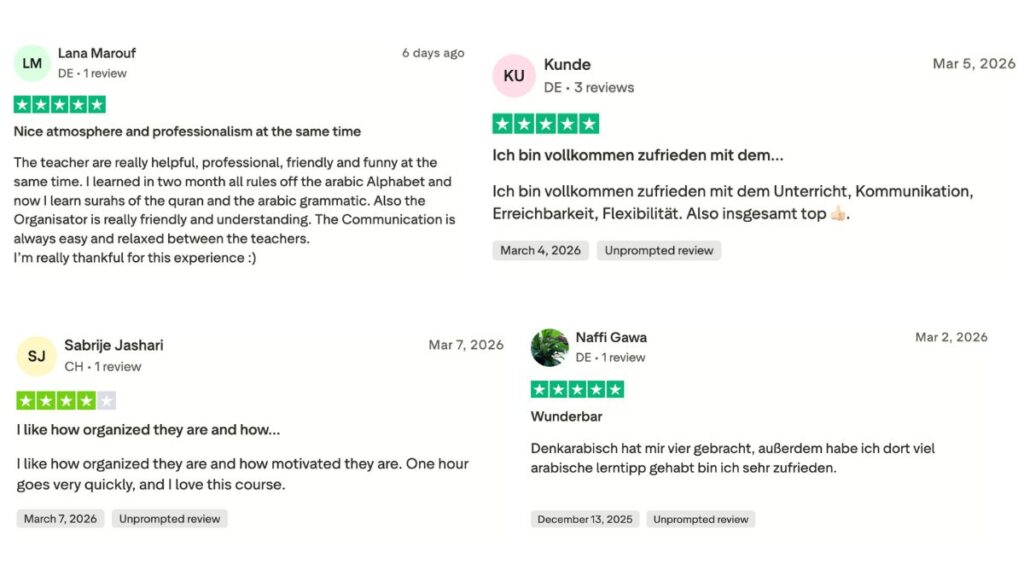
What Our Students Say About Denk Arabisch Academy
See what our students say about learning at Denk Arabisch Academy on Trustpilot. Read their experiences and check out more reviews to discover how our courses help improve Arabic.
Modern Tools to Help Children Memorize The Quran
While traditional methods are best, technology can be a great ally:
1. Hifz Apps: Apps like Quran Companion or Tarteel use AI to track progress and correct mistakes.
2. Online Quran Schools: If you don’t have access to a local teacher, online platforms offer one-on-one sessions with qualified tutors.
3. Digital Pens: These can help children listen to specific words they find difficult to pronounce.
The Importance of Revision The Quran For Kids (Muraja’ah)
There is a famous saying among teachers of the Quran: “Hifz is easy, but keeping it is hard.” The Prophet (Piece Be Upon Him) likened the Quran in the heart to a tethered camel; if you don’t look after it, it will slip away. Ensure your child has a structured revision plan. A Hafiz who does not revise is like someone pouring water into a leaking bucket.
Master Quran Hifz with Denk Arabisch
Memorizing the Quran is a life-changing milestone, but without the right system, it can feel like an uphill battle. At Denk Arabisch, we transform Hifz from a task of “repeating words” into a journey of deep cognitive mastery.
- Logic-Based Memorization: We don’t just help you memorize; we help you understand the Arabic root system (Radicals). When you know the meaning behind the verses, the words lock into your memory naturally.
- Precision Tajweed Integration: Never memorize a mistake again. Our platform ensures your Makharij and Ghunnah are perfect from day one, so your Hifz is as beautiful as it is accurate.
- Structured Retention System: We use the traditional Sabaq, Sabqi, and Manzil routine, enhanced by modern digital tracking to ensure you never forget a single Ayah.
👉 Ready to begin your Hifz journey?
Don’t just memorize—comprehend.
Our Courses Include:
- Arabic Courses for German Speakers
- Arabic Levels for German Speakers
- Arabic Dialect Courses for German Speakers
- Qur’an Learning Courses for German Speakers
- Islamic Studies Courses for German Speakers
- Courses for Muslim Kids for German Speakers
Join our Quran Tajweed Courses today and build a relationship with the Book of Allah that lasts a lifetime.
[Start Your Journey at Denk Arabisch]
Learn the Quran with Denk Arabisch Academy
Master reading and understanding the Quran through structured and supportive learning
Try a Free Trial
Conclusion
Memorizing the Quran is not a race; it is a life-long relationship. The goal is not just to finish the 30th Juz, but to build a child who lives by the values of the Quran—honesty, kindness, and discipline.
When your child completes their Hifz, they haven’t just memorized a book; they have developed a “super-memory,” mastered a second language, learned the art of patience, and gained a spiritual compass that will guide them through the complexities of adulthood.
FAQs
1. What is the “ideal” age to start Hifz?
While every child is unique, the window between 5 and 7 years old is widely considered the “Golden Age.” At this stage, the brain is like a sponge for phonetic sounds (Tajweed) and hasn’t yet been occupied by the heavy academic loads of later schooling. However, passive listening should start from the cradle.
2. My child struggles with focus. Should I stop Hifz?
Not at all. In fact, Hifz is a “muscle” that builds focus over time. If your child is struggling, try the “15-Minute Rule”: instead of one long hour, do three 15-minute sessions throughout the day. Short, high-intensity bursts are much more effective for young minds than long, draining sessions.
3. How do I handle “Mutashabihat” (Verses that sound similar)?
It is very common for children to get confused between verses that start or end similarly.
The Solution: Use a Visual Map. Circle the specific word that differs in a specific color. Explain the meaning of that specific word; once the child understands why the word is different (the context), the brain stores it in a different “folder” than the similar verse.
4. Should my child finish the Qaida/Nazira before starting Hifz?
Ideally, yes. A strong foundation in Nazira (reading fluently while looking) and Tajweed (rules of pronunciation) ensures that the child doesn’t “lock in” mistakes. It is much harder to unlearn a wrong pronunciation than to learn it correctly from the start.
5. What if my child forgets what they memorized last year?
This is the most common fear. Forgetfulness is a natural part of the journey. This is why Manzil (Distant Review) is non-negotiable. A Hafiz is not someone who memorized the Quran once; a Hafiz is someone who recites it daily for life. If they forget, simply re-incorporate that portion into the daily review until it’s strong again.
6. Is it okay to use rewards or “bribes” for Hifz?
There is a fine line between a bribe and an incentive. While we want the intention (Niyyah) to be for Allah, children operate on “tangible wins.” Small rewards (stickers, extra playtime, a favorite meal) help build a positive emotional association with the Quran. As they grow older, their internal motivation will naturally replace the external rewards.