Spiritual Benefits Of Reading The Quran – A Complete Guide For The Heart And Soul
02.05.2026
Takeaway:
Reading the Quran instills deep spiritual peace (Sakinah) that counters anxiety and lowers stress.
It acts as a mirror for self-purification, exposing the soul’s flaws and guiding refinement.
It connects you directly to God like a lifeline, offering real-time guidance for life’s struggles.
Its verses heal hidden emotional wounds such as grief, loneliness, arrogance, and hopelessness.
It builds mindful God‑consciousness (Taqwa), awakening you from spiritual heedlessness.
It marries intellect and faith through deep reflection, not blind belief.
It serves as a spiritual shield in this life and an intercessor in the afterlife.
It fosters deep love for the Creator, turning worship from obligation into heartfelt devotion.
Consistency matters most; a few verses read daily with reflection can transform the heart more than sporadic long readings.
In an era defined by digital noise, relentless productivity, and an often-overwhelming sense of existential “drift,” the human soul frequently finds itself parched. While we tend to our physical health with diets and our mental health with therapy, the spiritual heart (the Qalb) requires its own unique form of sustenance.
For over 1.8 billion people, that sustenance is found in the Quran—not merely a book of laws or historical accounts, but a living, breathing “revelation” intended to guide, heal, and transform. Reading the Quran is often described as entering into a private conversation with the Creator.
Here, we explore the profound spiritual benefits of engaging with the Quran, examining how this ancient text serves as a modern-day anchor for the soul.
Spiritual Benefits Of Reading The Quran
Table of Contents
1. Achieving “Sakinah”: The Descent of Allah’sTranquility
In the fast-paced modern world, anxiety is often the default state. The Quran offers an immediate antidote through a concept known as Sakinah (deep, spiritual peace).
“Verily, in the remembrance of Allah do hearts find rest” (Surah Ar-Ra’d: 28).
This isn’t just poetic sentiment; it describes a physiological and spiritual shift.
The Power of Sound: Even for those who do not speak Arabic, the rhythmic, melodic nature of Quranic recitation (Tajweed) has a documented calming effect on the nervous system, lowering cortisol levels and centering the mind.
Why it Matters:
When you read the Quran, you are stepping out of the “chronos” (linear, stressful time) and into a space of “kairos” (spiritual time). This transition allows the spirit to breathe, shedding the weight of worldly expectations.
Denk Arabisch Insight: Our Quran Tajweed Course for German Speakers is designed to help you master these rhythms, ensuring your recitation becomes a source of true tranquility.
2. Self-Awareness and Purification
One of the most transformative spiritual benefits of the Quran is its role as a mirror. It doesn’t just tell you about the world; it tells you about you.
The Process of Tazkiyah (Purification)
The Quran identifies various states of the soul:
1. Nafs al-Ammara: The soul prone to evil or ego-driven desires.
2. Nafs al-Lawwama: The self-reproaching soul that seeks to improve.
3. Nafs al-Mutma’inna: The soul at peace.
Reading the Quran regularly forces a process of Tazkiyah al-Nafs (purification of the soul). It highlights our biases, our arrogance, and our weaknesses, not to condemn us, but to provide a roadmap for refinement.
It encourages the reader to shed the “rust” of sin and distraction, polishing the heart until it can reflect Divine light.
“He has succeeded who purifies it (the soul), and he has failed who instills it [with corruption].” (Surah Ash-Shams: 9-10)
3. Strengthening the “Habl” (Allah’s Cord)
In Islamic theology, the Quran is referred to as Habl Allah (حبل الله)—the Rope of Allah. Spiritually, reading the Quran is the act of holding onto that rope.
Direct Communication: Unlike other forms of worship that may feel one-sided, reading the Quran is perceived as Allah speaking directly to the reader.
Guidance in Real-Time: Many practitioners report the phenomenon of opening the Quran to a random page and finding a verse that addresses their exact current struggle. This reinforces a sense of being seen and heard by the Divine.
The Verse:
“وَاعْتَصِمُوا بِحَبْلِ اللَّهِ جَمِيعًا وَلَا تَفَرَّقُوا” (سورة آل عمران: 103)
“And hold firmly to the rope of Allah all together and do not become divided.” (Surah Ali ‘Imran: 103)
The Quran describes itself as a Shifa (healing) for what is in the hearts. While it contains guidance for the body, its primary medicinal focus is the spirit.
Spiritual Ailment
Quranic Remedy
Grief/Sorrow
Stories of the Prophets (Yusuf, Maryam) showing light after darkness.
Loneliness
Verses emphasizing Allah’s closeness (“closer than the jugular vein”).
Arrogance
Reminders of the vastness of the universe and our humble origins.
Hopelessness
Repeated emphasis on Mercy ($Ar-Rahman$) and Forgiveness ($Al-Ghaffur$).
By engaging with these verses, the reader undergoes a form of spiritual alchemy, where pain is transformed into patience (Sabr) and fear is transformed into trust (Tawakkul).
Taqwa is often translated as “God-fearing,” but spiritually, it is better understood as God-consciousness or “mindful awareness.”
Reading the Quran sharpens this internal compass. It creates a state of “spiritual alertness” where a person becomes more aware of the moral consequences of their actions.
This consciousness isn’t about living in fear; it’s about living with intentionality. It prevents the soul from falling into Ghaflah (heedlessness)—the spiritual state of “sleepwalking” through life.
The Quran repeatedly asks its readers: “Do you not reflect?” or “Do you not use your intellect?” The spiritual benefit here is the intertwining of the mind and the heart. Unlike paths that require “blind faith,” the Quran encourages “contemplative faith” (Tadabbur).
Expansion of Perspective: Reading about the cosmos, biology, and history within a spiritual framework expands the reader’s worldview.
Cognitive Clarity: It provides a coherent framework for understanding suffering, success, and the afterlife, which settles the “intellectual anxiety” that often plagues the modern seeker.
“Then do they not reflect upon the Quran, or are there locks upon [their] hearts?” (Surah Muhammad: 24)
Spiritual Benefits Of Reading The Quran
7. Intercession and Protection in the Unseen
From a metaphysical perspective, the Quran is believed to have a “presence” that transcends the physical book.
The Light in the Grave: Islamic tradition teaches that the Quran will act as an intercessor for its companion in the afterlife.
Spiritual Shield: Specific chapters, such as Al-Baqarah or Al-Kahf, are cited as protections against spiritual harms (the “evil eye,” envy, or demonic whispers).
The Barakah (Blessing): Beyond the literal meaning, there is an inherent Barakah in the words themselves. Reciting them is believed to bring “increase” into one’s time, home, and sustenance.
The Hadith:
قال رسول الله ﷺ: “اقْرَؤُوا القُرْآنَ فإنَّه يَأْتي يَومَ القِيامَةِ شَفِيعًا لأَصْحابِهِ” (رواه مسلم)
The Messenger of Allah (ﷺ) said: “Read the Quran, for it will come as an intercessor for its companions on the Day of Resurrection.” (Narrated by Muslim)
8. Developing Allah’s Love
At its core, the Quran is a testament to the relationship between the Creator and the Created. Regular reading fosters a deep sense of Hubb (Love).
As the reader learns about the attributes of Allah—His Gentleness (Al-Latif), His Loving-Kindness (Al-Wadud), and His Wisdom (Al-Hakim)—the relationship shifts from one of mere obligation to one of profound affection. This love becomes the primary motivator for good character and service to humanity.
The Verse:
“يُحِبُّهُمْ وَيُحِبُّونَهُ” (سورة المائدة: 54)
“He will love them and they will love Him.” (Surah Al-Ma’idah: 54)
9. Practical Tips for Maximum Spiritual Impact
To truly reap these benefits, the method of reading is as important as the act itself.
1. Quality over Quantity: Reading one verse with deep reflection (Tadabbur) is often more spiritually potent than reading a whole chapter without understanding.
2. The “Tahajjud” Connection: Reading the Quran during the pre-dawn hours is highlighted in the text as being “more impactful” (Quran 73:6).
3. Active Listening: If you cannot read, listening to a beautiful recitation with focus can trigger the same “Sakinah” response.
4. Application: Ask yourself: “How can I live this verse today?” The ultimate spiritual benefit is realized when the Quran moves from the tongue to the limbs.
Exercise 1: Matching Quranic Remedies to Spiritual Ailments
Based on the “Ash-Shifa” table provided in the guide, match each spiritual challenge with its correct divine remedy:
— Choose the corresponding remedy —
Repeated emphasis on Divine Mercy (Ar-Rahman) and Forgiveness (Al-Ghaffur).
Verses emphasizing Allah’s closeness (“closer than the jugular vein”).
— Choose the corresponding remedy —
Repeated emphasis on Divine Mercy (Ar-Rahman) and Forgiveness (Al-Ghaffur).
Verses emphasizing Allah’s closeness (“closer than the jugular vein”).
Exercise 2: Identifying the Quranic States of the Soul (Nafs)
Click on the cards that correctly represent a legitimate spiritual state of the soul (Nafs) explicitly mentioned in the purification section of the article:
Nafs al-Ammara (The soul prone to evil or ego-driven desires)
Nafs al-Madiyya (The materialistic or consumerist modern soul)
Nafs al-Lawwama (The self-reproaching soul that seeks to improve)
Nafs al-Mutma’inna (The soul at ultimate peace)
Exercise 3: The Scientific and Spiritual Power of Sakinah
According to the text, how does rhythmic, melodic Quranic recitation (Tajweed) physiologically affect a listener, even if they do not speak Arabic?
Exercise 4: True or False?
In terms of transforming the spiritual heart, reading a few verses consistently every single day with deep reflection (Tadabbur) is far more potent than sporadic, long readings without real understanding.
Exercise 5: Core Spiritual Terminology
The Quran describes itself as a metaphorical rope. In Islamic theology, this direct line of communication and connection to the Creator is referred to as Habl““.
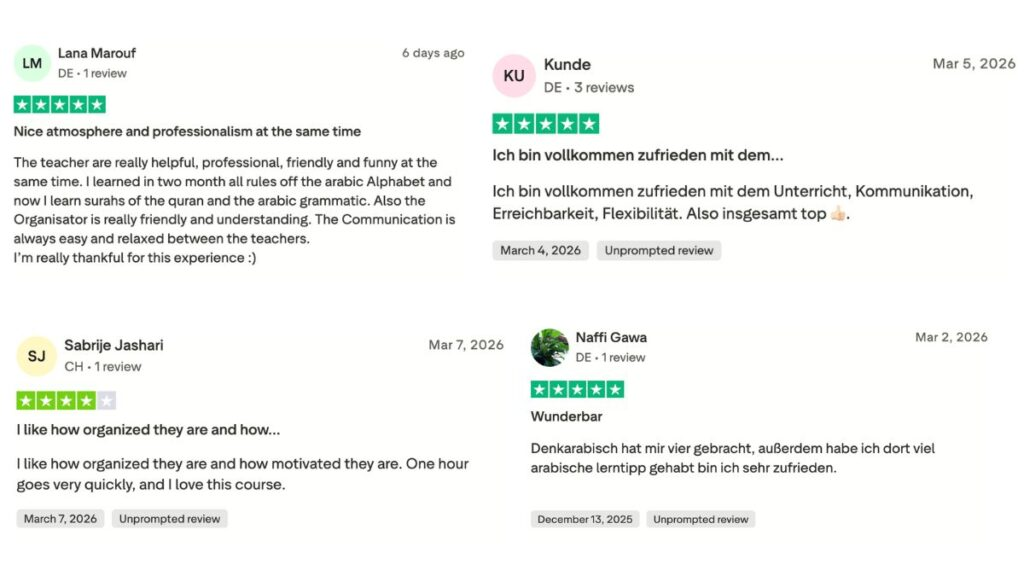
What Our Students Say About Denk Arabisch Academy
See what our students say about learning at Denk Arabisch Academy on Trustpilot. Read their experiences and check out more reviews to discover how our courses help improve Arabic.
Stop “Drifting” and Start Reciting Today!
Knowledge without action is like a parched soul seeing water but never drinking. You’ve read about the tranquility, the healing, and the divine love that the Quran offers—now it’s time to experience it.
At Denk Arabisch, we don’t just teach “lessons”; we provide a spiritual lifeline for Muslims in Germany. Whether you are a beginner looking for a Quran Reading Course, a parent seeking Arabic Lessons for your children, or a student wanting to master Tajweed, we have a seat waiting for you.
Reading the Quran is not a destination; it is a continuous journey. Each time a person approaches the text, they are at a different stage of their life, and thus, the text reveals new layers of meaning.
In the end, the greatest spiritual benefit of the Quran is return. It reminds the soul of its origin and its eventual destination, bridging the gap between the mundane and the Divine. It turns a “lost” individual into a “guided” soul, providing a lighthouse in the often-turbulent seas of human existence.
The Hadith:
قال رسول الله ﷺ: “إنَّ الذي ليس في جوفِه شيءٌ من القرآنِ كالبيتِ الخَرِبِ” (رواه الترمذي)
The Messenger of Allah (ﷺ) said: “The one who has nothing of the Quran inside him is like a ruined house.” (Narrated by Al-Tirmidhi)
By opening the Book, you are essentially opening the door to that house, inviting light, order, and peace back into the center of your being.
FAQs
1. What is the best time to read the Quran for spiritual growth?
While the Quran can be read at any time, the early morning (Fajr) and the last third of the night (Tahajjud) are spiritually significant. These times offer the quietude necessary for deep reflection and heart-to-heart connection with the Divine.
2. Can I get spiritual benefits if I don’t understand Arabic?
Yes. While understanding the meaning is vital for guidance, the melodic recitation itself has a spiritual and physiological calming effect. However, it is highly recommended to read a translation alongside the Arabic to allow the message to transform your intellect and character.
3. How often should I read the Quran to feel its effects?
Consistency (Istiqamah) is more important than volume. Reading a small amount—even just a few verses daily—is better than reading large portions sporadically. The heart requires regular “feeding” to stay alive and healthy.
4. What should I do if I feel my heart is “locked” or heavy when reading?
This is a common experience caused by spiritual “rust” or distractions. Start by asking for protection (Istia’dhah), read slowly, and perhaps listen to a moving recitation. Often, the heart opens gradually as you persist in your effort.
Um dir ein optimales Erlebnis zu bieten, verwenden wir Technologien wie Cookies, um Geräteinformationen zu speichern und/oder darauf zuzugreifen. Wenn du diesen Technologien zustimmst, können wir Daten wie das Surfverhalten oder eindeutige IDs auf dieser Website verarbeiten. Wenn du deine Einwillligung nicht erteilst oder zurückziehst, können bestimmte Merkmale und Funktionen beeinträchtigt werden.
Funktional
Always active
Die technische Speicherung oder der Zugang ist unbedingt erforderlich für den rechtmäßigen Zweck, die Nutzung eines bestimmten Dienstes zu ermöglichen, der vom Teilnehmer oder Nutzer ausdrücklich gewünscht wird, oder für den alleinigen Zweck, die Übertragung einer Nachricht über ein elektronisches Kommunikationsnetz durchzuführen.
Präferenzen
Die technische Speicherung oder der Zugriff ist für den rechtmäßigen Zweck der Speicherung von Präferenzen erforderlich, die nicht vom Abonnenten oder Benutzer angefordert wurden.
Statistiken
Die technische Speicherung oder der Zugriff, der ausschließlich zu statistischen Zwecken erfolgt.Die technische Speicherung oder der Zugriff, der ausschließlich zu anonymen statistischen Zwecken verwendet wird. Ohne eine Vorladung, die freiwillige Zustimmung deines Internetdienstanbieters oder zusätzliche Aufzeichnungen von Dritten können die zu diesem Zweck gespeicherten oder abgerufenen Informationen allein in der Regel nicht dazu verwendet werden, dich zu identifizieren.
Marketing
Die technische Speicherung oder der Zugriff ist erforderlich, um Nutzerprofile zu erstellen, um Werbung zu versenden oder um den Nutzer auf einer Website oder über mehrere Websites hinweg zu ähnlichen Marketingzwecken zu verfolgen.