Takeaway:
- Arabic consonants are the core of the language: carrying meaning, structuring rhythm, and forming the foundation for correct reading, Quran recitation, and prayer.
- Almost all 28 letters function as consonants; Wāw (و) and Yā’ (ي) can also act as long vowels.
- The Sukun (ْ) marks a consonant without a following vowel – it creates a sharp stop and is essential for precise pronunciation.
- Arabic uses 4 emphatic (dark) consonants – Ṣād (ص), Ḍād (ض), Ṭā’ (ط), Ẓā’ (ظ) – that are produced with a raised tongue and heavy resonance; swapping them with light counterparts changes meaning.
- Guttural sounds (Ḥā’ ح, ‘Ayn ع, Khā’ خ, Ghayn غ, Qāf ق) engage deep throat articulation, which is often unfamiliar to English and German speakers.
- Every Arabic word is built on a 3-consonant root that carries the core meaning; recognising radicals makes vocabulary systematic and predictable (e.g., K-T-B = writing).
- Short vowels are diacritical marks (Fatḥah, Kasrah, Ḍammah) that modify consonants; long vowels are written using Alif, Wāw, Yā’. Both together determine grammar and word meaning.
- Mastering consonants requires live feedback and muscle-memory training; reading alone without correction reinforces mistakes.
Arabic consonants are the bedrock of the language. If you are looking to master Arabic—especially for reading the Quran or deepening your understanding of daily prayers—mastering these sounds is your first essential milestone.
Many beginners in the expat community underestimate their importance. They often dive straight into vocabulary or grammar without truly grasping the phonetics. This is where most hurdles begin. In this guide, we provide a clear, structured roadmap to help you navigate:
Table of Contents
What Are Arabic Consonants? الحروف الساكنة (Al-Ḥurūf al-Sākina)
In Arabic, consonants are known as “al-ḥurūf al-sākina” (الحروف الساكنة), which literally translates to “the resting letters.” This name is perfect: a consonant on its own is “silent” or “still.” It requires the support of vowels (Harakat) to vibrate and be brought to life in speech.
The Structure of the Alphabet
The Arabic alphabet consists of 28 letters. A major difference for those used to the Latin alphabet is the fluid boundary between consonants and vowels:
- Primary Consonants: Almost all 28 letters function primarily as consonants.
- Semi-Vowels: The letters Wāw (و) and Yā’ (ي) are unique. They can act as consonants (similar to the English “w” or “y”) but also serve as long vowels (“ū” and “ī”).
- The Sukun (ْ): In Arabic phonology, the Sukun is indispensable. It is a small circle above a letter indicating that the consonant is pronounced without a following vowel. It creates a crisp, precise stop in the flow of speech.
How Many Consonants Are In Arabic?
While the English alphabet has 21 consonants and the German has 21 (excluding umlauts), Arabic offers a much broader spectrum with 28 consonants.
A Richness of Sound
This variety makes Arabic incredibly expressive. For learners in Germany, this means training your vocal apparatus in entirely new ways. Many Arabic sounds are produced in the throat and larynx—areas that are rarely used with such precision in English or German.
The Complete Arabic Consonant List
Here is an overview of the 28 letters with English comparisons for your practice:
| Letter | Name | Comparison / Description | Example |
| أ | Alif/Hamza | A brief stop (like in “uh-oh”) | Ra’s (Head) |
| ب | Bā’ | Like English/German “B” | Bahr (Sea) |
| ت | Tā’ | Like English/German “T” | Bayt (House) |
| ث | Thā’ | Like English “th” in “think” | Thalj (Snow) |
| ج | Jīm | Like “J” in “Jam” | Jamal (Camel) |
| ح | Ḥā’ | Sharp, breathed throat-H | Ḥub (Love) |
| خ | Khā’ | Like “ch” in German “Bach” | Khubz (Bread) |
| د | Dāl | Like English/German “D” | Dars (Lesson) |
| ذ | Dhāl | Like English “th” in “this” | Dhahab (Gold) |
| ر | Rā’ | A rolled lingual “R” (Spanish/Italian style) | Raml (Sand) |
| ز | Zā’ | A buzzing, voiced “Z/S” (like “Zebra”) | Zahra (Flower) |
| س | Sīn | A sharp, voiceless “S” (like “Snake”) | Sama (Sky) |
| ش | Shīn | Like English “Sh” or German “Sch” | Shams (Sun) |
| ص | Ṣād | Dark, emphatic “S” | Misr (Egypt) |
| ض | Ḍād | Dark, emphatic “D” | Fadl (Grace) |
| ط | Ṭā’ | Dark, emphatic “T” | Matbakh (Kitchen) |
| ظ | Ẓā’ | Dark, voiced “Th” | Mazhar (Appearance) |
| ع | ‘Ayn | Deep, pressed throat sound | Sa’d (Happiness) |
| غ | Ghayn | Rubbing “G/R” sound (French style) | Baghdad (Baghdad) |
| ف | Fā’ | Like English/German “F” | Fahm (Understanding) |
| ق | Qāf | Deep “K” spoken in the throat | Farq (Difference) |
| ك | Kāf | Like English/German “K” | Maktab (Office) |
| ل | Lām | Like English/German “L” | Layl (Night) |
| م | Mīm | Like English/German “M” | Māl (Money) |
| ن | Nūn | Like English/German “N” | Nahr (River) |
| ه | Hā’ | Like English/German “H” | Hawa (Air) |
| و | Wāw | Like English “W” | Walad (Boy) |
| ي | Yā’ | Like English “Y” or German “J” | Yad (Hand) |
What Is Arabic Phonology?
Phonology deals with the rules governing how sounds are pronounced and combined. In Arabic, this is particularly fascinating because the meaning of a word often hinges on tiny phonetic details. Understanding Arabic phonology helps you develop a natural-sounding accent that resonates with native speakers.
The Golden Rule: The Sukun (ْ)
The Sukun is a central pillar of Arabic phonology. While English and German grammar don’t have a direct symbol for this, it is vital in Arabic.
- The Meaning: “Sukun” literally means “rest” or “silence.”
- The Function: It tells you that a consonant is “silent” or “at rest,” meaning no vowel follows it.
A Practical Example: The Name Muhammad (مُحَمَّدْ)
Let’s look at the name Muhammad to understand this rule:
- The first letters have vowels (u, a) that guide the flow.
- At the end of the name sits the letter Dāl (د).
- When a Sukun is placed there (دْ), it means the name ends with a sharp, precise stop on the “D.” There is no “De” or “Da” sound at the end—the sound breaks off exactly at the consonant.
Why does this matter? In Arabic phonology, the Sukun acts like an architectural support. It creates the pauses and rhythms that structure the language. Without it, Arabic would lose its characteristic precision.
Pro Tip for Learners: Think of the Sukun as the “Stop Sign” of the Arabic language. It tells you exactly when a consonant must stand alone.
Arabic Consonants List With Examples
Here are selected examples showing consonants with sukūn (ْ) to highlight pronunciation:
- بْ → حَبْل (ḥabl) – rope
- تْ → بَيْت (bayt) – house
- جْ → مَجْلِس (majlis) – council
- حْ → بَحْر (baḥr) – sea
- دْ → وَلَدْ (walad) – boy
- رْ → دَرْس (dars) – lesson
- صْ → مِصْر (Miṣr) – Egypt
- طْ → مَطْبَخ (maṭbakh) – kitchen
- عْ → سَعْد (saʿd) – happiness
- قْ → فَرْقْ (farq) – difference
- مْ → شَمْس (shams) – sun
The sukūn creates a clear stop, making pronunciation sharper and more precise.
Read also: Can You Pray Without Knowing Arabic? – A Full Guide For Muslims
The 3 Consonant Roots
One of the most powerful concepts you’ll explore in our Arabic Courses for German Speakers at Denk Arabisch is the Arabic root system—taught in a simple, structured way that makes vocabulary easier to understand, remember, and use with confidence.
The Logic of Radicals
Almost every Arabic word—especially verbs—is based on a root consisting of three consonants, also called radicals. This root carries the core, abstract meaning of the word.
Example: The Root K-T-B (كتب) The fundamental idea of this root is “Writing.” By adding different vowel patterns or prefixes, dozens of words are born:
- Kataba (كَتَبَ): He wrote.
- Kitāb (كِتَاب): A book (the “written” object).
- Maktab (مَكْتَب): An office or desk (the “place of writing”).
- Kātib (كَاتِب): An author (the “one who writes”).
This structure allows you to decipher the meaning of unfamiliar words just by identifying the three root consonants. It is a modular, logical system that gives Arabic a level of clarity and depth unlike any other language.
Learn Arabic with Denk Arabisch Academy
Speak and understand Arabic through a clear and effective learning system
Try a Free Trial
How To Pronounce Arabic Consonants?
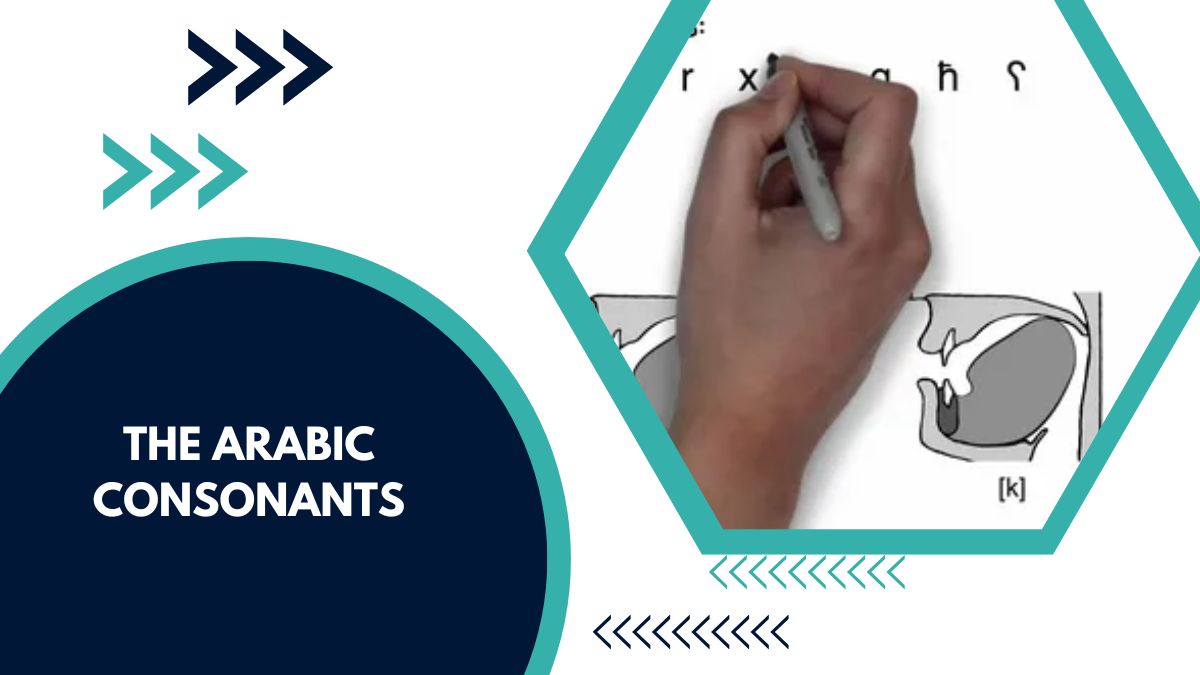
A defining characteristic of Arabic is the presence of emphatic or “dark” consonants. These sounds don’t have a direct equivalent in English or German. They are produced by raising the back of the tongue toward the soft palate, giving the sound a full, “heavy” resonance.
1. The 4 Essential Emphatic (Muphakham) Sounds:
- Ṣād (ص): A dark, heavy “S.” Compared to the “light” English/German “S” (س), it sounds much more voluminous.
- Ḍād (ض): A dark “D.” Arabic is often called “the language of the Ḍād” because this specific sound is almost unique in the world.
- Ṭā’ (ط): An emphatic “T.” It sounds much more powerful than the gentle English or German “t.”
- Ẓā’ (ظ): A dark, voiced “Th” sound (similar to “this” but much deeper).
Getting these right is crucial—swapping an emphatic sound for its “light” counterpart can completely change a word’s meaning.
In our Arabic Speaking Course for German Speakers, we focus on these key distinctions through practical speaking drills and real-time feedback—helping you build confidence and communicate naturally from day one.
2. The Gutturals
The biggest challenge for Western learners is often the guttural sounds. While German speakers might recognize the “ch” (as in “Bach”), Arabic utilizes even deeper regions of the throat.
How to Master the Gutturals:
- Ḥā’ (ح): A sharp, whispered “H.” Imagine you are fogging up a pair of glasses to clean them—but use much more pressure from the throat.
- ‘Ayn (ع): A voiced throat sound created by constricting the pharynx. It sounds unusual to beginners but is essential for a natural accent.
- Khā’ (خ): Similar to the “ch” in the German “Loch” or the Scottish “Loch,” but articulated a bit more roughly.
- Ghayn (غ): A friction-filled “R,” comparable to the French “R,” but with a stronger guttural note.
- Qāf (ق): A deep “K” struck at the very back of the throat. It is vastly different from the standard Kāf (ك), which is spoken at the front of the mouth.
Read also: Meem Sakinah Rules – A Complete Guide
Vowels vs. Consonants
In Arabic, consonants are the architects of the word, while vowels provide the nuances and grammatical function.
The System of Short and Long Vowels
There are six vowels in Arabic:
1. Three Short Vowels (Harakat):
Fatḥah (َ) → “a” → بَ
Kasrah (ِ) → “i” → بِ
Ḍammah (ُ) → “u” → بُ
These appear as small symbols above or below the consonants.
2. Three Long Vowels: Represented by the consonants
Alif (ا) (ā) → با
Wāw (و) (ū) → بو
Yā’ (ي) (ī) → بي
This interplay is called Tashkeel (تشكيل). Without the correct vocalization of consonants, it is often impossible to tell if a word is a subject, an object, or in a specific tense.
Key Differences
| Feature | Consonants | Vowels |
| Function | Carry core meaning | Modify pronunciation |
| Representation | Alphabet letters | Diacritical marks (harakat) |
| Number | 28 | 3 short + 3 long vowels |
Master Arabic pronunciation from the very beginning with our Arabic Vowels Course designed to help you read, speak, and understand Arabic clearly through simple explanations, guided practice, and step-by-step support tailored for German learners.
Read also: Is Learning Arabic Mandatory In Islam? – The Guide For Muslims
Practice Makes Perfect
Mastering Arabic consonants takes time and patience. Here are some proven strategies:
- Listen and Imitate: Use audio resources from native speakers. Pay close attention to the difference between light (ت، س) and dark (ط، ص) sounds.
- Visualization: Imagine where in the throat the sound is being formed. Gutturals often require a conscious tension in the throat muscles.
- The “Old Man” Analogy: A great way to remember the Sukun: A resting consonant is like an old man who cannot stand alone—he always needs a vowel before him to lean on.
- Read Aloud Daily: Even if you don’t know the meaning yet, reading aloud helps train your facial and throat muscles for these new movements.
Following a clear learning plan—like the one at Denk Arabisch —helps you avoid common pitfalls and make much faster progress.
Exercises on the Arabic Consonants
Exercise 1: Classifying Consonant Types
Match each phonetic description with its corresponding group of Arabic consonants:
— Select the group —
Emphatic Consonants (Muphakham)
Guttural Sounds
Semi-Vowels
— Select the group —
Emphatic Consonants (Muphakham)
Guttural Sounds
Semi-Vowels
Exercise 2: Identifying Core Phonological Properties
Click on the cards that accurately describe fundamental phonetic or morphological rules of Arabic consonants detailed in the text:
Wāw (و) and Yā’ (ي) serve a fluid dual function, acting as either primary consonants or long vowels.
Swapping a heavy emphatic consonant with its light counterpart is acceptable and never changes a word’s meaning.
Almost every Arabic word is built on a modular root of 3 consonants that carries its core abstract meaning.
The Sukun (ْ) functions as a stop sign, showing that a consonant is at rest without a following vowel.
Exercise 3: Grammatical Nuances and Diacritics
What structural role do short vowels (Fatḥah, Kasrah, Ḍammah) perform when interacting with Arabic consonants?
Exercise 4: True or False?
According to the guide guidelines, mastering the correct muscle memory and pronunciation of the 28 Arabic consonants can be achieved accurately through reading rules alone, without any live correction or audio feedback.
Exercise 5: Alphabet Spectrum
While Western languages like English or German utilize 21 consonant sounds, the Arabic language contains a broader phonetic spectrum consisting of exactly ““ consonants/letters.
What Our Students Say About Denk Arabisch Academy
See what our students say about learning at Denk Arabisch Academy on Trustpilot. Read their experiences and check out more reviews to discover how our courses help improve Arabic.

Master Arabic The Right Way — Start Now With Denk Arabisch
You’ve seen how important Arabic consonants are. But the truth is, you can’t master them through reading alone.
❌ No Feedback = incorrect pronunciation becomes a habit
❌ No System = slow, frustrating progress
❌ No Instructor = uncertainty when speaking
This is where Denk Arabisch makes the difference.
Our Courses Include:
- Arabic Courses for German Speakers
- Arabic Levels for German Speakers
- Arabic Dialect Courses for German Speakers
- Qur’an Learning Courses for German Speakers
- Islamic Studies Courses for German Speakers
- Courses for Muslim Kids for German Speakers
Why our students learn faster:
✔ Structured learning plans designed specifically for German speakers.
✔ Live classes with direct feedback on your pronunciation.
✔ A focus on the Quran, reading, and genuine language comprehension.
✔ A clear step-by-step method—no chaos, no guesswork.
Your shortcut to perfect pronunciation
Imagine reading Arabic fluently and correctly, understanding the structure of every word, and speaking with confidence instead of hesitation.
Join us today and take your first real step toward Arabic Speaking fluently.
Learn Arabic with Denk Arabisch Academy
Speak and understand Arabic through a clear and effective learning system
Try a Free TrialConclusion
Arabic consonants are the foundation of the entire language. Without them, correct reading and true understanding are impossible. They carry the meaning of words, dictate the rhythm of the language, and play a central role in the Quran and prayer.
While some sounds may seem difficult at first, experience shows that with the right method and regular training, these hurdles can be overcome quickly. Success isn’t about instant perfection; it’s about building a solid foundation and practicing consistently. Once you understand the consonants, the internal logic of the Arabic language finally clicks into place.
FAQs
1. Is the Arabic alphabet difficult for German speakers to learn?
While the script looks different, it is actually quite logical. For German speakers, the challenge isn’t the number of letters (28) but rather the articulation points in the throat. However, since German already uses guttural sounds (like the “ch” in Bach), you already have a head start compared to English-only speakers!
2. What is the hardest Arabic consonant to pronounce?
Most learners find the ‘Ayn (ع) and the Ḍād (ض) to be the most challenging. The ‘Ayn requires a constriction of the throat that is rare in Western languages, and the Ḍād is so unique that Arabic is often called “the language of the Ḍād” (Lughat al-Ḍād). In our courses, we use specific physical drills to help you find these “hidden” muscles.
3. Why do some letters look different depending on where they are in a word?
Arabic is a cursive script, meaning letters connect like handwriting. Most consonants have four forms: Isolated, Initial, Medial, and Final. While this sounds intimidating, the “skeleton” of the letter usually remains the same—only the “hooks” for connecting change.
4. Can I learn to read Arabic without learning the Sukun?
Technically, you can recognize words, but you won’t be able to pronounce them correctly. The Sukun is what gives Arabic its rhythmic “staccato” feel. Without it, you might accidentally add vowels where they don’t belong, which can change the meaning of a word entirely.
5. How long does it take to master the pronunciation of all 28 consonants?
With consistent daily practice and professional feedback, most students can accurately identify and produce all 28 sounds within 4 to 6 weeks. The key is “muscle memory”—training your tongue and throat just like you would train at the gym.
6. Do I need to learn the consonants before I start learning vocabulary?
Yes. Because Arabic is a root-based language, being able to identify the three core consonants (radicals) of a word is the “secret key” to unlocking its meaning. If you can’t distinguish the consonants, you can’t use a dictionary effectively or understand word patterns.