Takeaway:
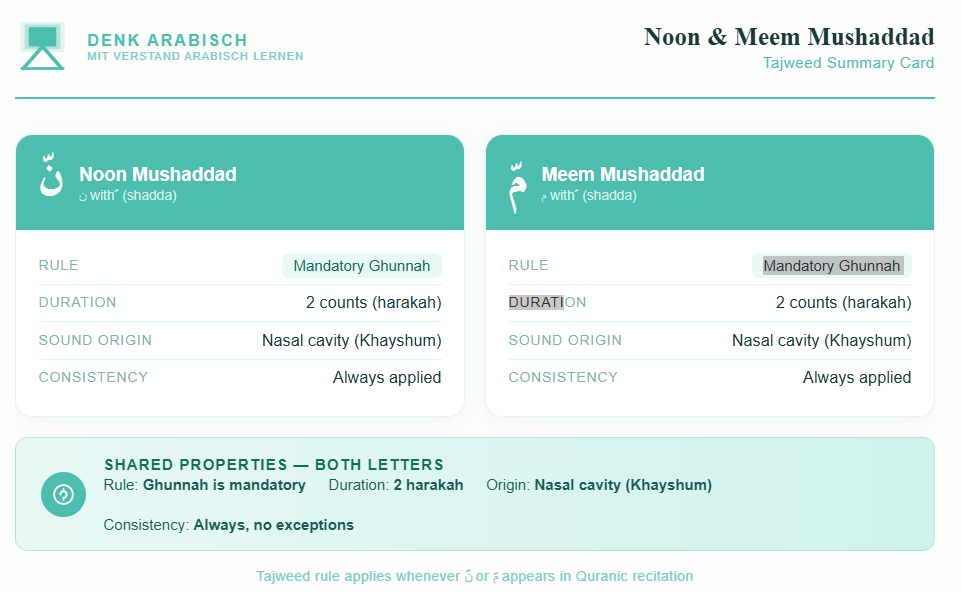
- The ruling for Noon (نّ) and Meem (مّ) with a shaddah is always a mandatory ghunnah (nasalization) lasting exactly two counts.
- A mushaddad letter is two identical consonants merged: the first has no vowel, the second is voweled, written with a shaddah (ّ).
- Ghunnah sound is produced entirely from the nasal passage (khayshum), not the mouth, and the duration never changes.
- The rule applies everywhere—mid-word or word-final, even when stopping (waqf) on the word.
- Common mistakes: cutting ghunnah to one count, humming from the mouth or throat, or releasing the tongue/lips before the two counts end.
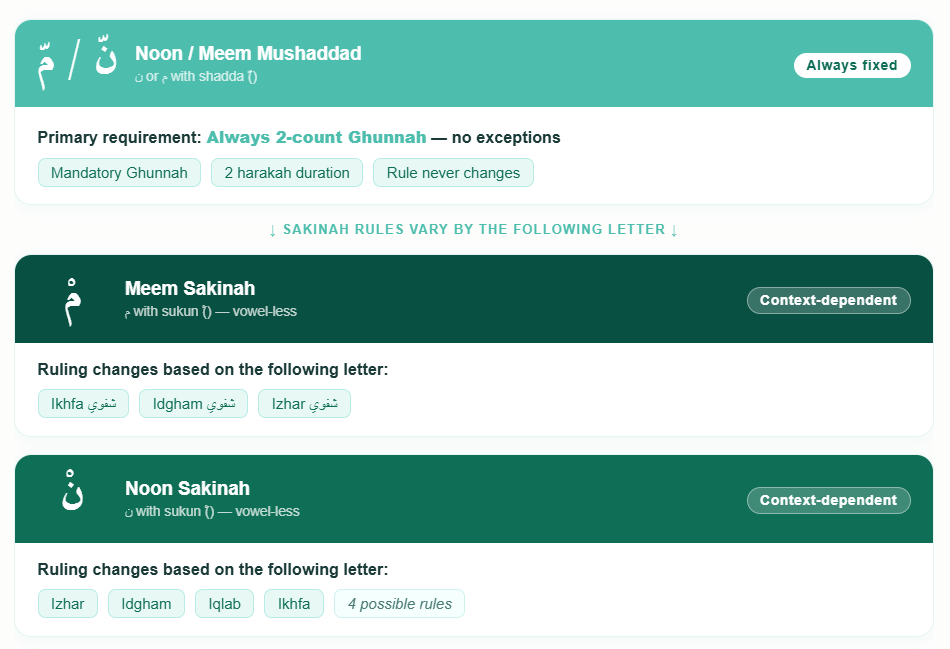
- Noon and Meem mushaddad differ from Noon/Meem sakinah (نْ / مْ), whose rules change based on the next letter; mushaddad letters always demand ghunnah.
- Frequent Quran examples: إِنَّا, عَمَّ, ثُمَّ, النَّاسِ, حَمَّالَةَ, with the doubled sound shaping the verse’s rhythm.
Every letter of the Quran carries a level of precision that demands a reciter’s full attention. Among the most fundamental yet consequential rules in Tajweed is the treatment of the mushaddad letter—specifically the Noon (نّ) and Meem (مّ).
Mastering these rules transforms a mechanical reading into genuine Tarteel, bringing out the resonant beauty and rhythm inherent in the Divine words. In this guide, we will break down the meaning of mushaddad, provide clear examples, and offer practical tips to perfect your nasalization (Ghunnah).

Table of Contents
What is a Mushaddad Letter?
The word mushaddad (مُشَدَّد) comes from the Arabic root sh-d-d, meaning to strengthen or intensify. In the context of Tajweed, a mushaddad letter is any letter that carries a Shaddah (ّ).
The Anatomy of a Shaddah
Technically, a mushaddad letter represents two identical consonants fused together:
1. The first letter is Sakin (vowel-less).
2. The second letter is Mutaharrik (voweled).
Through a process called Idgham (merging), they are written as one letter with a Shaddah above it. While almost any Arabic letter can be mushaddad, the Noon and Meem are unique because they trigger a mandatory Ghunnah.
👉 At Denk Arabisch, we help you understand Tajweed rules in a simple, structured way with live guidance from qualified teachers.
The Core Rule: Mandatory Ghunnah
The ruling for Noon and Meem Mushaddad is unambiguous: Whenever these two letters carry a Shaddah, a full Ghunnah is obligatory (Wajib).
- What is Ghunnah? It is a resonant nasal sound produced entirely from the Khayshum (nasal passage), not the mouth.
- The Duration: The Ghunnah must be held for exactly two counts (two harakah), which is roughly the time it takes to tap your finger twice.
Position Matters
This rule applies regardless of where the letter appears in the word or how you are reciting:
- Middle of a word: (e.g., إِنَّا, مُحَمَّدٌ) — Ghunnah is required.
- End of a word: (e.g., ثُمَّ, فِيهِنَّ) — Ghunnah is required even if you pause (Waqf) on the word.
👉 With Denk Arabisch, you don’t just learn rules—you practice them with correction. Our teachers help you fix Ghunnah timing, articulation, and rhythm in real time.
Noon Mushaddad (نّ) Examples
The Noon Mushaddad appears frequently in Quranic pronouns and emphasis particles.
Quranic Examples
- Example 1:
إِنَّا أَعْطَيْنَاكَ (سورة الكوثر)
“Indeed, We have granted you…” (Surah: Al-Kawthar)
- Transliteration: Innā a‘taynāka
- Tajweed Explanation: The word (Innā) starts with a Noon Mushaddad. You must hold the “N” sound with resonance from the nose before moving to the Alif.
- Example 2:
مِنَ الْجِنَّةِ وَالنَّاسِ (سورة الناس)
“…from the jinn and mankind.” (Surah: Al-An-Nas)
- Transliteration: …wal-nnās
- Tajweed Explanation: The word (An-Nās) contains a Noon Mushaddad due to the merging of the “Lam”. Hold the “N” for two counts with a clear nasal ring.
- Example 3:
وَأَنَّهُ هُوَ أَغْنَىٰ (سورة النجم)
“And that it is He who enriches…” (Surah: An-Najm)
- Transliteration: Wa annahu huwa…
- Tajweed Explanation: In (Annahu), the Noon is doubled. Ensure the tongue stays fixed at the articulation point while the sound flows through the nose.
Read also: Ghunnah Rules In Tajweed – A Complete Guide With Examples

Meem Mushaddad (مّ) Examples
The Meem Mushaddad requires the lips to be pressed together firmly while the sound resonates through the nose.
Quranic Examples
- Example 1:
عَمَّ يَتَسَاءَلُونَ (سورة النبأ)
“About what are they asking?” (Surah: An-Naba)
- Transliteration: Amma yatasa’alūn
- Tajweed Explanation: A very common example. The Meem in (‘Amma) must be held. A frequent error is reciting it too quickly like a normal “M.”
- Example 2:
فَأَمَّا الْيَتِيمَ (سورة الضحى)
“So as for the orphan…” (Surah: Ad-Duha)
- Transliteration: Fa-amma l-yatīma
- Tajweed Explanation: The Meem in (Amma) is Mushaddad. Keep the lips pressed together while the “humming” sound resonates through the nose.
Example 3:
حَمَّالَةَ الْحَطَبِ (سورة المسد)
“The carrier of firewood.” (Surah: Al-Masad)
- Transliteration: Hammālata l-hatab
- Tajweed Explanation:The word (Hammālata) requires focus. The doubling of the Meem is the “soul” of the word’s rhythm. Hold it for two counts.
Learn the Quran with Denk Arabisch Academy
Master reading and understanding the Quran through structured and supportive learning
Try a Free TrialSummary for Noon and Meem Mushaddad
| Feature | Noon Mushaddad (نّ) | Meem Mushaddad (مّ) |
| Symbol | ن with ّ | م with ّ |
| Rule | Mandatory Ghunnah | Mandatory Ghunnah |
| Duration | 2 Counts (Harakah) | 2 Counts (Harakah) |
| Origin of Sound | Nasal Cavity (Khayshum) | Nasal Cavity (Khayshum) |
| Consistency | Always applied | Always applied |
Noon/Meem Mushaddad vs. Sakinah Rules
It is common for beginners to confuse Mushaddad letters with Noon/Meem Sakinah (vowel-less letters). Here is a quick reference table to distinguish them:
| Rule Type | Symbol | Primary Requirement |
| Noon/Meem Mushaddad | نّ / مّ | Always 2-count Ghunnah. |
| Meem Sakinah | مْ | Ruling changes based on the following letter (Ikhfa, Idgham, or Izhar). |
| Noon Sakinah | نْ | Ruling changes based on the following letter (Izhar, Idgham, Iqlab, or Ikhfa). |
👉 Denk Arabisch helps you distinguish between similar rules like Mushaddad, Sakinah, Ikhfa, and Idgham through easy explanation and repetition practice.
Read also: Noon Sakinah And Tanween Rules – The Ultimate Guide To Tajweed

Common Recitation Errors to Avoid
- The “Short Cut”: Cutting the Ghunnah to only one count. This is the most common error among students.
- Mouth-Resonance: Producing the sound in the throat or mouth rather than the nasal passage.
- The Early Release: Releasing the tongue (for Noon) or the lips (for Meem) before the two counts are finished.
Exercises on Noon And Meem Mushaddad
Exercise 1: Fused Structural Components
A mushaddad letter is anatomically made up of two identical consonants merged together. Match each part with its proper initial state:
— Select the state —
Sakin (vowel-less / carrying no vowel)
Mutaharrik (voweled / carrying a vowel)
— Select the state —
Sakin (vowel-less / carrying no vowel)
Mutaharrik (voweled / carrying a vowel)
Exercise 2: Recitation Pitfalls Checklist
Click on the cards that properly identify common recitation mistakes or bad habits when dealing with Noon and Meem Mushaddad:
The “Short Cut”: Cutting down the mandatory nasalization sound to only a single quick count.
The Early Release: Dropping or moving the tongue or lips before the full structural count is finished.
Mouth-Resonance: Erroneously pulling the humming sound down into the throat or mouth instead of the nasal cavity.
Keeping the nasal humming sound fully sustained even when performing a complete pause (Waqf) at the end of a verse.
Exercise 3: Rule Stability vs. Context Change
How does the core requirement for a Noon or Meem Mushaddad compare to a Noon or Meem Sakinah?
Exercise 4: True or False?
While the timing and the nasal source passage are perfectly identical, executing the Meem Mushaddad requires the lips to be closed gently but firmly, whereas the Noon Mushaddad requires the tip of the tongue to touch the upper gum ridge.
Exercise 5: Rhythmic Duration Metric
Whenever a Noon or Meem carries a Shaddah emblem, a full Wajib Ghunnah resonance is mandatory, which must be held continuously for exactly ““ counts (harakah).
What Our Students Say About Denk Arabisch Academy
See what our students say about learning at Denk Arabisch Academy on Trustpilot. Read their experiences and check out more reviews to discover how our courses help improve Arabic.

Do you want to perfect your Quran recitation with real guidance—not just reading rules?
At Denk Arabisch, we don’t just teach Tajweed… we train you to recite correctly with confidence.
✔ Quran Tajweed Course
✔ Certified Islamic teachers
✔ Step-by-step Tajweed training
✔ Correction of every mistake in real time with Arabic Courses
✔ Courses for beginners, kids, and adults
👉 Stop guessing your recitation.
👉 Start learning the correct way with experts.
Join Denk Arabisch today and transform your Quran recitation from basic reading to beautiful Tarteel.
Learn the Quran with Denk Arabisch Academy
Master reading and understanding the Quran through structured and supportive learning
Try a Free TrialConclusion
Mastering the rules of Noon and Meem Mushaddad is one of the most rewarding steps a student of Tajweed can take. These rules are consistent and universal, appearing in almost every page of the Quran. By giving these two letters their due right—a resonant, two-count Ghunnah—you move beyond simply pronouncing words to capturing the melodic essence of the Divine text.Remember that Tajweed is an oral tradition; while understanding the theory is essential, the “soul” of the rule is found in its application. Consistency is your best teacher. Whether you are reciting a long Surah or a short verse in prayer, treating every نّ and مّ with precision ensures your recitation remains faithful to the way it was taught by the Prophet ﷺ.
FAQs
1. Does the Ghunnah rule change if I stop (Waqf) on a Mushaddad letter?
No, the rule remains the same. If a word ends with a Noon Mushaddad (e.g., $فِيهِنَّ$) or a Meem Mushaddad (e.g., $ثُمَّ$) and you choose to stop there, you must still hold the Ghunnah for two counts before coming to a complete rest.
2. Is there a difference between the Ghunnah of Noon and the Ghunnah of Meem?
The timing (two counts) and the source (nasal cavity) are identical. The only difference is the articulation point:
For Noon, the sound is held while the tip of the tongue touches the upper gum ridge.
For Meem, the sound is held while the lips are gently but firmly closed.
3. Why do some other letters have a Shaddah but no Ghunnah?
The Ghunnah is an inherent quality only of the Noon and Meem. While letters like Baa (بّ) or Kaaf (كّ) can be doubled (Mushaddad), they are pronounced with strength and emphasis (Shiddah) but without any nasal resonance.
4. How can I accurately measure “two counts” (Harakah)?
In Tajweed, a count is a relative measure based on the speed of your recitation. A common practical way to measure it is the time it takes to fold or unfold a finger at a medium pace. Consistency is key; your counts should match the overall tempo of your reading.
5. What happens if I forget the Ghunnah on a Mushaddad letter?
Omitting the Ghunnah is considered a Lahm Khafi (a hidden or minor mistake). While it may not change the literal meaning of the word as drastically as a major mistake, it strips the Quranic recitation of its required beauty and technical precision.
6. Does the Ghunnah sound different depending on the vowel (Fatha, Dammah, Kasra)?
The sound of the Ghunnah itself—the nasal resonance—remains consistent regardless of the vowel. However, the mouth must be prepared to transition into the specific vowel (opening for Fatha, circling the lips for Dammah, or lowering the jaw for Kasra) immediately after the two counts are completed.