Takeaway:
- Use عفوًا (Afwan) as the universal, safest “you’re welcome” in any Arabic-speaking country, especially in formal or Modern Standard Arabic settings.
- For humility and warmth, say لا شكر على واجب (Lā shukra ʿalā wājib) – “no need to thank me, it’s my duty.”
- In Egyptian Arabic, the most common friendly replies are ولا يهمك (Wala yhemmak) – “don’t worry about it” – and على إيه؟ (ʿAlā eih?) – “for what? (it’s nothing).”
- In Levantine Arabic, use ولو (Walaw) – “of course!” – or تكرم (Tikram) – “at your service” – for a warm, generous tone.
- In Gulf Arabic, reply to thanks or apologies with ما عليه (Mā ʿalayh) – “no worries” – and show readiness with أبشر (Abshir) – “consider it done.”
- In Moroccan Arabic, بلا مزية (Bla mziya) means “no need to thank me,” and لا بأس (Lā bās) is used for “it’s okay / no problem.”
- For “no problem,” MSA لا مشكلة (Lā mushkila) works everywhere formally, while dialects prefer their own versions like Egyptian مفيش مشكلة (Mafish mushkila) or Levantine/Gulf عادي (ʿĀdy) – “it’s normal.”
- Apology responses (e.g., for being late) commonly use ولا يهمك, عادي, ما عليه, or لا بأس across different regions, with no direct blame.
- Formal settings call for phrases like على الرحب والسعة (ʿAlā ar-raḥb wa as-saʿa) – “my pleasure” – or من دواعي سروري (Min dawāʿī surūrī) – “it’s my pleasure.”
- Gender matters when addressing someone directly: use masculine endings (e.g., wala yhemmak) for men, feminine (e.g., wala yhemmik) for women.
- Repeating the response (e.g., tikram, tikram) is culturally common to emphasize sincerity and strengthen social bonds.
Arabic is a language rooted in warmth and respect, where communication is about building rapport. Mastering the “art of the response”—how to gracefully accept thanks or ease an apology—is essential for any learner.
Whether in a business meeting or a local café, your choice of words reflects your grasp of social etiquette and the rich variety of Arabic dialects.
This guide covers the best ways to say “You’re Welcome” and “No Problem” in Modern Standard Arabic and various dialects, with German equivalents to help you navigate these nuances with ease.
Table of Contents
Why Is “You’re Welcome” Important In Arabic?
In Arabic-speaking societies, social interactions are often warm and expressive. When someone says thank you “شكرًا” (shukran), it is natural to respond with a phrase that acknowledges their gratitude.
These responses often:
- Show humility (downplaying your help)
- Express generosity and hospitality
- Strengthen personal relationships
Sometimes, the conversation even turns into a friendly exchange of repeated thanks and responses!
Politeness is the first step to making friends in the Arab world. Our Arabic Courses For German Speakers focus on these essential social cues from day one, ensuring you sound natural and respectful.
Ways to Say “You’re Welcome” in MSA
Modern Standard Arabic is used in formal speech, writing, media, and education. These expressions are widely understood across the Arab world.
1. عفوًا (Afwan)
Meaning: You’re welcome
This is the simplest and most widely used phrase. It works in almost every situation—formal or informal.
Example:
- شكرًا لك (Thank you)
- عفوًا (You’re welcome)
2. على الرحب والسعة (ʿAlā ar-raḥb wa as-saʿa)
Meaning: My pleasure
This phrase sounds warm and welcoming. It is often used in formal situations or when you want to sound especially polite.
Example:
- شكرًا لك (Thank you)
- على الرحب والسعة (My pleasure)
3. لا شكر على واجب (Lā shukra ʿalā wājib)
Meaning: No need to thank me / It’s my duty
This expression reflects humility and is commonly used when helping someone feels like an obligation rather than a favor.
Example:
- شكرًا لك (Thank you)
- لا شكر على واجب (No need to thank me)
4. من دواعي سروري (Min dawāʿī surūrī)
Meaning: It’s my pleasure
A slightly formal phrase often used in professional or courteous conversations.
Example:
- شكرًا على تعاونك (Thank you for your cooperation)
- من دواعي سروري (It’s my pleasure)
5. لا عليك (Lā ʿalayk)
Meaning: Don’t mention it / No problem
This phrase is often used to reassure someone, especially after they apologize or thank you.
Example:
- شكرًا إنك استنيتني (Thanks for waiting for me)
- لا عليك (No problem)
Teach your children the beauty of Arabic hospitality early on. Our Courses For Muslim Kids make learning polite expressions fun and engaging for children in Germany.
“You’re Welcome” in Egyptian Arabic
Egyptian Arabic (Masri) is one of the most widely understood dialects due to media and movies.
1. العفو (El-ʿafw)
A direct equivalent of “you’re welcome.”
Example:
- شكرًا لك (Thank you)
- العفو (You’re welcome)
2. ولا يهمك (Wala yhemmak)
Meaning: Don’t worry about it
Very common in daily conversation. It sounds friendly and reassuring.
Example:
- شكرًا إنك ساعدتني (Thanks for helping me)
- ولا يهمك (Don’t worry about it)
3. تحت أمرك (Taḥt amrak / taḥt amrik)
Meaning: At your service
Used to show politeness and willingness to help.
Example:
- شكرًا ليك (Thanks to you)
- تحت أمرك (At your service)
4. على إيه؟ (ʿAlā eih?)
Meaning: For what? (It’s nothing!)
A casual way to downplay what you did.
Example:
- شكرًا على تعبك (Thanks for your effort)
- على إيه؟ (For what?)
“You’re Welcome” in Levantine Arabic
Spoken in countries like Lebanon, Syria, Jordan, and Palestine.
1. ولو (Walaw)
Meaning: Of course!
A very popular, short, and friendly response.
Example:
- شكرًا ليك (Thanks to you)
- ولو (Of course!)
2. تكرم (Tikram)
Meaning: At your service
Used to show generosity and politeness.
Example:
- شكرًا على مساعدتك (Thanks for your help)
- تكرم (At your service)
3. أهلا وسهلا (Ahlan wa sahlan)
A warm welcoming phrase that can also mean “you’re welcome.”
Example:
- شكرًا ليك (Thanks to you)
- أهلا وسهلا (You’re welcome)
4. على عيني (ʿAla ʿayni)
Meaning: With pleasure
This phrase expresses strong willingness and kindness.
Example:
- شكرًا على تعبك (Thanks for your effort)
- على عيني (With pleasure)
MSA is great for reading, but real life happens in dialects. Explore our Arabic Dialect Courses to learn how people actually speak in the streets of Cairo, Dubai, or Beirut.
Read also: Eid Mubarak In Arabic – A Complete Guide
“You’re Welcome” in Gulf Arabic
Used in Saudi Arabia, UAE, Kuwait, and other Gulf countries.
1. أبشر (Abshir)
Meaning: Consider it done
This is more than “you’re welcome”—it shows readiness to help immediately.
Example:
- ممكن تساعدني في الموضوع ده؟ (Can you help me with this?)
- أبشر (Consider it done)
2. ما عليه (Mā ʿalayh)
Meaning: No worries
Often used after an apology.
Example:
- آسف على التأخير (Sorry for being late)
- ما عليه (No worries)
3. حياك الله (Hayyak Allah)
A respectful and welcoming phrase used in polite conversations.
Example:
- شكرًا لك (Thank you)
- حياك الله (You’re welcome)
“You’re Welcome” in Moroccan
Moroccan Arabic has its own unique expressions:
1. بلا مزية (Bla mziya)
Meaning: No need to thank me
Example:
- شكرًا على مساعدتك (Thanks for your help)
- بلا مزية (No need to thank me)
2. يعِيشك (ʿAychek)
A polite and friendly response to thanks.
Example:
- شكرًا ليك (Thanks to you)
- يعيشِك (You’re welcome)
When to Use Each Expression
Choosing the right phrase depends on the situation:
After someone says “Thank you”
- عفوًا
- ولا يهمك
- ولو
After an apology
- لا بأس
- ولا يهمك
- ما عليه
In formal settings
- على الرحب والسعة
- من دواعي سروري
- لا شكر على واجب
With friends or casually
- ولا يهمك
- على إيه؟
- ولو
Why “No Problem” Is Important In Arabic
In Arabic-speaking cultures, communication is warm and considerate. When someone apologizes or says thanks, using phrases like “لا مشكلة” (lā mushkila) helps keep the interaction relaxed and friendly.
These responses often:
- Reassure others
- Show politeness and kindness
- Reduce awkwardness
- Strengthen social connections
Learn Arabic with Denk Arabisch Academy
Speak and understand Arabic through a clear and effective learning system
Try a Free TrialWays to Say “No Problem” in MSA
Modern Standard Arabic is used in formal writing, news, education, and official communication across all Arab countries.
1. لا مشكلة (Lā mushkila)
Meaning: No problem
This is the most direct translation and is widely understood everywhere.
Example:
- هل يمكنك مساعدتي؟ (Can you help me?)
- لا مشكلة (No problem)
2. لا بأس (Lā ba’s)
Meaning: It’s okay / No problem
A soft and polite expression often used when reassuring someone.
Example:
- آسف على التأخير (Sorry for the delay)
- لا بأس (No problem / It’s fine)
3. ليس هناك مشكلة (Laysa hunāk mushkila)
Meaning: There is no problem
More formal and often used in professional or written Arabic.
Example:
- نعتذر عن الخطأ (We apologize for the mistake)
- ليس هناك مشكلة (There is no problem)
4. على راحتك (ʿAlā rāḥtak)
Meaning: Take your time / No problem
Used to make someone feel comfortable.
Example:
- هل أستطيع أن آخذ وقتي؟ (Can I take my time?)
- على راحتك (Take your time / No problem)
“No Problem” in Egyptian Arabic
Egyptian Arabic (Masri) is one of the most widely understood dialects due to Egyptian movies and TV shows.
1. ولا يهمك (Wala yhemmak / yhemmik)
Meaning: Don’t worry about it / No problem
This is the most common response in Egypt.
Example:
- شكرًا على المساعدة (Thanks for the help)
- ولا يهمك (No problem)
2. عادي (ʿĀdy)
Meaning: It’s normal / No problem
Very casual and widely used among friends.
Example:
- آسف إني اتأخرت (Sorry I’m late)
- عادي (No problem)
3. مفيش مشكلة (Mafish mushkila)
Meaning: No problem
A direct and very common phrase.
Example:
- معلش تعبتك معايا (Sorry I bothered you)
- مفيش مشكلة (No problem)
4. تحت أمرك (Taḥt amrak / amrik)
Meaning: At your service
Used to show strong politeness and willingness to help.
Example:
- شكرًا ليك (Thanks to you)
- تحت أمرك (At your service)
Read also: Iftar In Ramadan – The Complete Guide For Muslims
“No Problem” in Levantine Arabic
Levantine Arabic is known for its soft and friendly tone.
1. ولا يهمك (Wala yhemmak)
Same as Egyptian Arabic and extremely common.
Example:
- شكراً كتير (Thanks a lot)
- ولا يهمك (No problem)
2. عادي (ʿĀdi)
Meaning: It’s okay / no problem
Very casual and natural.
Example:
- آسف على الإزعاج (Sorry for bothering you)
- عادي (No problem)
3. ولو (Wlaw / Walaw)
Meaning: Of course / don’t mention it
One of the most iconic Levantine responses.
Example:
- شكراً كتير (Thanks a lot)
- ولو! (Of course!)
4. تكرم (Tikram)
Meaning: You are welcome / at your service
Shows respect and generosity.
Example:
- يسلمو (Thanks)
- تكرم (You’re welcome)
“No Problem” in Gulf Arabic
Gulf Arabic is spoken in Saudi Arabia, UAE, Kuwait, Qatar, Bahrain, and Oman.
1. ما عليه (Mā ʿalayh)
Meaning: No problem / don’t worry
Very common in daily conversation.
Example:
- آسف على الغلط (Sorry for the mistake)
- ما عليه (No problem)
2. أبشر (Abshir)
Meaning: Consider it done / no problem
A strong and polite expression showing readiness to help immediately.
Example:
- ممكن تساعدني؟ (Can you help me?)
- أبشر (Consider it done)
3. عادي (ʿĀdi)
Used just like other dialects: “it’s fine.”
Example:
- تأخرت شوي (I was a bit late)
- عادي (No problem)
4. حياك الله (Ḥayyāk Allāh)
Meaning: Welcome / no problem
Very polite and commonly used in hospitality situations.
Example:
- شكراً على كرمك (Thanks for your generosity)
- حياك الله (You’re welcome)
“No Problem” in Morocco
Moroccan Arabic has unique expressions that differ from the rest of the Arab world.
1. لا بأس (Lā bās)
Meaning: It’s okay / no problem
Similar to MSA but pronounced in a Moroccan way.
Example:
- سمح ليا (Sorry)
- لا بأس (No problem)
2. بلا مزية (Bla mzyya)
Meaning: No need to thank me
Very common in everyday speech.
Example:
- شكراً بزاف (Thanks a lot)
- بلا مزية (No need to thank me)
3. عادي (ʿĀdi)
Also widely used in Morocco among young people.
Example:
- سمح ليا عطلت (Sorry I was late)
- عادي (No problem)

When to Use “No Problem” in Arabic
Choosing the right phrase depends on context:
After someone says “thank you”
- لا مشكلة
- ولا يهمك
- ولو
- مفيش مشكلة
After an apology
- لا بأس
- ما عليه
- ولا يهمك
In formal situations
- لا مشكلة
- ليس هناك مشكلة
- على راحتك
With friends (casual tone)
- عادي
- ولو
- ما عليه
Exercises No Problem / You’re Welcome in Arabic
Exercise 1: Regional Dialect Matching
Match the dialect-specific phrases for saying “you’re welcome” or “no problem” to their respective Arabic regions:
— Select the correct region —
Moroccan Arabic Dialect
Gulf Arabic Dialect
— Select the correct region —
Moroccan Arabic Dialect
Gulf Arabic Dialect
Exercise 2: Identifying Authentic Arabic Social Cues
Click on the cards that correctly describe genuine cultural rules or linguistic behaviors outlined in the guide:
Arabs often repeat politeness phrases multiple times (e.g., Tikram, tikram) to emphasize sincerity and strengthen social bonds.
Gender grammatical endings must be carefully applied, changing “Wala yhemmak” for a man to “Wala yhemmik” for a woman.
Using casual expressions like “عادي” (ʿĀdy) or “على إيه؟” (ʿAlā eih?) is strictly forbidden in informal contexts with close friends.
Modern Standard Arabic (MSA) expressions like “عفوًا” (Afwan) function as the universal safety net understood in any Arab region.
Exercise 3: Professional & Courteous Interactions
Which phrase is specifically highlighted as ideal for formal settings or professional cooperation to say “It’s my pleasure”?
Exercise 4: True or False?
While “لا مشكلة” (Lā mushkila) is perfectly accurate in formal Modern Standard Arabic, it sounds somewhat formal for everyday street life, where native speakers heavily prefer local variations like “مفيش مشكلة” in Egypt or “عادي” across the Levant.
Exercise 5: Universal Vocabulary Mastery
The single most universal, safest standard word used as a direct answer to “Shukran” (Thank you) across all official and casual boundaries in every Arab country is ““.
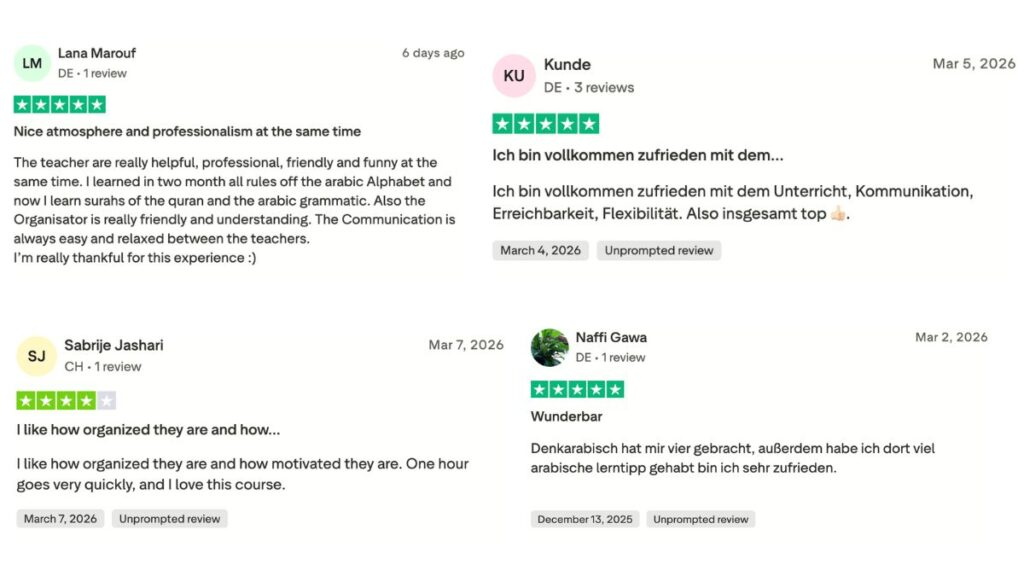
What Our Students Say About Denk Arabisch Academy
See what our students say about learning at Denk Arabisch Academy on Trustpilot. Read their experiences and check out more reviews to discover how our courses help improve Arabic.
Want to speak Arabic quickly and confidently?
Denk Arabisch gives you All Arabic Levels that you need to start speaking real Arabic from day one—no confusion, no unnecessary theory.
✔ Learn essential Arabic phrases fast with Arabic Courses at Denk Arabisch
✔ Understand real dialects (Egyptian, Levantine, Gulf)
✔ Learn everyday Arabic Lessons
✔ Gain confidence in speaking, listening, and responding naturally
Stop struggling with complicated textbooks. Start learning Arabic the smart way with structured lessons designed for real-life use.
Join Denk Arabisch today and start speaking Arabic faster than you ever thought possible.
Learn Arabic with Denk Arabisch Academy
Speak and understand Arabic through a clear and effective learning system
Try a Free TrialConclusion
Choosing the right response to gratitude or an apology is more than just a linguistic task—it is a reflection of social intelligence and cultural appreciation. Whether you opt for the classic “Afwan” in a formal setting or the friendly “Wala yhemmak” while chatting with peers, your choice helps maintain the flow of kindness that characterizes Arabic interactions.
We hope this guide serves as a valuable resource in your journey to discovering the beauty and diversity of the Arabic language. By mastering these small but significant expressions, you are one step closer to communicating with confidence, heart, and true cultural fluency.
FAQs
1. What is the most common way to say “You’re welcome” across all Arabic countries?
The word “Afwan” (عفوًا) is the universal standard. Whether you are in Egypt, Morocco, or Saudi Arabia, everyone will understand this response. It is the safest choice for beginners.
2. Can I use “Ahlan wa Sahlan” to say “You’re welcome”?
Yes! While “Ahlan wa Sahlan” (أهلاً وسهلاً) primarily means “Welcome” (as in welcoming someone to a place), it is very common in Levantine and Egyptian dialects to use it as a warm way of saying “You are welcome” after someone thanks you.
3. Is there a difference between responding to a man versus a woman?
In Modern Standard Arabic and most dialects, the response itself usually stays the same, but the “you” part of the sentence changes. For example:
To a man: Wala yhemmak
To a woman: Wala yhemmik
To a man: Tikram
To a woman: Tikrami
4. Why do Arabs sometimes repeat the response multiple times?
Arabic culture places a high value on generosity and politeness. Repeating phrases like “Wala yhemmak, maffish mushkila” or “Tikram, tikram” is a way to emphasize that the favor was truly no trouble at all and to strengthen the social bond.
5. What is the best response if I accidentally bump into someone?
If you apologize by saying “Asif” (Sorry), the other person will likely respond with “Wala yhemmak” (Don’t worry about it) or “Ma’aleish” (It’s okay/No harm done).
6. Is “La mushkila” used in daily conversation?
While “La mushkila” (لا مشكلة) is perfectly correct, it sounds a bit formal. In daily life, people are more likely to use dialect-specific versions like “Maffish mushkila” (Egypt) or “Ma fi mushkileh” (Levant).