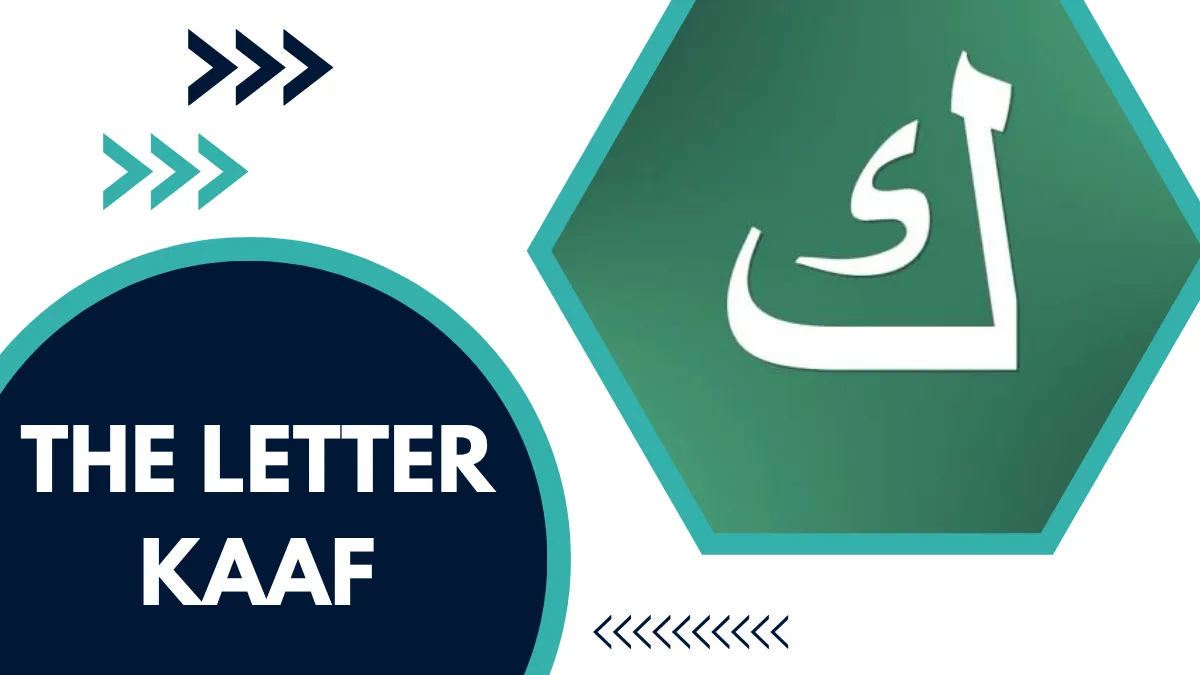
The letter Kaaf (كَاف) is the 22nd letter of the Arabic alphabet. You make its sound by pressing the back of your tongue against the soft palate and releasing a short burst of air. Linguists call it a voiceless velar plosive, written [k] in IPA.
German speakers have a head start. Kaaf sounds like the k in Kind, Katze and Kuh. You already own this sound, so you can focus on writing, rules and a few small traps.
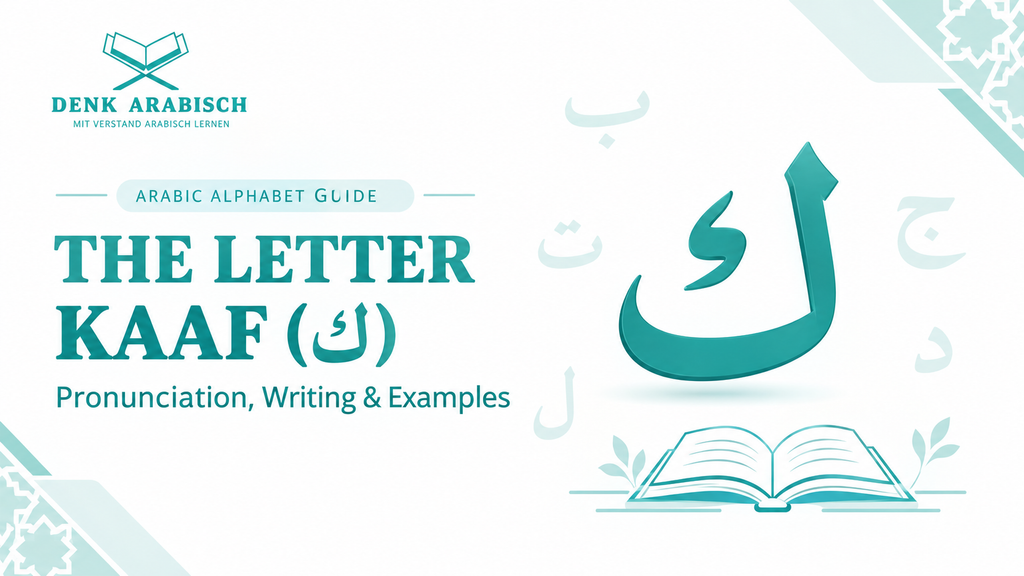
This quick profile gives you Kaaf’s sound, position, value and behavior in one place, so you can return to it whenever you need a fast reminder.
Discover How Many Letters in Arabic? and explore the Arabic alphabet, learn how many letters it contains, and understand how they form the foundation of reading and writing Arabic.
| Fact | Kaaf |
| Name | Kaaf (كَاف) |
| Sound | [k], voiceless velar plosive, as in German Kind, Katze |
| Position in the alphabet | 22nd letter (hijāʾī order) |
| Abjad value | 11th in Abjad order, value 20 |
| Transliteration | Kaaf (common), kāf (DIN 31635), Kaf (simplified); Arabizi: k (no number) |
| Point of articulation | Back of the tongue and soft palate, just in front of Qaaf |
| Sun or Moon letter | Moon letter |
| Heavy or light | Light |
| Dots | None |
| Connection | Connects on both sides (4 forms) |
Table of Contents
The Letter Kaaf (ك) in the Arabic Alphabet: Order, Value and Family
Kaaf is the 22nd letter in the hijāʾī order, the order used in dictionaries and schoolbooks: ا ب ت ث ج ح خ د ذ ر ز س ش ص ض ط ظ ع غ ف ق ك.
In the Abjad order, Kaaf is 11th and has the value 20. This order still matters for numbers and for dates on manuscripts and inscriptions.
How to Recognize Kaaf Among Look-Alikes
Kaaf has no sister letters that share its body shape, so you recognize it by three visual clues instead of dot patterns.
- No dots: Kaaf never carries a dot, above or below.
- Its own small mark: at the start or in the middle of a word, Kaaf has a slanted stroke on top (كـ); at the end or standing alone, it has a small hamza-like mark inside (ك). Laam (ل) never has either.
- A tall stroke: Kaaf shares it with Laam (ل), so check for the small stroke before you decide.
Learn Kaaf and Laam together, and you will stop mixing up the tall-stroke letters.
Why Kaaf Is a Moon Letter
Before a moon letter, the laam of al- is pronounced clearly and carries a sukūn (الْـ). Kaaf is one of the 14 moon letters, all found in the phrase
اِبْغِ حَجَّكَ وَخَفْ عَقِيمَهُ.
- الْكِتَابُ (al-kitābu), the book
- الْكَلْبُ (al-kalbu), the dog
- الْكَبِيرُ (al-kabīru), the big one
In writing, the laam carries a sukūn and Kaaf has no shadda. Compare الشَّمْسُ, where the shadda on the sun letter replaces the laam sound.
Ready to build the whole alphabet on solid ground? The Arabic Alphabet Course at Denk Arabisch teaches all 28 letters with sounds, shapes and German-based explanations.
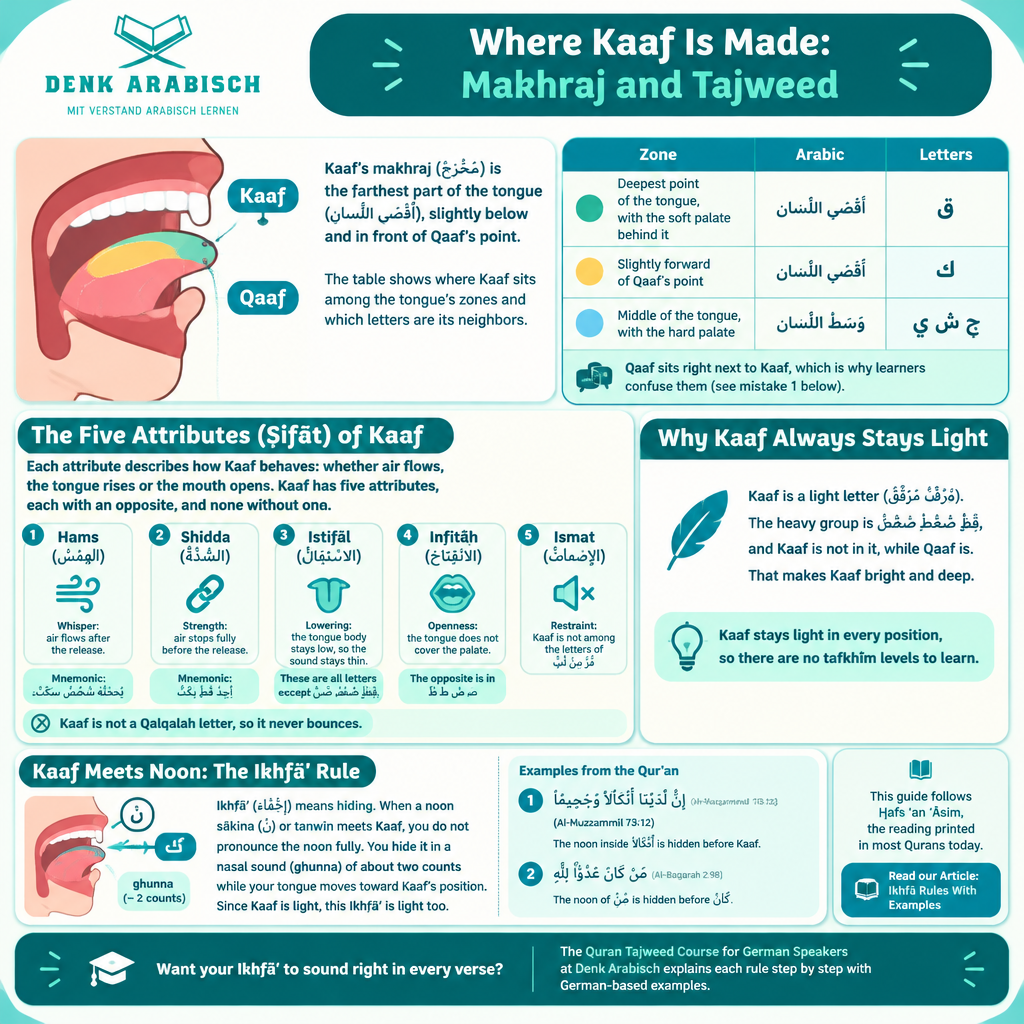
Where Kaaf Is Made: Makhraj and Tajweed
Kaaf’s makhraj (مَخْرَجٌ) is the farthest part of the tongue (أَقْصَى اللِّسَانِ), slightly below and in front of Qaaf’s point. The table shows where Kaaf sits among the tongue’s zones and which letters are its neighbors.
| Zone | Arabic | Letters |
| Deepest point of the tongue, with the soft palate behind it | أَقْصَى اللِّسَانِ | ق |
| Slightly forward of Qaaf’s point | أَقْصَى اللِّسَانِ | ك |
| Middle of the tongue, with the hard palate | وَسَطُ اللِّسَانِ | ج ش ي |
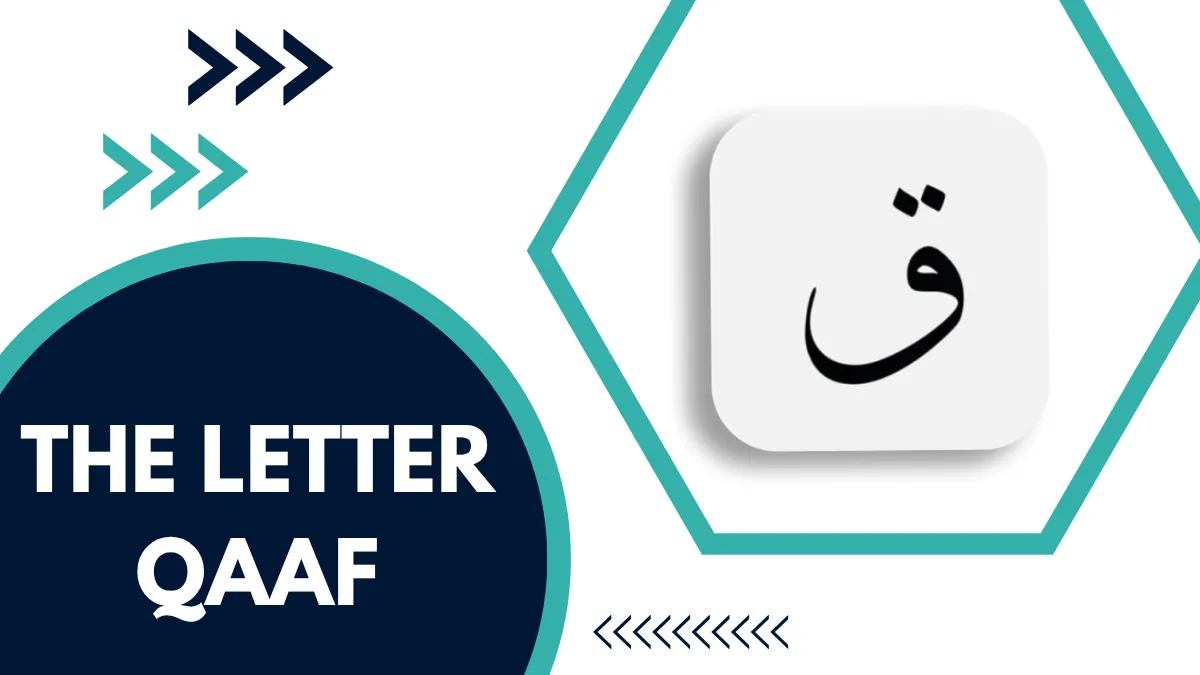
Qaaf sits right next to Kaaf, which is why learners confuse them (see mistake 1 below).
The Five Attributes (Ṣifāt) of Kaaf
Each attribute describes how Kaaf behaves: whether air flows, the tongue rises or the mouth opens. Kaaf has five attributes, each with an opposite, and none without one.
- Hams (الْهَمْسُ), whisper: air flows after the release. Mnemonic: فَحَثَّهُ شَخْصٌ سَكَتَ.
- Shidda (الشِّدَّةُ), strength: the air stops fully before the release. Mnemonic: أَجِدُ قَطٍ بَكَتْ.
- Istifāl (الِاسْتِفَالُ), lowering: the tongue body stays low, so the sound stays thin. These are all letters except خُصَّ ضَغْطٍ قِظْ.
- Infitāḥ (الِانْفِتَاحُ), openness: the tongue does not cover the palate. The opposite is in ص ض ط ظ.
- Ismāt (الْإِصْمَاتُ), restraint: Kaaf is not among the letters of فَرَّ مِنْ لُبّ.
Kaaf is not a Qalqalah letter, so it never bounces.
Why Kaaf Always Stays Light
Kaaf is a light letter (حَرْفٌ مُرَقَّقٌ). The heavy group is خُصَّ ضَغْطٍ قِظْ, and Kaaf is not in it, while Qaaf is. That makes Kaaf bright and Qaaf deep. Kaaf stays light in every position, so there are no tafkhīm levels to learn.
Kaaf Meets Noon: The Ikhfāʾ Rule
Ikhfāʾ (إِخْفَاءٌ) means hiding. When a noon sākina (نْ) or tanwīn meets Kaaf, you do not pronounce the noon fully. You hide it in a nasal sound (ghunna) of about two counts while your tongue moves toward Kaaf’s position. Since Kaaf is light, this Ikhfāʾ is light too.
- إِنَّ لَدَيْنَا أَنْكَالًا وَجَحِيمًا (Al-Muzzammil 73:12): the noon inside أَنْكَالًا is hidden before Kaaf.
- مَنْ كَانَ عَدُوًّا لِّلَّهِ (Al-Baqarah 2:98): the noon of مَنْ is hidden before كَانَ.
This guide follows Ḥafṣ ʿan ʿĀṣim, the reading printed in most Qurans today.
Read our Article: Ikhfa Rules With Examples
Want your Ikhfāʾ to sound right in every verse? The Quran Tajweed Course for German Speakers at Denk Arabisch explains each rule step by step with German-based examples.
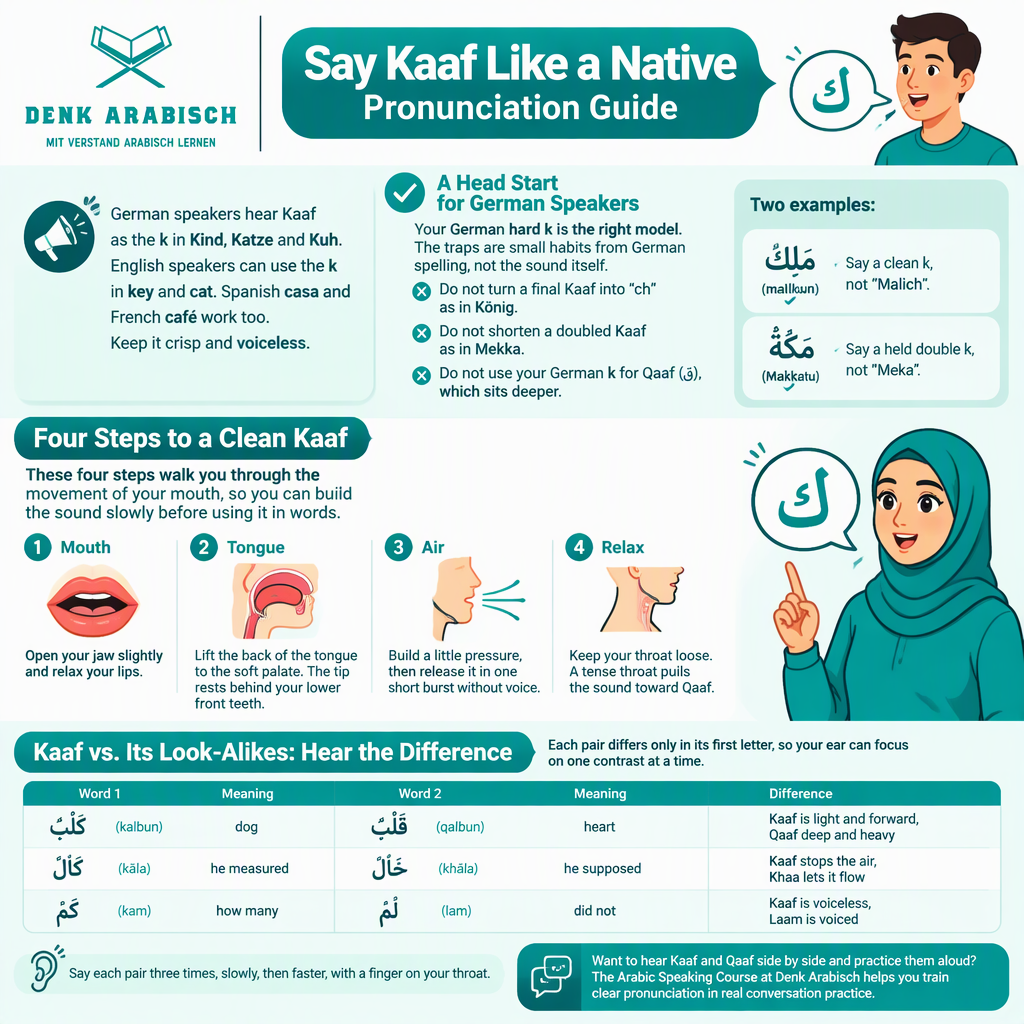
Say Kaaf Like a Native: Pronunciation Guide
German speakers hear Kaaf as the k in Kind, Katze and Kuh. English speakers can use the k in key and cat. Spanish casa and French café work too. Keep it crisp and voiceless.
A Head Start for German Speakers
Your German hard k is the right model. The traps are small habits from German spelling, not the sound itself.
- Do not turn a final Kaaf into “ch” as in König.
- Do not shorten a doubled Kaaf as in Mekka.
- Do not use your German k for Qaaf (ق), which sits deeper.
Two examples: say مَلِكٌ (malikun) with a clean k, not “Malich”. Say مَكَّةُ (Makkatu) with a held double k, not “Meka”.
Four Steps to a Clean Kaaf
These four steps walk you through the movement of your mouth, so you can build the sound slowly before using it in words.
- Mouth: open your jaw slightly and relax your lips.
- Tongue: lift the back of the tongue to the soft palate. The tip rests behind your lower front teeth.
- Air: build a little pressure, then release it in one short burst without voice.
- Relax: keep your throat loose. A tense throat pulls the sound toward Qaaf.
Discover How To Speak Arabic? and learn practical tips to improve your Arabic speaking skills, build confidence, and start communicating naturally in everyday conversations.
Kaaf vs. Its Sound-Alikes: Hear the Difference
Each pair differs only in its first letter, so your ear can focus on one contrast at a time.
| Word 1 | Meaning | Word 2 | Meaning | Difference |
| كَلْبٌ (kalbun) | dog | قَلْبٌ (qalbun) | heart | Kaaf is light and forward, Qaaf deep and heavy |
| كَالَ (kāla) | he measured | خَالَ (khāla) | he supposed | Kaaf stops the air, Khaa lets it flow |
| كَمْ (kam) | how many | لَمْ (lam) | did not | Kaaf is voiceless, Laam is voiced |
Say each pair three times, slowly, then faster, with a finger on your throat.
When Qaaf Merges into Kaaf
Because Qaaf and Kaaf are such close neighbors, a Qaaf sākina followed by Kaaf can merge into it. The best-known example is أَلَمْ نَخْلُقكُّم (Al-Mursalat 77:20), which in Ḥafṣ is usually read with full merging: alam nakhlukkum. Two Kaafs in a row also merge, as in يُدْرِككُّمُ الْمَوْتُ (An-Nisa 4:78).
Want to hear Kaaf and Qaaf side by side and practice them aloud? The Arabic Speaking Course at Denk Arabisch helps you train clear pronunciation in real conversation practice.
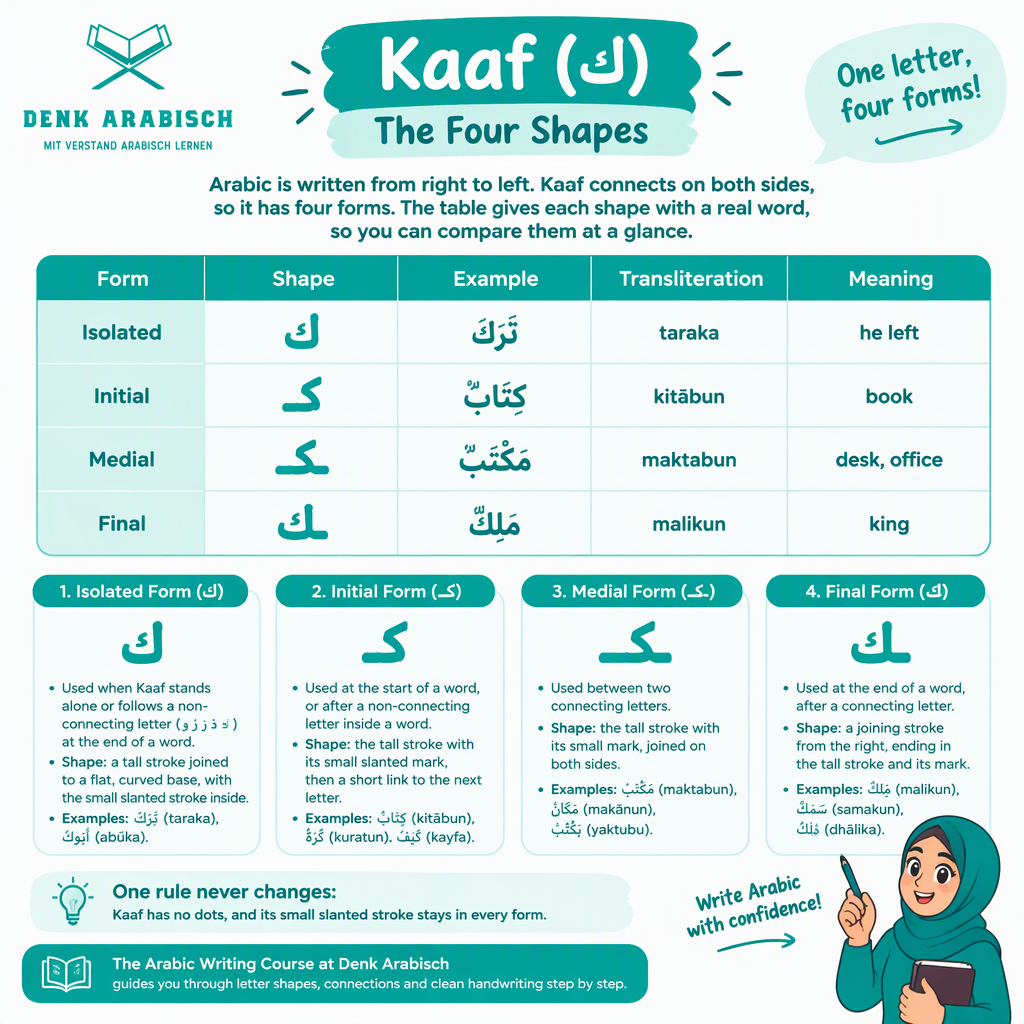
Writing Kaaf (ك): The Four Shapes
Arabic is written from right to left. Kaaf connects on both sides, so it has four forms.
1. Isolated Form (ك)
Used when Kaaf stands alone or follows a non-connecting letter (ا د ذ ر ز و) at the end of a word.
Shape: a tall stroke joined to a flat, curved base, with the small slanted stroke inside.
Examples: تَرَكَ (taraka, he left), أَبُوكَ (abūka, your father).
2. Initial Form (كـ)
Used at the start of a word, or after a non-connecting letter inside a word.
Shape: the tall stroke with its small slanted mark, then a short link to the next letter.
Examples: كِتَابٌ (kitābun, book), كُرَةٌ (kuratun, ball), كَيْفَ (kayfa, how).
3. Medial Form (ـكـ)
Used between two connecting letters.
Shape: the tall stroke with its small mark, joined on both sides.
Examples: مَكْتَبٌ (maktabun, desk), مَكَانٌ (makānun, place), يَكْتُبُ (yaktubu, he writes).
Learn Arabic with Denk Arabisch Academy
Speak and understand Arabic through a clear and effective learning system
Try a Free Trial4. Final Form (ـك)
Used at the end of a word, after a connecting letter.
Shape: a joining stroke from the right, ending in the tall stroke and its mark.
Examples: مَلِكٌ (malikun, king), سَمَكٌ (samakun, fish), ذٰلِكَ (dhālika, that).
Kaaf with Vowels and Shadda
Because Kaaf is light, every vowel stays clear and bright: ka, ku and ki sound crisp, never deep.
Short Vowel Marks on Kaaf
The four marks below show how Kaaf sounds with each short vowel and with silence, each with one common word.
| Mark | Name | Sound | Example | Meaning |
| كَ | fatḥa | ka | كَمْ (kam) | how many |
| كُ | ḍamma | ku | كُرَةٌ (kuratun) | ball |
| كِ | kasra | ki | كِتَابٌ (kitābun) | book |
| كْ | sukūn | k | مَكْتَبٌ (maktabun) | desk |
Long Vowels and Diphthongs with Kaaf
Long vowels last about twice as long as short ones. Here is Kaaf with each of the three.
| Combination | Sound | Example | Meaning |
| كَا | kā | كَاتِبٌ (kātibun) | writer |
| كُو | kū | كُوبٌ (kūbun) | cup |
| كِي | kī | كِيسٌ (kīsun) | bag |
Diphthongs: كَيْفَ (kayfa, how) has ay, and كَوْكَبٌ (kawkabun, planet) has aw.
Doubled Kaaf: Kaaf with Shadda
The shadda doubles Kaaf: you hold the closure briefly, then release.
- مَكَّةُ (Makkatu), Makkah
- سُكَّرٌ (sukkarun), sugar
- شَكَّ (shakka), he doubted
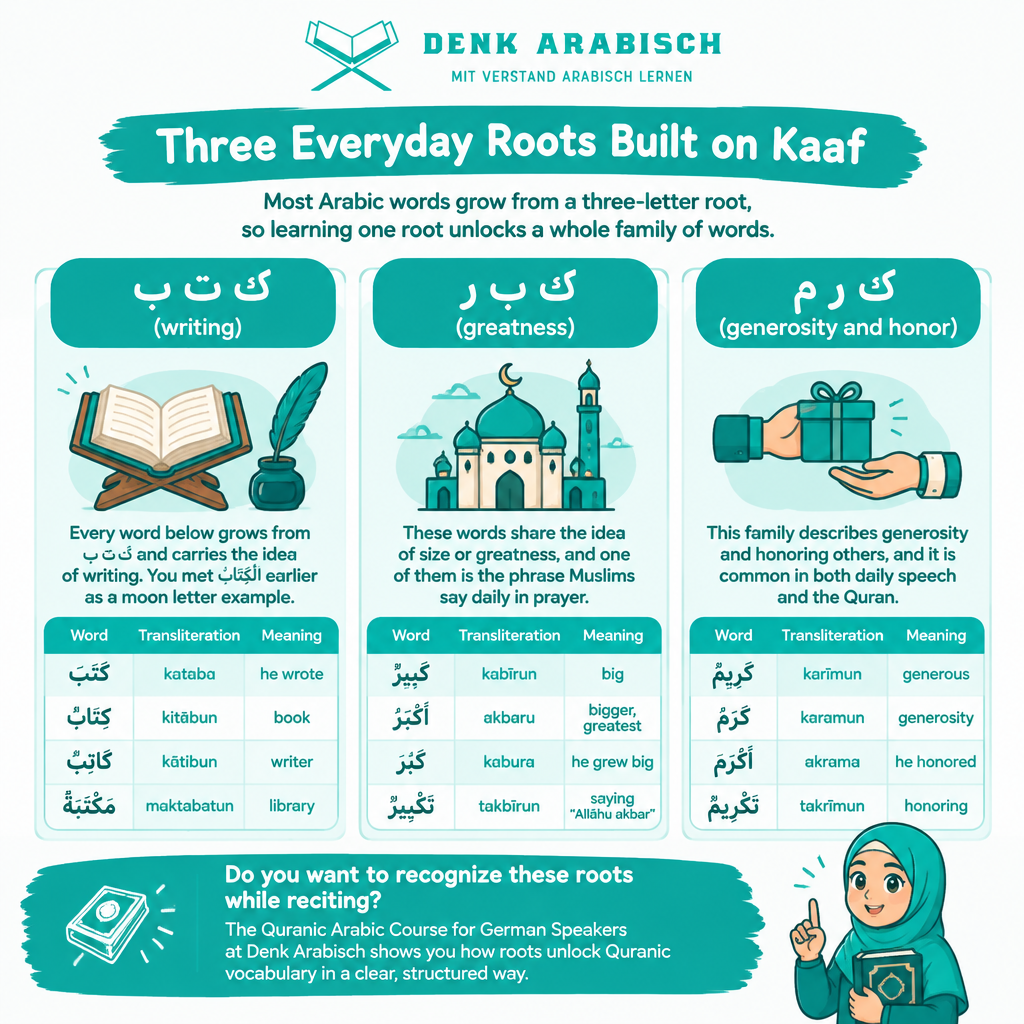
Three Everyday Roots Built on Kaaf
Most Arabic words grow from a three-letter root, so learning one root unlocks a whole family of words.
ك ت ب (writing)
Every word below grows from ك ت ب and carries the idea of writing. You met الْكِتَابُ earlier as a moon letter example.
| Word | Transliteration | Meaning |
| كَتَبَ | kataba | he wrote |
| كِتَابٌ | kitābun | book |
| كَاتِبٌ | kātibun | writer |
| مَكْتَبَةٌ | maktabatun | library |
ك ب ر (greatness)
These words share the idea of size or greatness, and one of them is the phrase Muslims say daily in prayer.
| Word | Transliteration | Meaning |
| كَبِيرٌ | kabīrun | big |
| أَكْبَرُ | akbaru | bigger, greatest |
| كَبُرَ | kabura | he grew big |
| تَكْبِيرٌ | takbīrun | saying “Allāhu akbar” |
ك ر م (generosity and honor)
This family describes generosity and honoring others, and it is common in both daily speech and the Quran.
| Word | Transliteration | Meaning |
| كَرِيمٌ | karīmun | generous |
| كَرَمٌ | karamun | generosity |
| أَكْرَمَ | akrama | he honored |
| تَكْرِيمٌ | takrīmun | honoring |
Do you want to recognize these roots while reciting? The Quranic Arabic Course for German Speakers at Denk Arabisch shows you how roots unlock Quranic vocabulary in a clear, structured way.
Kaaf at the Start, Middle and End of Words
The table shows Kaaf in all three positions, with at least one everyday word for each.
| Position | Arabic Word | Transliteration | Meaning |
| Beginning | كِتَابٌ | kitābun | book |
| Middle | مَكْتَبٌ | maktabun | desk |
| End | مَلِكٌ | malikun | king |
Discover How Many Words Are In Arabic? and explore the richness of the Arabic language, from its vast vocabulary to the fascinating words and expressions that make it unique.
Kaaf in Short Sentences
These three short sentences reuse words you met earlier in this guide, so you can see Kaaf working in real Arabic.
| Arabic Sentence | Transliteration | Meaning |
| الْكِتَابُ كَبِيرٌ. | al-kitābu kabīrun. | The book is big. |
| الْكِتَابُ عَلَى الْمَكْتَبِ. | al-kitābu ʿalā l-maktabi. | The book is on the desk. |
| الْمَلِكُ كَرِيمٌ. | al-maliku karīmun. | The king is generous. |
Explore Arabic Sentences to learn how Arabic words come together to form meaningful sentences and build your confidence in reading, writing, and speaking Arabic naturally.
Four Kaaf Pitfalls and How to Fix Them
Mastering the pronunciation of Kaaf (ك) requires understanding how it differs from similar Arabic letters in both sound and writing.
By recognizing common mistakes and practicing simple pronunciation tests, learners can develop greater accuracy and confidence when reading Arabic.
1. Mixing up Kaaf (ك) and Qaaf (ق)
Cause: both come from the back of the tongue, but Qaaf sits deeper and is heavy.
Test: say كَ, then قَ. Feel the contact point slide back, and the sound turn deeper on Qaaf.
2. Mixing up Kaaf (ك) and Khaa (خ)
Cause: Kaaf stops the air, while Khaa lets it rub through like the ach-Laut. Beginners soften k into ch.
Test: hold a hand before your mouth. Kaaf gives one short puff, Khaa a steady stream.
3. Mixing up Kaaf (ك) and Laam (ل)
Cause: both are tall letters that look alike in joined forms, and كَمْ and لَمْ sound close to a tired ear.
Test: put two fingers on your throat and say كَمْ, then لَمْ. Laam buzzes, Kaaf stays silent. In writing, never add dots and keep the small slanted stroke.
4. Saying a final Kaaf as “ch” (German-specific)
Cause: German endings like -ig in König sound like ich.
Test: say مَلِكٌ and stop. Your tongue should stay at the palate with no hiss. A hiss means ch.
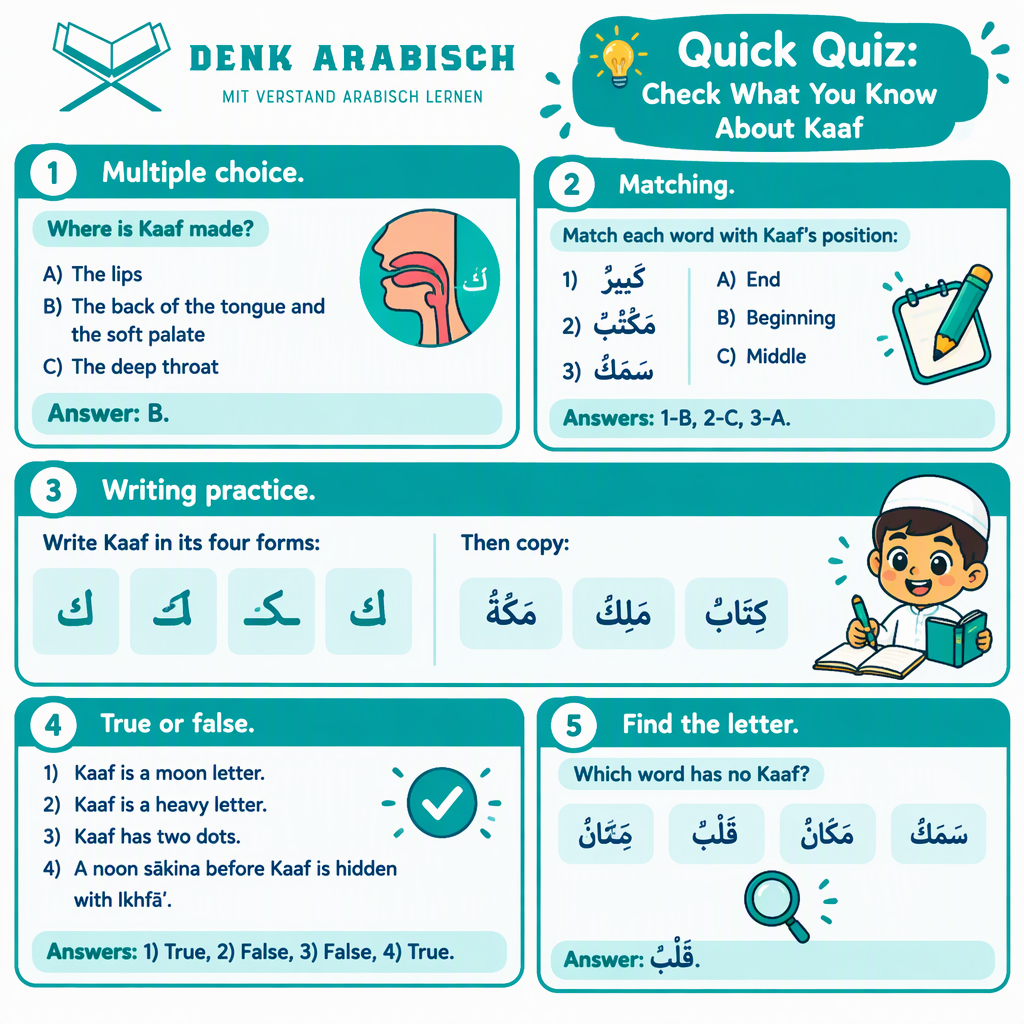
Quick Quiz: Check What You Know About Kaaf
Test your understanding of the Arabic letter Kaaf (ك) with these quick exercises covering pronunciation, letter positions, writing forms, and key characteristics.
Exercise 1: Multiple choice.
Where is Kaaf made?
A) The lips
B) The back of the tongue and the soft palate
C) The deep throat
Answer: B.
Exercise 2: Matching.
Match each word with Kaaf’s position: 1) كَبِيرٌ 2) مَكْتَبٌ 3) سَمَكٌ with A) End B) Beginning C) Middle.
Answers: 1-B, 2-C, 3-A.
Exercise 3: Writing practice.
Write Kaaf in its four forms (ك, كـ, ـكـ, ـك). Then copy كِتَابٌ, مَلِكٌ and مَكَّةُ.
Exercise 4: True or false.
- Kaaf is a moon letter.
- Kaaf is a heavy letter.
- Kaaf has two dots.
- A noon sākina before Kaaf is hidden with Ikhfāʾ.
Answers: 1) True, 2) False, 3) False, 4) True.
Exercise 5: Find the letter. Which word has no Kaaf: كِتَابٌ, مَكَانٌ, قَلْبٌ, سَمَكٌ?
Answer: قَلْبٌ.
What Our Students Say About Denk Arabisch Academy
See what our students say about learning at Denk Arabisch Academy on Trustpilot. Read their experiences and check out more reviews to discover how our courses help improve Arabic.

Learn Arabic Beyond Kaaf with Denk Arabisch
Kaaf is one of 28 letters, and each one becomes easier with a clear plan. Denk Arabisch is built for German-speaking learners and explains Arabic through German.
Here is what that means in practice:
- German-based explanations for every sound
- A clear path from alphabet to reading and writing
- Tajweed and Quranic Arabic options
- Courses from first steps to speaking practice
Choose Your Specialized Course:
- Arabic Course For Beginners: your first steps, from sounds to simple sentences.
- Arabic Alphabet Course: all 28 letters with sounds and shapes.
- Arabic Reading Course: read words and short texts with confidence.
- Arabic Writing Course: letter shapes, connections and clean handwriting.
- Arabic Speaking Course: speak clearly and practice real conversations.
- Quranic Arabic Course for German Speakers: understand Quranic words and roots.
- Quran Tajweed Course for German Speakers: apply rules like Ikhfāʾ in recitation.
Ready to start? Book your free trial lesson at Denk Arabisch.
You can read what our students say on Trustpilot.
Learn Arabic with Denk Arabisch Academy
Speak and understand Arabic through a clear and effective learning system
Try a Free TrialConclusion
The letter Kaaf (ك) is easy to learn once you know its sound, its shapes and its one Tajweed rule.
- Sound: a crisp, voiceless [k], like German Kind.
- Writing: four forms, no dots, always the small slanted stroke.
- Recognition: a moon letter, light in every position.
Practice today: say كَلْبٌ and قَلْبٌ, then كَالَ and خَالَ. Write كِتَابٌ and مَلِكٌ by hand. Then read the three roots, ك ت ب, ك ب ر and ك ر م, aloud.
You already have the sound. The rest is practice, and you are closer than you think.
Book a free trial lesson at Denk Arabisch and take your next letter with confidence.

FAQs
1. What is the difference between Kaaf (ك) and Qaaf (ق)?
Kaaf is light and made slightly forward on the tongue. Qaaf is heavy and made deeper. Compare كَلْبٌ (dog) and قَلْبٌ (heart).
2. How is Kaaf different from Khaa (خ)?
Kaaf stops the air completely, then releases it. Khaa lets the air flow with friction, like the German ach-Laut. Compare كَالَ with خَالَ.
3. Is Kaaf a sun or moon letter?
Kaaf is a moon letter. The laam of al- keeps its sukūn, as in الْكِتَابُ, and Kaaf takes no shadda.
4. Is Kaaf heavy or light?
Kaaf is light. It is not in the heavy group خُصَّ ضَغْطٍ قِظْ, and it stays light in every position.
5. What Tajweed rule does Kaaf trigger?
A noon sākina or tanwīn before Kaaf is hidden with Ikhfāʾ. You add a nasal sound of about two counts, as in مَنْ كَانَ.