
Takeaway:
- Iqlab means turning a Noon Sakinah (نْ) or Tanween into a hidden Meem (م) when the next letter is Bā’ (ب).
- It only happens with the letter Bā’, making it the simplest Tajweed rule in terms of letter count.
- The change is accompanied by a Ghunnah (nasal sound) held for exactly two counts.
- In printed Qurans (Mus-haf), a small مـ is placed over the Noon or between the Tanween strokes to signal Iqlab.
- The lips come together lightly for the Meem (gentle closure preferred) while the tongue stays away from the palate.
- The purpose is to create a smooth, fluent transition from the nasal “N” sound to the lip-based “B” sound.
- Common mistakes to avoid: pressing lips too hard, not holding the Ghunnah for two counts, or letting an “N” sound mix in.
The recitation of the Holy Quran is a science in itself, known as Tajweed. The goal of Tajweed is to give every letter its right and to reproduce the words of Allah as they were revealed to the Prophet Muhammad (ṣallā Allāhu ʿalayhi wa-sallam). Among the many rules a student learns, the Iqlab rule (إقلاب) is one of the most fascinating and melodic.
In this comprehensive guide, you will learn everything about Iqlab: from its linguistic definition to practical application and the typical mistakes you should avoid. We will show you how to master this rule to elevate your recitation to a new level of precision and beauty.
Beautiful recitation begins with mastering the details. At Denk Arabisch, we help you turn Tajweed rules into confident, natural recitation through our Tajweed Course.

Table of Contents
What is Iqlab?
Before we dive into practice, we must understand the foundation. The word Iqlab stems from the Arabic root qa-la-ba, which literally means “to turn around,” “to transform,” or “to convert.”
1. The Definition of Iqlab in Tajweed
In the context of Quranic recitation, Iqlab refers to the transformation of a Noon Sakinah (نْ — a Noon without a vowel) or a Tanween (ـًـٍـٌ — the “n” sounding end-doubling of vowels on nouns) into a Meem (م) when followed by the letter Ba (ب).
This transformation does not happen in isolation. It is accompanied by:
- Ghunnah: A nasal sound.
- Ikhfa: A slight “hiding” or concealment of the newly formed Meem.
2. Why does Iqlab exist?
The Arabic language strives for fluency (Fasaha). Transitioning from a clear “N” sound directly to a “B” sound can feel harsh and abrupt in the flow of speech. Since the Meem (م) shares the same articulation point (Makhraj) as the Ba (ب)—namely the lips—while preserving the nasality (Ghunnah) of the Noon (ن), it serves as the perfect acoustic bridge.
Mastering definitions is just the beginning—our live Arabic Courses at Denk Arabisch help you hear and apply every rule correctly.
When does Iqlab occur?
The beauty of Iqlab is its simplicity in theory. While other rules like Izhar or Ikhfa have a long list of letters, Iqlab involves only one single letter:
Formula: Noon Sakinah (نْ) or Tanween + Ba (ب) = Iqlab
The Sign of Iqlab in Mus-haf
In most modern prints of the Quran (such as the Madinah Mus-haf), there is very helpful visual support. Above the Noon (ن) or in place of the second stroke of the Tanween, you will find a small, narrow Meem (مـ). This sign immediately signals: “Attention, the Noon is not pronounced as an ‘N’ here, but as an ‘M’!”
Practical Application of Iqlab in Tajweed
Knowing the theory is the first step, but Tajweed is a practical art. To execute Iqlab correctly, you must master three components simultaneously:
Step 1: Transformation (Qalb)
Imagine the Noon (ن) disappearing completely and being replaced by a Meem (م). Your brain should prepare to close the lips for a Meem instead of placing the tip of the tongue against the upper palate for a Noon.
Step 2: Ghunnah (Nasality)
The heart of Iqlab is the nasal sound. As soon as you form the Meem, the sound must vibrate through the nose. This Ghunnah is held for exactly two counts (Harakat).
Step 3: Lip Position (The Secret of the Scholars)
There are two recognized schools among Tajweed scholars regarding this, both of which are correct:
- Al-Isbaq: A complete but gentle closure of the lips.
- Al-Furjah: A tiny gap between the lips (so thin that barely a piece of paper could fit through).
At Denk Arabisch, we generally recommend a gentle contact of the lips without pressure to create a natural and soft sound.

Iqlab with Noon Sakinah From Quran
Iqlab occurs when a Noon Sakinah or Tanween is followed by the letter Baa (ب)—the “N” sound is converted into a hidden Meem (م) with a two-count nasal sound (Ghunnah).
It applies in two words, one word, and with Tanween, always maintaining the same rule: بدل النون ميم مخفاة مع غنة for smooth, accurate recitation.
1. Iqlab with Noon Sakinah In two words
- Quranic Example:
مِن بَعْدِ مَا جَاءَتْهُمُ الْبَيِّنَاتُ (سورة البقرة)
“after the clear evidences had come to them.” (Surah: Al-Baqarah)
- Transliteration (Ta’reeb): Mim-ba‘di
- Explanation: The Noon Sakinah is followed by the letter Baa. Instead of pronouncing the “N,” you “turn” it into a Meem sound. You must close your lips lightly and hold a nasal hum (Ghunnah) for two counts. It sounds like Mim-ba‘di.
2. Iqlab with Noon Sakinah In one word
- Quranic Example:
قَالَ يَا آدَمُ أَنبِئْهُم بِأَسْمَائِهِمْ (سورة البقرة)
“He said, ‘O Adam, inform them of their names.'” (Surah: Al-Baqarah)
- Transliteration (Ta’reeb): Am-bi’hum
- Explanation: Here, the Noon Sakinah and the letter Baa meet within a single word. The same rule applies: the Noon is converted into a Meem. You pronounce it as Am-bi’hum with a two-count nasalization.
3. Iqlab with Tanween
- Quranic Example:
وَاللَّهُ سَمِيعٌ بَصِيرٌ (سورة البقرة)
“And Allah is All-Hearing, All-Seeing.” (Surah: Al-Baqarah)
- Transliteration (Ta’reeb): Samee‘um-baseer
- Explanation: This example uses Tanween Damm (the “un” sound). Because it is followed by the letter Baa, the “un” sound turns into “um.” You transition from the word Samee‘un to Samee‘um while keeping the lips lightly closed for the Ghunnah.
Real improvement happens when you recite and get corrected. Join Denk Arabisch and practice real Quranic examples with expert feedback.
Read also: Izhar Rules – The Complete Guide With Examples
Summary Table for Iqlab
| Letter | Quranic Example | Transliteration | Position |
| ب | مِن بَعْدِ | Mim-ba‘di | Two words |
| ب | أَنبِئْهُم | Am-bi’hum | Same word |
| ب | سَمِيعٌ بَصِيرٌ | Samee‘um-baseer | Two words (Tanween) |
Clear summaries help—but guided repetition is what truly builds mastery. Join our structured Quran Tajweed Course today.
Learn the Quran with Denk Arabisch Academy
Master reading and understanding the Quran through structured and supportive learning
Try a Free Trial
Common Mistakes in Iqlab and How to Avoid Them
Even advanced students sometimes fall into traps. Here are the three most common mistakes:
1. Too Much Pressure on the Lips
Many students press their lips together too tightly during the Meem. This creates an “explosive” sound that disrupts the smoothness of the Tajweed.
- Solution: The lips should only touch as they do during normal breathing.
2. Skipping the Ghunnah
Some transform the Noon into a Meem but pronounce it short and dry (like a normal ‘M’ in English).
- Solution: Remember that Iqlab needs two counts of time. The sound must “rest” in the nose.
3. The “N” Sneaks In
Sometimes a mixture of ‘N’ and ‘M’ is heard.
- Solution: The tongue must not touch the palate. As soon as you see the Ba, the oral cavity belongs to the Meem.
This is a comprehensive and well-structured overview of the Iqlab rule. To round out this guide, here is a detailed Frequently Asked Questions (FAQs) section designed to address common student inquiries and clarify the nuances of the rule.
Exercises on Iqlab Rules with Examples
Exercise 1: Structural Application Environments
Match the provided Quranic examples with the correct structural context where the Iqlab rule occurs:
— Select the correct context —
Iqlab within a single word
Iqlab across two separate words
— Select the correct context —
Iqlab within a single word
Iqlab across two separate words
Exercise 2: Identifying Recitation Pitfalls and Mistakes
Click on the cards that properly highlight common execution mistakes or incorrect habits that students should avoid according to the text:
Pressing the lips together too tightly, creating a harsh, explosive “M” sound that breaks fluency.
Closing the lips softly and naturally without pressure as you would during normal breathing.
Skipping the timing of the nasal hum, making it a short and dry sound without holding it for two counts.
Allowing a hybrid “N” sound to sneak in by mistakenly touching the tip of the tongue to the upper palate.
Exercise 3: Phonetic Rationale of the Rule
Based on the guide and its detailed FAQs, why was the letter Meem (م) specifically selected by scholars as the acoustic bridge for Iqlab?
Exercise 4: True or False?
If a verse terminates with a Tanween, and the following verse opens with the letter Baa, you must apply the Iqlab rule if you decide to connect both verses continuously without taking a pause.
Exercise 5: Rhythmic Timing and Counts
To execute the rule precisely, the nasalized hum (Ghunnah) must resonate and rest inside the nasal cavity for a duration of exactly ““ counts (Haratak).
What Our Students Say About Denk Arabisch Academy
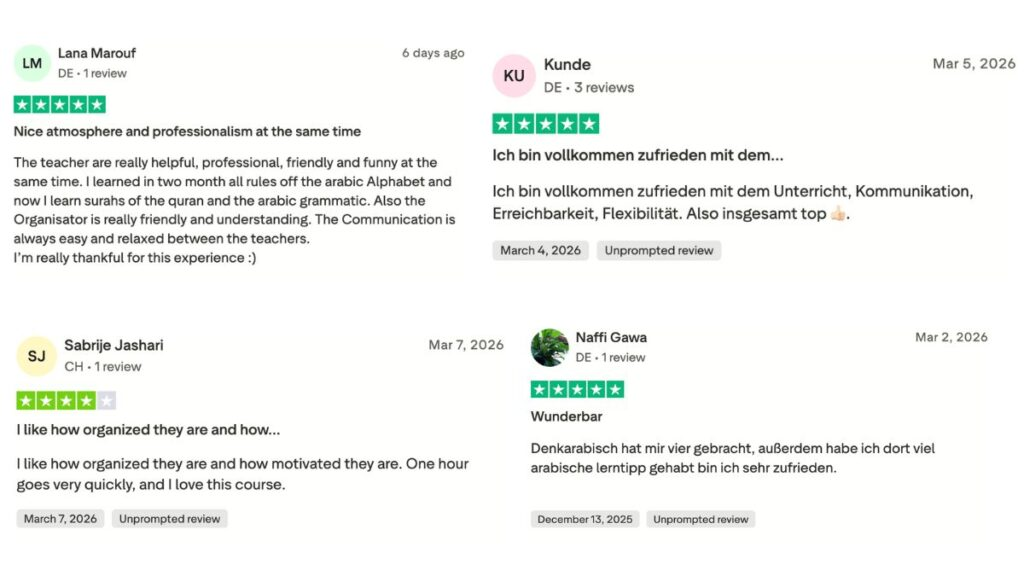
See what our students say about learning at Denk Arabisch Academy on Trustpilot. Read their experiences and check out more reviews to discover how our courses help improve Arabic.
Read also: Ikhfa Rules With Examples
Why learn Iqlab with Denk Arabisch?
Reading theory in an article is a great start, but Tajweed lives through oral tradition. Without the trained ear of a teacher, it is difficult to know if your Ghunnah is exactly two counts long or if your lip position is correct.
At Denk Arabisch, we offer you:
- Individual Correction: Our teachers listen closely and show you the correct mouth position via webcam.
- Structured Exercises: We practice Iqlab with you using various Surahs until it becomes second nature.
- Native Expertise: Learn the rules directly from experts who hold an Ijazah (authorization to teach).
Your Next Step to Perfect Tilaawah
Our Courses Include:
- Arabic Courses for German Speakers
- Arabic Levels for German Speakers
- Arabic Dialect Courses for German Speakers
- Qur’an Learning Courses for German Speakers
- Islamic Studies Courses for German Speakers
- Courses for Muslim Kids for German Speakers
Are you ready to refine your pronunciation? Do you want to not just understand Iqlab, but apply it perfectly?
Learn the Quran with Denk Arabisch Academy
Master reading and understanding the Quran through structured and supportive learning
Try a Free TrialRegister with Tajweed Course at Denk Arabisch today!
Conclusion
Mastering Iqlab is a milestone in any student’s Tajweed journey. While it focuses on a single letter, this rule adds a unique melodic depth and smoothness to your recitation. By balancing the transformation of the letter with a resonant, two-count Ghunnah, you honor the precision and beauty of the Quranic text as it was traditionally revealed. Keep practicing the gentle lip contact, and you will soon find this “transformation” becoming a natural, effortless part of your Tilaawah.
FAQs
1. Does Iqlab happen with letters other than Ba (ب)?
No. Unlike other Tajweed rules such as Idgham (which has 6 letters) or Ikhfa (which has 15), Iqlab only occurs with one letter: Ba (ب). Whenever a Noon Sakinah or Tanween meets a Ba, Iqlab is mandatory.
2. How long should I hold the Ghunnah during Iqlab?
The Ghunnah (nasal sound) should be held for two counts (Harakat). A common way to measure this is the time it takes to slowly fold or unfold a finger. Consistency is key; make sure your Iqlab timing matches the timing of your other nasal rules like Idgham with Ghunnah.
3. I see a small Meem (مـ) in my Quran; is that always Iqlab?
Not necessarily. It is important to distinguish between:
The small Iqlab Meem (مـ): This is placed above a Noon or next to a Tanween to signal the conversion to an “M” sound.
The Waqf Laazim sign (م): A different-looking small Meem (often a tail-less or differently shaped version) that indicates a compulsory stop in the verse. Always check if the Meem is replacing a Noon/Tanween before a Ba to confirm it is Iqlab.
4. What is the difference between Al-Isbaq and Al-Furjah?
These are the two schools of thought regarding lip position:
Al-Isbaq: Closing the lips completely but very gently.
Al-Furjah: Leaving a microscopic gap between the lips. Most modern teachers recommend Al-Isbaq (gentle closure), as it is often easier for students to execute without accidentally making a “v” or “f” sound.
5. Can Iqlab occur between two different verses?
Yes. If a verse ends with a Tanween and the next verse begins with the letter Ba, and you choose to connect the two verses without stopping, you must apply the Iqlab rule. However, if you stop at the end of the first verse, the rule is not applied.
6. Why is the sound changed to a Meem (م) specifically?
The letter Meem was chosen because it acts as a perfect middle ground. It shares the nasal quality (Ghunnah) of the letter Noon, but it shares the articulation point (lips) with the letter Ba. This makes the transition smooth and effortless for the tongue.
7. Is Iqlab the same as Ikhfa Meemi?
They sound very similar because both involve a Meem followed by a Ba with Ghunnah. However:
Iqlab starts with a Noon or Tanween that becomes a Meem.
Ikhfa Meemi occurs when a Meem Sakinah (original letter Meem) is followed by a Ba. The resulting sound is nearly identical, but the starting point in the script is different.