Takeaway:
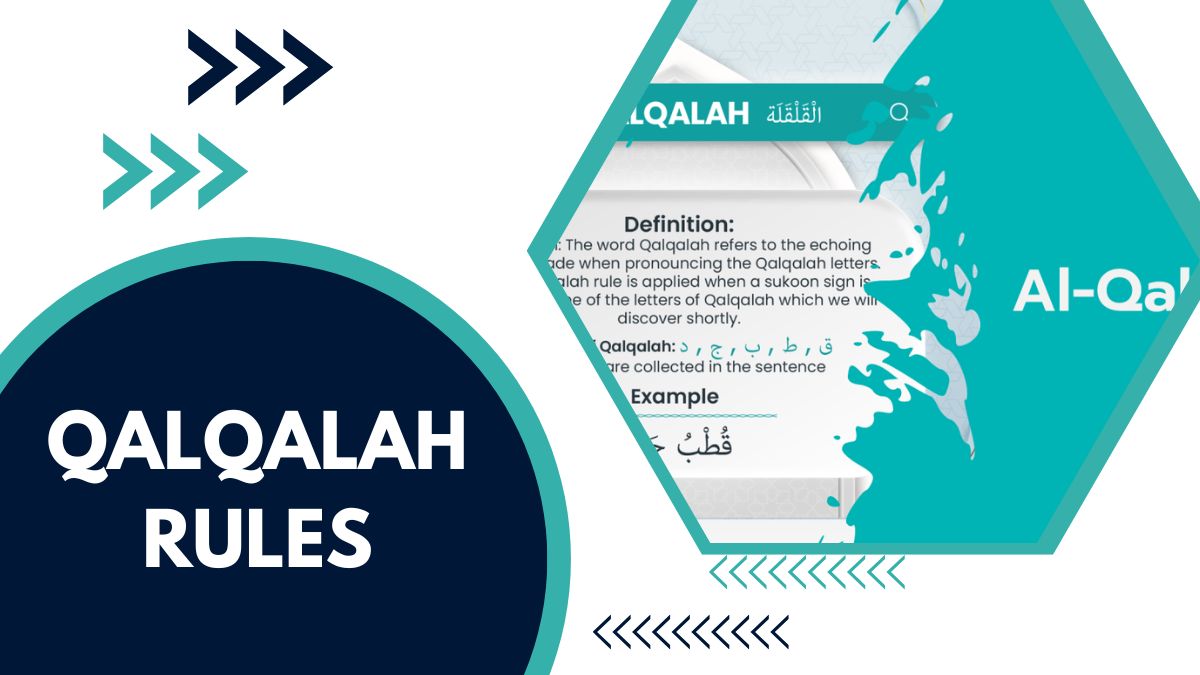
- Qalqalah is an echoing or bouncing sound produced when specific letters are pronounced with a Sukoon, created by a sudden release of trapped air and voice at the articulation point.
- The five Qalqalah letters are ق, ط, ب, ج, د, memorized through the phrase “Qutbu Jadd.”
- It is only applied when one of these letters carries a written Sukoon (ـْ) or an incidental Sukoon caused by stopping at the end of a word.
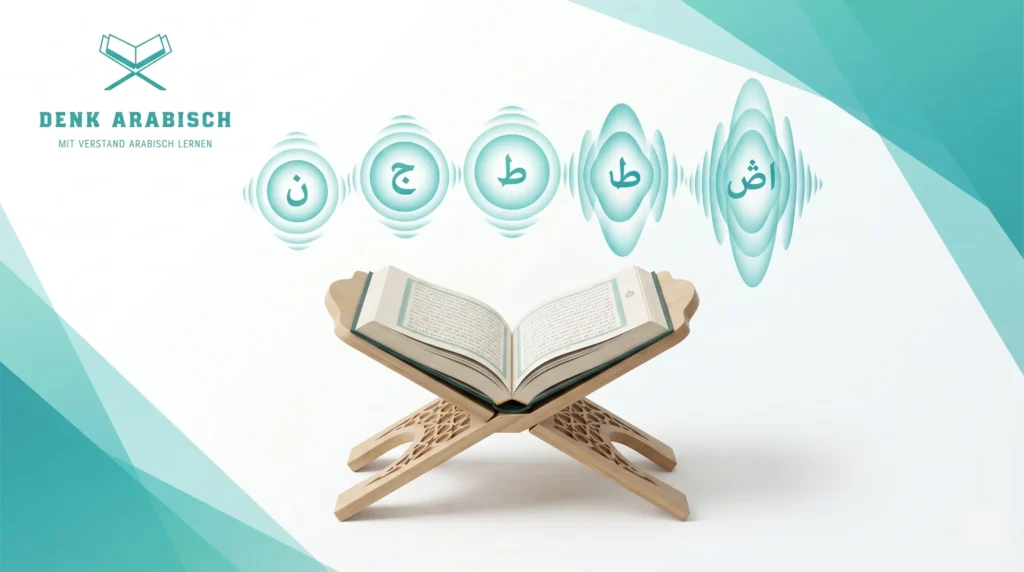
- The echo has three levels of intensity:
- Sughra (minor): a light, quick bounce when the letter appears in the middle of a word.
- Kubra (major): a stronger, more resonant echo when stopping on a Qalqalah letter at the end of a word.
- Akbar (strongest): the most intense bounce, applied when stopping on a Qalqalah letter that also has a Shaddah.
- Proper Qalqalah prevents letters from being swallowed or distorted, preserving the clarity of words and the rhythmic beauty of recitation.
- Common mistakes include adding a vowel (like a Fatha) to the echo, producing a Hamza-like cutoff, stretching the sound too long, or pausing unnaturally before a mid-word echo.
- To improve, practice an instant “rebound” of the tongue or lips, ensure no nasal sound is present (pinch the nose to test), and listen closely to expert reciters for the difference between heavy (ق, ط) and light (ب, ج, د) echoes.
The beauty of Quranic recitation lies in its intricate phonetic system. Among the most vital rules for any student of Tajweed is Qalqalah (the Echo). This rule is not merely a stylistic choice; it is a fundamental linguistic requirement to ensure that certain Arabic letters are heard clearly when they are in a state of “silence” or Sukoon.
Without the application of Qalqalah, the sound of these specific letters would be “trapped” or “swallowed,” making the word difficult to distinguish.
In this comprehensive guide from Denk Arabisch, we explore the mechanics of the echo and how to master its different levels.

Table of Contents
What is Qalqalah in Tajweed?
The word Qalqalah is a technical term that describes a very specific physical occurrence in the mouth.
1. Meaning of Qalqalah in Arabic (Lughatan)
Linguistically, Qalqalah means “shaking,” “vibration,” or “disturbance.” It describes the movement of an object that cannot stay still.
2. Meaning of Qalqalah in Tajweed (Istilahan)
In Tajweed, it refers to the audible echoing or bouncing sound produced at the articulation point (Makhraj) when specific letters are pronounced with a Sukoon (a vowelless state).
3. The Science Behind the Sound
The Qalqalah letters share two critical characteristics:
- Shiddah (Strength): The airflow is completely blocked at the point of articulation.
- Jahr (Apparent): The vocal cords vibrate strongly (the letter is voiced). Because the air is blocked but the voice is strong, the only way to “free” the sound is to release the pressure suddenly, creating that characteristic “bounce.”
The Five Letters of Qalqalah
There are five specific letters that trigger this rule. To make them easy to remember, Tajweed scholars have grouped them into the mnemonic phrase “Qutbu Jadd” (قُطْبُ جَدّ).
| Letter | Arabic | Articulation Point |
| Qaf | ق | Back of the tongue meeting the soft palate |
| Ta | ط | Tip of the tongue against the upper gum ridge |
| Ba | ب | Both lips pressed together |
| Jim | ج | Middle of the tongue against the hard palate |
| Dal | د | Tip of the tongue against the upper gum ridge |
Conditions for Qalqalah’s Application
Qalqalah is not applied every time you see these letters. It only occurs under two specific conditions:
1. Written Sukoon: When the letter has a visible Sukoon mark (ـْ) in the middle or end of a word.
2. Incidental Sukoon: When you stop (make Waqf) on a word ending in one of these five letters. Even if the letter originally had a vowel (Fatha, Kasra, or Damma), stopping on it makes it silent, thus triggering the Qalqalah.
Note: If the letter has a vowel (a, i, u) and you are continuing your recitation, no Qalqalah is applied.
The 3 Levels of Qalqalah (Intensity)
Not all echoes are created equal. The strength of the “bounce” depends on where the letter is located and whether it has a Shaddah (emphasis mark).
1. Qalqalah Sughra (Minor/Light)
This occurs when the Qalqalah letter is in the middle of a word. The echo is light and quick, designed to flow into the next letter without breaking the rhythm.
- Example: يَبْتَغُونَ (Yabtaghoona) — The ب has a light bounce.
2. Qalqalah Kubra (Major/Strong)
This occurs when the letter is at the end of a word where the reciter pauses. Because the sound is at a stopping point, the echo has more space to resonate.
- Example: الْفَلَقِ (Al-Falaq) — When stopping on the ق, it produces a strong echo.
3. Qalqalah Akbar (Strongest)
The most intense level occurs when the letter is at the end of a word, you stop on it, and it has a Shaddah (ّ). This requires a momentary “holding” of the sound before releasing a powerful echo.
- Example: وَتَبَّ (Watabb) — The ب is doubled and stopped, requiring maximum intensity.
Read also: Idgham Rules With Examples
Examples in the Quran
The following verses showcase how the Qalqalah effect brings life to the Quranic text:
- Letter Qaf (ق)
In the word مُّقْمَحُونَ from Surah Yasin {فَهُم مُّقْمَحُونَ}. The middle Qaf produces a light Sughra bounce.
- Letter Ta (ط)
In the word نُّطْفَةٍ from Surah Al-Insan {خَلَقْنَاهُ مِن نُّطْفَةٍ}. The Taa vibrates mid-word.
- Letter Ba (ب)
In the word وَاضْرِبْ from Surah Ya-Sin {وَاضْرِبْ لَهُم مَّثَلاً}. The Baa creates an echo at the end of the command.
- Letter Jeem (ج)
In the word تَجْرِي from Surah Luqman {تَجْرِي لِمُسْتَقَرٍّ لَّهَا}. A subtle vibration is heard on the Jeem.
- Letter Dal (د)
In the word أَحَدٌ from Surah Al-Ikhlas {قُلْ هُوَ اللَّهُ أَحَدٌ}. When stopping, the Dal produces a resonant, clear echo.
Examples are just the beginning. At Denk Arabisch, you practice real verses with expert feedback until every sound becomes natural.
Learn the Quran with Denk Arabisch Academy
Master reading and understanding the Quran through structured and supportive learning
Try a Free Trial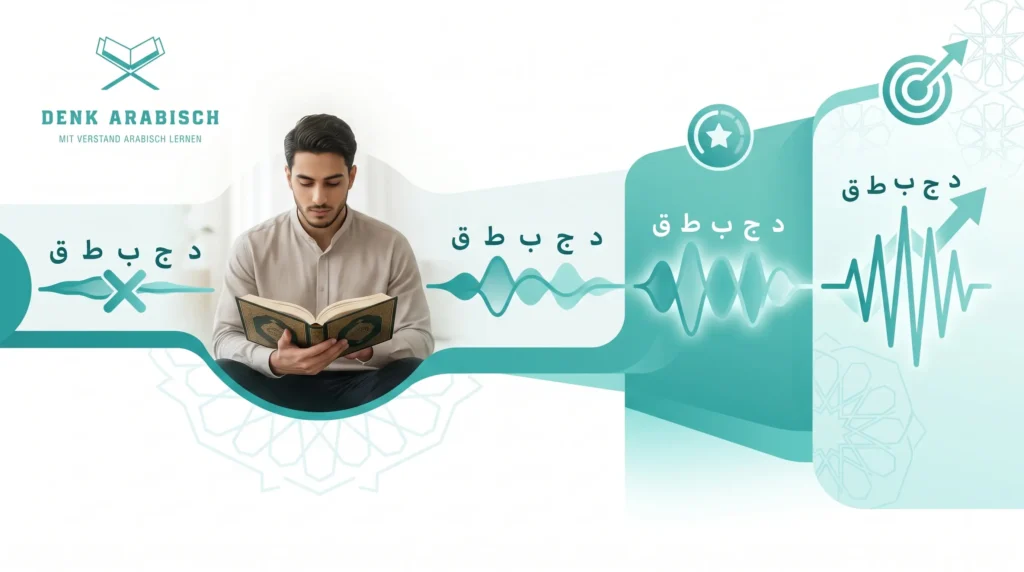
Importance of Qalqalah in Tajweed
Qalqalah plays a crucial role in preserving the clarity and accuracy of Quranic recitation. It ensures that certain letters are pronounced distinctly and not swallowed when they carry a Sukoon, preventing any distortion of meaning.
Beyond correctness, Qalqalah also enhances the rhythmic beauty and flow of the recitation, giving the Quran its characteristic melodious sound. Mastering this rule helps reciters achieve both precision and elegance in their tilawah.
Common Mistakes to Avoid
Even experienced learners can sometimes misapply these rules. Be mindful of these four common mistakes:
1. Adding a Vowel (Harakah): The most common error is turning the Qalqalah into a Fatha. For example, pronouncing Ab as A-ba. The echo must remain “vowelless.”
2. The “Hamza” Sound: Do not end the echo by abruptly closing the throat, which creates a sharp “Ugh” sound (like a Hamza). The sound should fade out naturally.
3. Stretching the Sound: The echo should be a quick bounce, not a long, drawn-out vibration that changes the timing (Meezan) of the verse.
4. Pausing Before the Echo: In Qalqalah Sughra (mid-word), avoid making a tiny stop before the echo. It should be a fluid part of the word’s pronunciation.
Read also: Learning The Quran For Children In Berlin – The Comprehensive Guide For Parents
How to Perfect Your Qalqalah
1. The “Release” Technique: Imagine a ball bouncing. The moment your tongue or lips hit the articulation point, let them “rebound” instantly.
2. Pinch Test: Unlike Ikhfa, Qalqalah has no nasal component. If you pinch your nose, the sound should not change.
3. Listen and Repeat: Use the expert-led programs at Denk Arabisch to hear the difference between a “Heavy” Qaf echo and a “Light” Dal echo.
Exercises Qalqalah Rules
Exercise 1: Matching Qalqalah Intensity Levels
Match each structural Quranic scenario with its correct technical intensity level as outlined in the guide:
— Select the correct level —
Qalqalah Sughra (Minor)
Qalqalah Kubra (Major)
Qalqalah Akbar (Strongest)
— Select the correct level —
Qalqalah Sughra (Minor)
Qalqalah Kubra (Major)
Qalqalah Akbar (Strongest)
Exercise 2: Identifying Critical Errors in Recitation
Click on the cards that properly highlight common pitfalls or incorrect habits to avoid when applying the echo:
Adding an incidental vowel (like a Fatha) to the vibration, transforming a pure “Ab” into an incorrect “A-ba”.
Letting the sound fade out naturally without making an abrupt sharp cutoff in the throat resembling a Hamza.
Stretching the sound into an unnaturally long, drawn-out vibration that corrupts the internal rhythm of the verse.
Making an unnatural, deliberate tiny pause right before producing a mid-word echo in Qalqalah Sughra.
Exercise 3: Articulation and Phonetic Heaviness
According to the FAQs, which specific subset of the Qutbu Jadd letters are categorized as Mufakham (heavy), meaning their echo must sound thick and deep?
Exercise 4: True or False?
If a Qutbu Jadd letter carries a normal vowel (Fatha, Kasra, or Damma) and you are continuing your recitation normally without stopping, no Qalqalah rule is triggered or applied.
Exercise 5: Mnemonic Vocabulary Mastery
To help students memorize the five letters that trigger this echoing rule, Tajweed scholars have historically combined them into the easy-to-remember phrase ““.
What Our Students Say About Denk Arabisch Academy
See what our students say about learning at Denk Arabisch Academy on Trustpilot. Read their experiences and check out more reviews to discover how our courses help improve Arabic.

Master Tajweed with Denk Arabisch
At Denk Arabisch, we believe that Tajweed is not just a set of rules—it is an art form. Our structured programs are designed to take you from a basic understanding to confident, beautiful recitation.
- Guided Practice: Perfect your Qalqalah with one-on-one feedback.
- Visual Aids: Understand the “logical skeleton” of Arabic phonetics with our Arabic Courses.
- Melodic Flow: Learn how to balance the levels of Qalqalah to achieve a professional Tarteel.
Ready to elevate your recitation?
Our Courses Include:
- Arabic Courses for German Speakers
- Arabic Levels for German Speakers
- Arabic Dialect Courses for German Speakers
- Qur’an Learning Courses for German Speakers
- Islamic Studies Courses for German Speakers
- Courses for Muslim Kids for German Speakers
Start your journey with Denk Arabisch today and experience how to read the Quran through our Quran Courses as it was meant to be heard.
Learn the Quran with Denk Arabisch Academy
Master reading and understanding the Quran through structured and supportive learning
Try a Free TrialConclusion
Mastering Qalqalah is a journey of the ear. By recognizing the “Qutbu Jadd” letters and practicing the different levels of intensity, you can transform your recitation from a simple reading into a melodic, precise, and beautiful tilawah. Regular practice with a qualified teacher and listening to expert reciters is the best way to perfect these “echoes of the Quran.”
At Denk Arabisch, we emphasize that Tajweed is more than a set of mechanical rules; it is a way to preserve the linguistic miracle of the Quran. Proper application of the “echo” prevents the distortion of words and adds a rhythmic elegance that has been passed down through generations of scholars.
Mastery comes with time, a sharp ear, and consistent practice. As you continue to refine your recitation, remember that every vibration and every bounce is a step closer to reciting the words of Allah exactly as they were revealed.
FAQs
To further refine your understanding, here are the most common questions students ask when mastering the rules of Qalqalah at Denk Arabisch.
1. How can I distinguish between the three levels of Qalqalah in practice?
Think of it as a scale of resonance.
Sughra (Minor) is like a quick heartbeat in the middle of a word—it shouldn’t interrupt the flow.
Kubra (Major) is a clear, final bounce when you stop at the end of an Ayah.
Akbar (Strongest) is the most deliberate; you must feel the “pressure” of the Shaddah (double letter) for a split second before releasing the echo.
2. Does Qalqalah have a specific vowel sound?
This is a common misconception. The echo should not sound like a Fatha (a), Kasra (i), or Damma (u). It is a neutral vibration. A common mistake is leaning toward a Fatha sound, which can actually change the grammatical meaning of the word in Arabic.
3. Why are these specific five letters (ق ط ب ج د) chosen for Qalqalah?
These letters possess a unique combination of two qualities: Strength (Shiddah) and Voice (Jahr). When you try to pronounce them with a Sukoon, the breath and sound are completely trapped. Without the “bounce” of Qalqalah, the listener wouldn’t be able to hear which letter was being pronounced.
4. What happens if I forget to apply Qalqalah?
If you skip the Qalqalah, the letter will sound “stifled” or “cut off.” In some cases, this is considered a Lahn Jali (clear mistake) because it obscures the letter, and in others, it is a Lahn Khafi (hidden mistake) that affects the beauty and characteristics of the recitation.
5. Is there a difference in “heaviness” between Qalqalah letters?
Yes! Just as we discussed with the Ikhfa Ghunnah, the echo follows the nature of the letter.
Qaf (ق) and Taa (ط) are Mufakham (heavy) letters, so their echo should sound thick and deep.
Baa (ب), Jeem (ج), and Dal (د) are Muraqqaq (light) letters, so their echo should sound thin and bright.
6. Can Ikhfa and Qalqalah happen at the same time?
No. Ikhfa applies to the Noon Sakinah and Tanween, while Qalqalah applies only to the five Qutbu Jadd letters. However, they often appear near each other in a verse, requiring the reciter to switch quickly between “hiding” the sound (Ikhfa) and “bouncing” the sound (Qalqalah).