Takeaway:
- Meem Sakinah (مْ) is a non-voweled Meem with a Sukoon; it always carries a natural nasal sound (Ghunnah) from the nose.
- Ikhfa Shafawi: When followed by the letter ب (Ba), press the lips gently and sustain the Ghunnah for 2 counts before pronouncing the Ba. Occurs only between two words.
- Idgham Shafawi: When followed by another م (Meem), merge the two Meems with a firm lip closure and a strong 2‑count Ghunnah. The first Meem loses its Sukoon, and the second carries a Shaddah.
- Izhar Shafawi: When followed by any of the remaining 26 letters, pronounce the Meem clearly with no extra nasal extension. Pay special attention before و (Waw) and ف (Fa) to avoid accidental hiding.
- Visual cues in the Mus‑haf: Absence of a Sukoon on the Meem signals Ikhfa or Idgham; a visible Sukoon (ـْ) indicates Izhar.
The beauty of the Quran lies not only in its words but in the way they are recited. Those beginning their Tajweed journey quickly encounter the Meem Sakinah Rules (Ahkam al-Meem as-Sakinah). While many students initially focus on the Noon Sakinah rules, the “silent Meem” (مْ) is the true key to a fluid, melodic, and correct flow of recitation.
In this comprehensive guide, we will walk you through the theoretical foundations and practical applications of the three main rules. We will show you how to avoid common mistakes and elevate your recitation to a professional level.

Table of Contents
Definition of Meem Sakinah?
Before we can apply specific rules, we must understand the foundation. What exactly is a Meem Sakinah (مْ), and why does it hold such a special place in Tajweed?
The Meem (م) is a labial letter (Harf Shafawi). Its point of articulation (Makhraj) is at the lips. When we pronounce a Meem, we close our lips. However, what makes the Meem unique is its connection to the nasal cavity (Al-Khaishum). Every Meem possesses a natural Ghunnah (a nasal sound). Without this nasal component, the Meem would be incomplete.
“Sakinah” in Arabic means “resting” or “still.” A Meem Sakinah is a letter Meem that carries no vowel (Haraka). This means:
- No Fatha (ـَ)
- No Damma (ـُ)
- No Kasra (ـِ)
Instead, it carries a Sukoon (ـْ). In modern Quranic script (Mus-haf), the Sukoon is often represented as a small circle or a crescent-shaped sign above the Meem. Sometimes the sign is missing entirely—a vital visual cue for an impending merging (Idgham) or concealment (Ikhfa).
The importance of the rules of Meem Sakinah?
The rules of Meem Sakinah serve to make the transition from the Meem to the following letter as natural as possible. The Arabic language strives for Fasaha (eloquence) and ease. If we were to pronounce every Meem harshly and in isolation, the melody of the Quran would be lost. These rules teach us when to extend the nasal sound (Ghunnah) and when to open the lips quickly for the next letter.
The Three Rules of Meem Sakinah
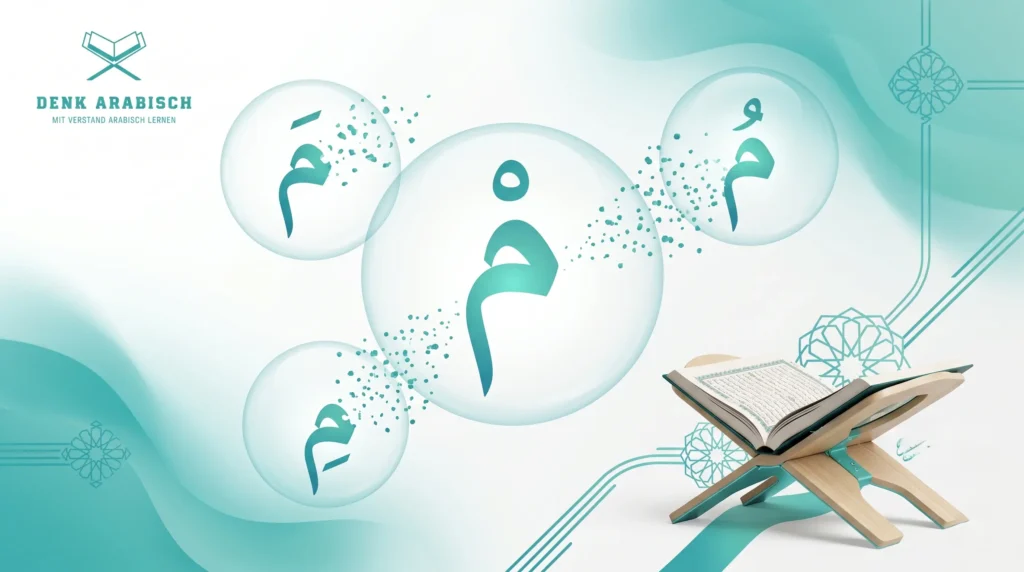
The rules of Meem Sakinah (the non-voweled Meem) are essential for achieving a smooth and melodious flow in Quranic recitation. Here is a brief breakdown of the three rules:
1. Ikhfa Shafawi
The first major rule is Ikhfa Shafawi (إخفاء شفوي). This is often the rule that requires the most finesse from students.
When does Ikhfa Shafawi occur?
This rule applies exclusively in one situation: When a Meem Sakinah (مْ) appears at the end of a word and the next word begins with the letter Ba (ب).
- Formula: Meem Sakinah (مْ) + Ba (ب) = Ikhfa Shafawi.
The Meaning of Ikhfa and Shafawi
- Ikhfa means “concealment” or “hiding.” We “hide” the harsh contact of the lips for the Meem.
- Shafawi means “labial” or “related to the lips,” as both Meem and Ba are articulated at the lips.
Correct Pronunciation (Step-by-Step)
To perform Ikhfa Shafawi correctly, follow these steps:
1. Lip Contact: Close your lips for the Meem, but do not press them tightly together. It should be a very gentle, almost paper-thin contact. Some scholars describe it as if “a sheet of paper” could still fit between them.
2. Ghunnah (Nasalization): Activate the nasal sound in your nose.
3. Duration: Hold this state for exactly two counts (Harakat).
4. Transition: After the two counts, move directly into the pronunciation of the letter Ba.
Example from the Quran
A classic example is found in Surah Al-Fil:
“tarmihim bihijaratin” (تَرْمِيهِم بِحِجَارَةٍ)
Here, the Meem at the end of tarmihim is not pronounced harshly. You hold the nasal hum gently at the lips before pronouncing the bi.
Common mistake: To pronounce the meem completely like an izhar (clear) or to keep the ghunnah too short. At Denk Arabisch we train this intensively through listening and speaking.
Read also: The Arabic Consonants – The Ultimate Guide For Learners
2. Idgham Shafawi
The second rule, Idgham Shafawi (إدغام شفوي), is also known as Idgham Mithlayn Sagheer—the merging of two identical small letters.
Conditions for Idgham
This rule is the easiest to recognize. It occurs when a Meem Sakinah (مْ) meets another vocalized Meem (مَ مِ مُ).
- Formula: Meem Sakinah (مْ) + Meem (م) = Idgham Shafawi.
What happens during merging?
In this rule, the first resting Meem “dives” completely into the second Meem. In the Quranic script, you recognize this because the first Meem has no Sukoon and the second Meem carries a Shaddah (ـّ).
Execution
1. Complete Closure: The lips close firmly for the Meem.
2. Maximum Ghunnah: Since two Meems meet here, the Ghunnah (nasal hum) is at its strongest.
3. Duration: Hold the merging for two full counts. The sound should be resonant and vibrate strongly in the nose.
Example from the Quran
In Surah Al-Quraysh:
“alladhi at’amahum min ju’” (الَّذِي أَطْعَمَهُم مِّن جُوعٍ)
The Meem of at’amahum merges completely with the Meem of min. It sounds like one long, emphasized Meem.
3. Izhar Shafawi
The third and most common rule is Izhar Shafawi (إظهار شفوي).
When to apply Izhar?
This is the “default” rule. It applies when a Meem Sakinah (مْ) is followed by any of the remaining 26 letters of the Arabic alphabet (everything except Ba and Meem).
- Formula: Meem Sakinah (مْ) + (Remaining Letters) = Izhar Shafawi.
The Meaning of Izhar
- Izhar means “clarity,” “revelation,” or “manifestation.” The Meem is shown here in its natural form without alteration.
Correct Pronunciation
Unlike Ikhfa and Idgham, there is no extension of the Ghunnah here.
1. Short Contact: The lips close for the Meem and open immediately for the next letter.
2. No Extra Duration: The natural Ghunnah of the Meem is present, but it is not artificially lengthened.
3. Precision: The Meem must end clearly before the next letter begins.
Read also: Is Learning Arabic Mandatory In Islam? – The Guide For Muslims
Focus on Waw (و) and Fa (ف)
A special focus in Tajweed lies on the letters Waw and Fa. Because these letters are also formed at the lips, there is a tendency to accidentally “hide” the Meem (Ikhfa).
Example:
“Lakum deenukum waliya deen” (لَكُمْ دِينُكُمْ وَلِيَ دِينِ)
Here, the Meem in lakum and deenukum must be pronounced extremely clearly, even though a Waw follows. Scholars explicitly warn against “mumbling” here.
Learn the Quran with Denk Arabisch Academy
Master reading and understanding the Quran through structured and supportive learning
Try a Free TrialSummary: Meem Sakinah Checklist
To check your recitation, you can use this table as a guide:
| Rule | Letters | Characteristics | Visual in Mus-haf |
| Ikhfa Shafawi | ب (Ba) | Gentle lips, Ghunnah (2 counts) | Meem without sign |
| Idgham Shafawi | م (Meem) | Merging, strong Ghunnah (2 counts) | Meem without sign + Shaddah |
| Izhar Shafawi | Rest (26) | Clear, short pronunciation | Meem with Sukoon (ـْ) |
Why Learn Tajweed with Denk Arabisch?
Understanding Tajweed rules is important—but true mastery comes from hearing, practicing, and being guided step by step. Tajweed is not just knowledge you read; it’s a skill you develop through correct pronunciation, repetition, and expert feedback.
At Denk Arabisch, we bridge the gap between theory and real recitation. Our approach focuses on practical learning, helping you apply Tajweed rules naturally as you recite the Quran. With personalized guidance, clear explanations, and interactive practice, you don’t just learn Tajweed—you experience it the way it has been taught for generations.
Our Courses Include:
- Arabic Courses for German Speakers
- Arabic Levels for German Speakers
- Arabic Dialect Courses for German Speakers
- Qur’an Learning Courses for German Speakers
- Islamic Studies Courses for German Speakers
- Courses for Muslim Kids for German Speakers
At Denk Arabisch, we offer:
- One-on-One Expert Instruction: Our teachers are Al-Azhar University graduates with an Ijazah. They hear every letter and correct your lip positioning in real-time.
- Structured Curriculum: We guide you from basic letters to the most complex rules of recitation.
- Flexibility: Learn comfortably from home, whenever it fits your schedule.
Read also: Can You Pray Without Knowing Arabic? – A Full Guide For Muslims
Exercises on Meem Sakinah Rules
Exercise 1: Mus-haf Visual Signs Identification
Match each structural spelling sign of Meem Sakinah in the Quranic script with its correct technical Tajweed rule:
— Select the rule —
Ikhfa Shafawi (Concealment)
Idgham Shafawi (Merging)
Izhar Shafawi (Clarity)
— Select the rule —
Ikhfa Shafawi (Concealment)
Idgham Shafawi (Merging)
Izhar Shafawi (Clarity)
Exercise 2: Execution Traps & Recitation Pitfalls
Click on the cards that properly highlight common structural recitation errors or special warnings regarding Meem Sakinah rules mentioned in the text:
Accidentally “hiding” or mumbling the Meem Sakinah when it is followed by the labial letters Waw (و) or Fa (ف) instead of keeping it completely clear.
Pressing the lips together completely harshly and cutting the Ghunnah short during Ikhfa Shafawi execution.
Artificially extending the nasalization sound (Ghunnah) during Izhar Shafawi when meeting regular letters.
Letting your lips close with very gentle, paper-thin contact to hold a full two-count nasal hum during Ikhfa Shafawi.
Exercise 3: Word-Boundary Constraints
According to the text guidelines and structural classifications, where can the rules of Ikhfa Shafawi and Idgham Shafawi legally take place?
Exercise 4: True or False?
The letter Meem is structurally categorized as a labial letter, but because it contains an inseparable permanent nasal quality (Ghunnah) originating from the Khayshum, it cannot be completely or accurately pronounced using the lips alone.
Exercise 5: Rhythmic Timing Value
When executing either Ikhfa Shafawi or Idgham Shafawi, the vocalized nasal resonance (Ghunnah) must be smoothly held and sustained for a pulse duration of exactly ““ counts (Haratak).
What Our Students Say About Denk Arabisch Academy
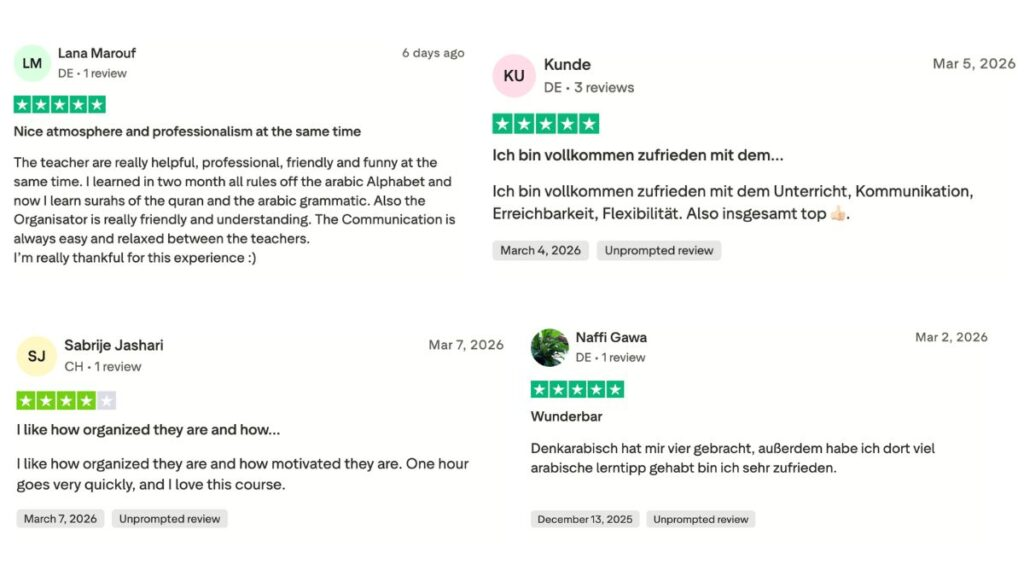
See what our students say about learning at Denk Arabisch Academy on Trustpilot. Read their experiences and check out more reviews to discover how our courses help improve Arabic.
Your next step to perfect recitation
Want to know if you are performing Ikhfa Shafawi correctly? Or are you having trouble judging the duration of the Ghunnah?
Sign up now with the Arabic Course at Denk Arabisch!
Experience how our teachers refine your pronunciation with patience and precision.
Learn the Quran with Denk Arabisch Academy
Master reading and understanding the Quran through structured and supportive learning
Try a Free TrialConclusion
The rules of Meem Sakinah are the heart of a fluid Quranic recitation. Whether it is the gentle concealment of Ikhfa, the powerful merging of Idgham, or the crystal-clear manifestation of Izhar—each rule contributes to the incomparable aesthetic of the holy text. With consistent training and the right guidance, you will soon be able to apply these rules intuitively.
FAQs
1. What is the difference between Ikhfa Shafawi and Ikhfa Haqiqi?
While both involve “concealment,” they apply to different letters. Ikhfa Shafawi only involves the letter Meem Sakinah (مْ) followed by Ba (ب). Ikhfa Haqiqi, on the other hand, applies to Noon Sakinah (نْ) or Tanween when followed by one of 15 specific letters.
2. Why is the Meem sometimes written without a Sukoon in the Quran?
In the standard Uthmani script, if a Meem Sakinah has no sign above it, it is a visual cue that you must perform either Idgham (if the next letter is Meem) or Ikhfa (if the next letter is Ba). If you see the Sukoon (ـْ) clearly, it indicates Izhar (clear pronunciation).
3. How long should the Ghunnah be held?
For both Ikhfa Shafawi and Idgham Shafawi, the Ghunnah (nasal sound) should be held for two counts. A “count” is approximately the time it takes to fold or unfold a finger at a medium pace.
4. Can Ikhfa Shafawi occur within a single word?
No. Unlike some other Tajweed rules, Ikhfa Shafawi and Idgham Shafawi only occur between two separate words. Izhar Shafawi, however, can occur both within one word and between two words.
5. What is the most common mistake with Izhar Shafawi?
The most frequent error occurs when the Meem is followed by Waw (و) or Fa (ف). Because these letters share a similar point of articulation (the lips) with the Meem, students often accidentally “hide” the Meem. You must take extra care to keep the Meem clear and distinct in these cases.